Avatar

The only constant is change – and companies that do not change get left behind. My perspective is that it’s best to accept change as inevitable – to embrace it, lead it, and use it to shape desired outcomes. As I discussed previously, many of today’s leading trends –what I call market transitions – are combining into the Internet of Everything, which we define as the intelligent connection of people, processes, data, and things.

Disruptive innovation is fueling the emergence of the Internet of Everything. I attended the World Economic Forum recently and much of the discussion in Davos focused on the state of innovation. At Cisco, we believe the world has never been more innovative, and this is reinforced in our ongoing discussions with many business and technology leaders.

In an effort to better understand the extent of the opportunity for our customers presented by increasing connectedness, Cisco has conducted analysis on the potential economic impact of the Internet of Everything, the findings of which we’re releasing today. Our analysis indicates that there is as much as $14.4 trillion of potential economic “value at stake” for global private-sector businesses over the next decade, as a result of the emergence of the Internet of Everything.

We define the potential value at stake to be a combination of net new economic value created as a result of the Internet of Everything, as well as value that will migrate from lagging companies and industries to those that take advantage of new innovations — minus the cost of implementation. Based on our analysis, the Internet of Everything has the potential to increase global corporate profits by approximately 21% in aggregate over the next 10 years.

Continue reading “The Possibilities of The Internet of Everything Economy #IoE”

Authors

John Chambers

No Longer with Cisco

Avatar

For the fifth year, Cisco has released its updated Mobile Visual Networking Index Forecast.  This year, we’ve seen dramatic changes in consumer behavior as well as continued explosive growth in mobile data.

Global mobile traffic grew 70% in 2012 and traffic is forecast to rise 13 times between 2012 and 2017, a CAGR of 66%.  And in 2012, for the first time, video exceeded 50% of global mobile data.

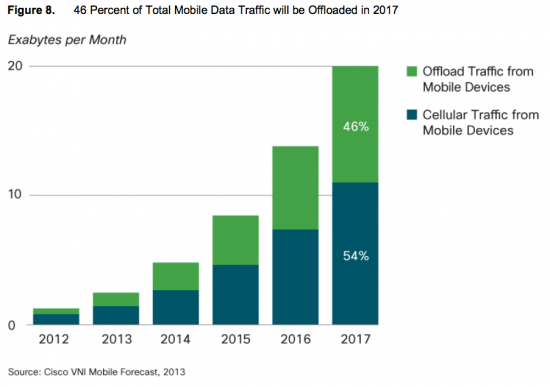
The key take away from this year’s report, however, is the dramatic shift of mobile traffic offloaded to small cells, primarily Wi-Fi. The chart below (Figure 8 from the mobile VNI report) illustrates how mobile offload increases from 33 percent of total mobile traffic (cellular plus small cell/ Wi-Fi) in 2012, to 46 percent in 2017. This is significantly larger than we forecasted just a year ago when we estimated mobile offload would comprise 11% of total traffic in 2011, growing to 22% in 2016.

Fig8 - Mobile VNI 2013

Offloading is even more pronounced in the US where it will account for 66% of total mobile traffic in 2017.

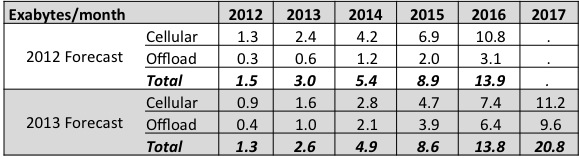
While the underlying aggregate global mobile data traffic, cellular plus Wi-Fi, has been revised slightly from last year (2012 total traffic revised to 1.3 exabytes from 1.5 exabytes/month; 2016 traffic revised to 13.8 exabytes from 13.9 exabytes), the shift from cellular to Wi-Fi is occurring faster than we had anticipated. The table below compares the 2012 and 2013 forecasts.

VNI Forecast Comparison 7

So what’s happening in the mobile landscape that is driving these changes?

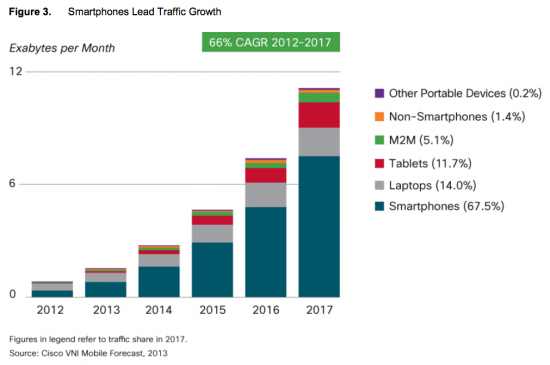
First, the mobile VNI report highlights an acceleration of smartphone uptake, and even faster adoption relative to the use of mobile connected laptops. While mobile connected laptops, mostly using dongles, helped drive early consumption of mobile data traffic, consumers are adopting smart phones and tablets faster than earlier forecasted. The shift from mobile connected laptops to smart phones and tablets lowers data consumption as the latter use less data per application (because of smaller screens size and lower processing speeds). Forecasting to 2017, smart phones and tablets are expected to overwhelm laptops and account for about 80% of connected devices in 2017 vs. only 14% for laptops (see graph below).

Fig3 - Mobile VNI 2013

The second trend is a dramatic uptake of offloading data traffic to small cells, primarily Wi-Fi. Offload is being driven by service providers (both mobile as well as fixed, such as cable) deploying and using Wi-Fi hot spots, as well as a by consumers using WiFi for bandwidth hungry applications such as high-resolution video.  Operators are offloading data connections to cope with limited and increasingly congested spectrum for macro cell networks while, at the same time, consumers are using WiFi offload for better indoor performance and to avoid exceeding their mobile data plans.

Working together, these two trends are driving dramatic change in the composition of total wireless data traffic (cellular plus Wi-Fi).

The full Mobile VNI 2013 report highlights this shift as well as other key trends driving growth in mobile IP traffic.

Authors

Robert Pepper

No Longer with Cisco

Avatar

You heard about the new features packed into Cisco Wireless Release 7.4 before the holidays. We are now unveiling the 7.4 Release for the Mobility Services Engine, and I am excited to announce the General Availability of Cisco Advanced Location Services for the Mobility Services Engine (MSE), a capability that enables Cisco Connected Experiences.

MSECisco Connected Mobile Experiences allows enterprises and service providers to detect, connect and engage their end users on their Wi-Fi network, enabling them to communicate with relevant mobile content. The star feature of our new software release is Cisco Advanced Location Services, which includes Location Analytics and Mobile Concierge. Location Analytics provide real-time location analytics gathered from the Wi-Fi network, alongside historical trends, enabling greater visibility into customer movements and patterns through trending data.

Mobile Concierge allows engaging users through a native app on a smartphone. It also includes the Mobile Concierge SDK, a developer’s kit that provides an easy-to-use approach to developing mobile applications that leverage location data from the MSE.

Cisco MSE Datasheet

Cisco MSE Licensing and Ordering Guide

Cisco MSE Product Overview

Cisco Connected Mobile Experiences At-A-Glance

For more information on the Mobility Services Engine, see www.cisco.com/go/mse.

For more information on Connected Mobile Experiences, see www.cisco.com/go/cmx.


Avatar

chowjBy Joe Chow, Vice President and General Manager, Connected Devices Business Unit

Following Cisco’s 2Q FY ’13 earnings call last week, we received questions about our commitment to certain elements of our set-top box business. Comments were made that Cisco is walking away from low-margin deals. I would like to clear up any confusion surrounding those comments here.

Cisco remains committed to providing world-class managed customer premise equipment (CPE), which includes digital set-tops, intelligent media gateways and other devices. CPE is an integral part of Cisco’s end-to-end Videoscape TV services delivery platform. For emerging markets, CPE enables Cisco to offer a complete end-to-end solution for new customers as they launch and grow their digital platforms. For customers with more advanced video platforms and in more advanced video markets, CPE provides a key strategic advantage and opportunity for Cisco. Continue reading “Cisco Committed to CPE as Part of Overall Video Strategy”

Avatar

In this installment of the “We’re Listening” blog, Kathy Harrington, VP of Global Service Delivery, delves into actions taken by Cisco’s Order Management team to improve your order management experience.

We constantly strive to achieve the best possible customer experience in every part of our business. As customers and partners, you’ve told us you want Cisco’s order management process to be less complicated, more efficient, and take less time. Your feedback is taken seriously and has resulted in several improvements to ensure placing a product or service order with Cisco is fast and simple.

Read the full article: The We’re Listening Blog Series:  Making It Easier to Do Business with Cisco by Simplifying Order Management

Authors

Curt Hill

Senior Vice President

Customer Assurance

Avatar

Cisco_Sizzle_FinalWelcome to the Cisco Sizzle! Each month, we’ll be rounding up the best of the best from across our social media channels for your reading pleasure. From the most read blog posts to the top engaging content on Facebook or LinkedIn, catch up on things you might have missed, or on the articles you just want to see again, all in one place.

Let’s take our first look into the Cisco vault …

16 Years and Counting
What makes your company great to work for? For the 16th year in a row (yes, 16 years in a row!), Cisco is on Fortune’s “Best Companies to Work For” list!

Today: The Internet of Things
Dave Evans introduces the Internet of Things (IoT) through an infographic that represents the increase of “things” connected to the Internet.

Tomorrow: The Internet of Everything
Dave Evans takes a look into the Internet of Everything (IoE), which brings together people, process, data, and things to make networked connections more relevant and valuable than ever before.

Connecting the Unconnected
Remember the days of dial-up? Cisco VP Marie Hattar looks at the evolution of the Internet and how Cisco technologies are fueling the transition from IoT to IoE.

Tomorrow Starts Here
Cisco is waking up the world. Explore how IoE will change the way we work, live, play and learn:

World Economic Forum: Pushing Innovation
Last month, Cisco CEO John Chambers participated in a World Economic Forum roundtable discussion hosted and moderated by TIME. In his words, “if you don’t take risks and don’t push innovation, you will get left behind very quickly.”

Avatar

Mobile data traffic worldwide will increase 13 times by 2017.  That’s from the latest Cisco VNI Mobile Data Forecast Update, 2012-2017 released in early February. (For a quick recap, check out Thomas Barnett’s blog post and infographic.)

For those of you who surf or enjoyed the movie Chasing Mavericks, imagine mobile traffic as a rapidly rising wave, exabytes of zeros and ones surging forward and gaining momentum, towering over the ocean’s surface.

But, what does all this mobile traffic growth, this Mavericks wave if you will, mean to SPs?

I see at least four significant implications: Continue reading “Catching the Wave: SPs and Mobile Growth”

Authors

Doug Webster

Vice President

Avatar

The great (relatively) untapped kingdom of ‘indoor wireless’ may be the next great frontier?

With expectations of WiFi connectivity for just about any business we visit these days, there is no reason this next step for making the physical world more accessible should not be adopted.  Indoor location services offer the chance for us to use our ever-present smart devices to navigate large facilities easier than ever before.  This also represents great opportunity for retail to touch (and measure) customers better than ever before as the struggle between bricks and mortar vs. online shopping continues.

MSE Super GuyFierce Broadband Wireless covered the recent Qualcomm and Cisco announcement around Hotspot 2.0 and Passpoint and you can see how this continues to heat up.  It is valuable for so many reasons.

Continue reading “Indoor Location Services: New Data/New Opportunities”

Authors

Robb Boyd

Producer, Writer, Host

Avatar

Add this to your list of parties spoilt by the Internet revolution: national sovereignty.

We all know that the borderless nature of the Internet is stretching longstanding technical and legal definitions. But recently, my colleague Richard Aceves and I got to talking about the mish-mash that social media is making of culture, language, and national identity. It should come as no surprise that cultures and languages are being diluted by the global online discussion, in the same way that the advent of television and radio had a dampening effect on certain regional spoken colloquialisms and accents. Richard will examine some cultural questions in a forthcoming blog post, while I’ll be discussing the psychological impact on national sovereignty.

Judging by the proliferation of Internet policies and legislation, it is pretty clear that bureaucrats and politicians in capital cities around the world are worried that the Internet (with special thanks to social media) is simultaneously eroding both their authority and their national identity. Continue reading “Sovereignty and the Internet”

Authors

Jean Gordon Kocienda

Global Threat Analyst

Corporate Security Programs