Avatar

Successful IT managers today and in the future need to quickly adapt to changing business strategies. But how does IT increase efficiency, support more applications and provide additional services with flat or decreasing IT budgets?

In my previous blog, I discussed how Cisco, EMC, NetApp, and VCE introduced converged infrastructures to increase IT efficiency and significantly reduce data center costs. I also addressed the breakdown of IT time and resources between management and maintenance (75 percent) and value-add services (25 percent). So how does IT flip that ratio and spend more time on innovation and less on routine administration?

Watch our new video to learn how Cisco Cloupia—through automated, comprehensive management of converged infrastructure solutions based on Cisco UCS and Nexus—empowers IT to better align quickly with business strategy. By doing so, the software helps drive a positive shift in that 75:25 ratio, providing infrastructure administrators with greater agility and flexibility.

https://youtu.be/FK16U3HvMXw

There are a number of converged infrastructure management solutions, but Cisco Cloupia is unique in the industry by delivering:

•Simplicity
In less than 4 hours, you can be experiencing the benefits of automated converged infrastructure management with Cisco Cloupia. The solution installs in less than 1 hour without any service engagement. (In one of our labs at Cisco, the solution was installed in 15 minutes.) Following installation and 2-3 hours of training, conducted by our partners, you can be experiencing all the benefits of the software.

•Comprehensive Management
Cisco Cloupia is the only solution on the market today that manages the leading converged infrastructures from Cisco, EMC, NetApp, and VCE from the same management console. Today’s data centers are heterogeneous, and management tools need to accommodate multiple vendor solutions. Cisco Cloupia enables you to choose the best converged infrastructure solution to meet your business requirements.

•Single pane of glass
Using one tool that manages both physical and virtual compute, network, storage, and virtualization reduces complexity and training time for your staff, helping drive that shift in the 75:25 ratio towards innovation.

•Model-based orchestration
Cisco Cloupia’s unique model-based orchestration enables IT teams to build and execute repeatable physical and virtual infrastructure workflows without complex custom scripts and expensive system integration engagements.

•Greater IT Management and Control
Cisco Cloupia can manage multi-tenant or secure multi-tenant environments, permitting virtualized and non-virtualized workloads to securely run side-by-side while their associated resources remain independent.

As data centers seek to innovate and meet changing business requirements, they need automation and management to ensure that they experience the full potential of their converged infrastructure. These are just some of the ways that Cisco Cloupia can help. To learn more, go here.

Authors

Joann Starke

No Longer with Cisco

Avatar

On March 12thCisco announced the ISR-AX and how Cisco is changing the game, reducing complexity and making it simpler for enterprises to deliver and manage application delivery to users. Cisco is expanding the role of our Integrated Service Routers (ISRs) to deliver application-centric networks that provide granular visibility, control, and optimization without additional devices or bandwidth upgrades – Cisco® Application Experience (AX) Router family is now a part of the ISR family of routers!  The Cisco ISR-AX Routers directly integrate Cisco Wide Area Application Services (WAAS), Application Visibility and Control (AVC), Data/IPBase and Security services into a platform that is simple to order, configure, and deploy for secure, optimized cloud connectivity and branch-office routing.  The Cisco ISR G2 and ISR-AX Routers are based on the same hardware and software that you know and love and are deploying today. Today I wanted to go into the technical details of each of the components. Continue reading “Cisco ISR-AX is Now a Part of the Integrated Services Router Family!”

Authors

Adam Keller

Marketing Manager

Enterprise Networking and Mobility

Avatar

The attacks against South Korean media and banking organizations last week severely disrupted a handful of organizations with a coordinated distribution of “wiper” malware designed to destroy data on hard drives and render them unbootable. At 14:00 KST on March 20, 2013, the wiper was triggered across three media organizations and four banks, setting off a firestorm of speculation and finger-pointing and that which continues as of this writing. In this post, I’ll share a perspective no one else seems to be talking about, but may be the real motivation behind these attacks.

The What and the Possible Why

Let’s start with what we know:

  • The attack was highly targeted
  • The malware was specifically designed to distribute the wiper payload throughout the impacted organizations
  • The malware was timed to deploy its destructive payload simultaneously across all affected organizations
  • The resulting loss of data and downtime has been severe

While the “what” of the attack is well established, the “why” and “how” are still a matter of debate. Theories postulated include an outright act of warfare from North Korea designed to economically disrupt South Korea, or an act of sabotage to cover the tracks of data exfiltration allegedly wrought by China. But what if there were an explanation that was less about countries and politics and more about that all-time motivator of crime: money? Consider, if you will, the following timeline. Continue reading “Thoughts on DarkSeoul: Data Sharing and Targeted Attackers”

Avatar

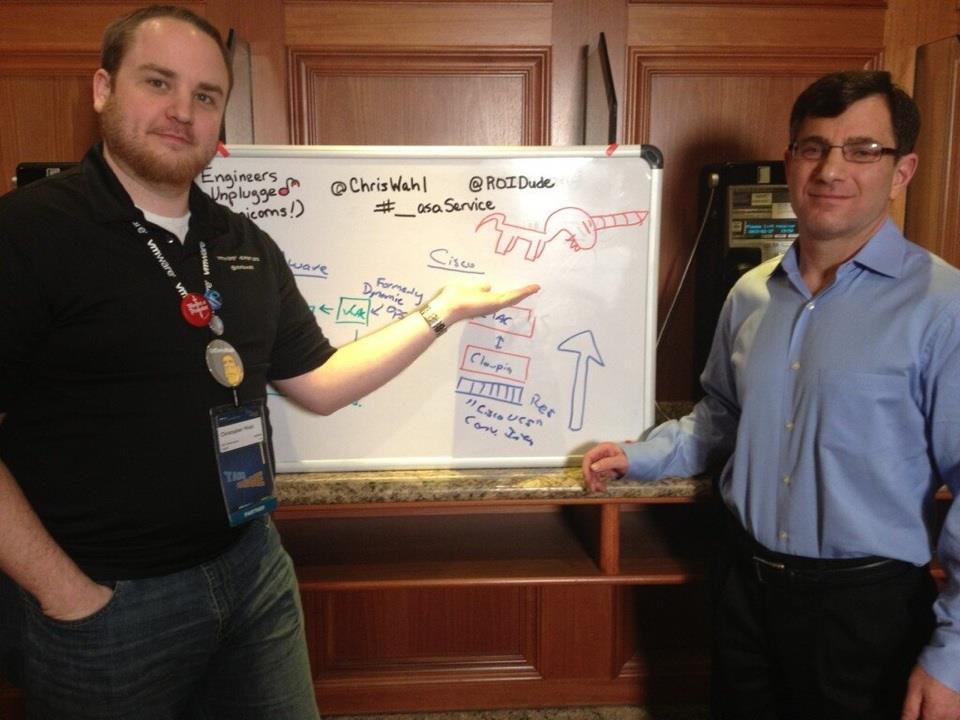
Another week of all the technology that’s fit to whiteboard, Engineers Unplugged features Chris Wahl (@chriswahl) and Steve Kaplan (@ROIDude) talking through cloud stack options, including Cisco Cloupia and Cisco Intelligent Automation for Cloud (IAC) as well as VMware’s vCloud Director (vCD) and vCloud Automation Center (vCAC). It’s ___aaS in the new cloud world. Great conversation from the partner perspective. Here we go:

Chris Wahl and Steve Kaplan with the very first UaaS (Unicorn as a Service). Is there anything the cloud can not do?

 Welcome to Engineers Unplugged, where technologists talk to each other the way they know best, with a whiteboard. The rules are simple:

  1. Episodes will publish weekly (or as close to it as we can manage)
  2. Subscribe to the podcast here: engineersunplugged.com
  3. Follow the #engineersunplugged conversation on Twitter
  4. Submit ideas for episodes or volunteer to appear by Tweeting to @CommsNinja
  5. Practice drawing unicorns

Join the conversation by following @ciscoDC on Twitter. For outtakes, unicorn photo albums, and more, like the Engineers Unplugged Facebook page.

Authors

Avatar

I have been working for Cisco for over 15 years, much of that time as a Consulting Engineer for Routing and Switching. 

I understand strengths and weakness of routing, the value of a good hierarchical design…. But what’s worse than having an end-user having problems with one of his business application and being unable to provide an answer? Yes we have traceroute, ping and other fancy networking tools but nowadays we have to deal with applications and user experience. We have to move forward and take into account the performance of an application rather than just forwarding packets based on static cost metrics. It’s not just about connectivity anymore.

Therefore I’ve moved to the Application Visibility and Control (AVC) group in Engineering. It’s like jumping from standard L3 to advanced L4-L7 kind of routing.

I know what you may be thinking when you read these lines … yet another new acronym. We have the good old routing protocols, why should I care about this new AVC? Continue reading “Are You Ready for Performance Routing?”

Authors

Jean-Marc Barozet

Technical Leader

Software Engineering Group

Avatar

Today, Cisco is celebrating a milestone in its commitment to helping you act on security intelligence—our 10th bundle of Cisco IOS Software Security Advisories. We’re proud of our commitment to these predictable disclosures (on the fourth Wednesday of March and September annually) because they originated as a direct response to your feedback. Bundled publications allow you to plan ahead and ensure resources are available to analyze, test, and remediate vulnerabilities in your environments. In an upcoming post, my colleague John Stuppi will share how the Cisco Product Security Incident Response Team (PSIRT) drove the evolution from a traditional disclosure model to the current semiannual bundled publication. John’s post will also provide another vehicle to share feedback with PSIRT, the organization that manages the receipt, investigation, and public reporting of security vulnerability information that is related to Cisco products and networks.

Make sure you take a look at the Cisco Event Response—our “go to” document that correlates the full array of Cisco Security Intelligence Operations (SIO) resources for this bundle (including links to the advisories, mitigations, Cisco IntelliShield Alerts, CVSS scores, and OVAL content). Remember, this collateral is not unique to Cisco IOS Software Security Advisories but is part of Cisco SIO’s response to current security events.

Today’s edition of the Cisco IOS Software Security Advisory Bundled Publication includes seven advisories that affect the following technologies:

Authors

Erin Float

Project Manager

Security Research and Operations Group

Avatar

Segment routing (SR) is a concept that’s been working its way through the IETF standards process but is finally becoming ready for real world deployment. It’s a network technology that provides enhanced packet forwarding behavior while minimizing the need for maintaining awareness of mass volumes of network state. SR satisfies essential requirements for application-enabled routing in software defined networks, including the ability to provide strict network performance guarantees, efficient use of network resources and very high scalability for application-based transactions. Segment Routing relies on a small number of extensions to IS-IS and OSPF and can operate with an MPLS or an IPv6 data plane and integrates with the rich multi-service capabilities of MPLS such as L3VPN, VPWS, VPLS, E-VPN, etc.

With Continue reading “Segment Routing: Impact on Software Defined Networks”

Avatar

With the ever growing demands placed on IT organizations to “do more with less” it is becoming apparent that the way we deploy the network infrastructure, how we administer policies and how we manage the whole thing needs to evolve.

Why is IT spending so much time maintaining separate wired, wireless and VPN networks? We need to focus on the business that is banging on the door telling you to support more mobile and wired devices, more bandwidth hungry applications and extend that support well beyond the walls of corporate facilities.

How can we simplify how IT operates and still deliver a high-performance, high-quality connected experience? Cisco Unified Access can help! We announced the webinar series earlier this week, and part 1 is just around the corner.

In next Wednesday’s webinar (CLICK TO REGISTER) we will discuss:

  • The industry perspective regarding challenges surrounding, BYOD, Mobility and the Internet of Everything
  • The latest Cisco technology that can help you simplify and optimize you network
  • How a unified access network can improve performance and operations
  • Deploying consistent and contextual policies will improve access control and enforcement
  •  How reducing operational complexity can accelerate device deployment and end user problem resolution.

Continue reading “Activate the IT Transformation with Cisco Unified Access: Part 1”

Authors

Brian Robertson

Product Marketing Manager

CMO EMM Mobility Solutions

Avatar

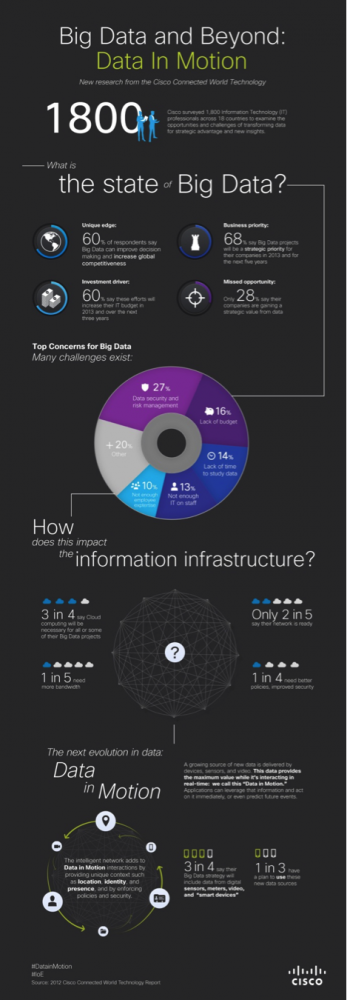
This week, the third and final chapter of the most recent Cisco Connected World Technology Report was released. This global survey asked 1,800 IT professionals in 18 countries across a broad range of industries to share their views on the potential challenges of Big Data and beyond. In a previous post , I discussed the evolution of Big Data and the importance of extracting value out of Data in Motion to create new  applications that matter here and now, in real-time. ( Beyond Big Data : Mastering Data in Motion for Positive Business Impact)

Just as the Internet of Everything is bringing together people, process, data, and things to make networked connections more relevant and valuable, the same is true of Big Data — the ability to turn information into actions will create key advantages for businesses, individuals, and countries. This latest CCWTR report provides crucial insight into how IT professionals view this sea change.

Two in three of the survey respondents indicated that Big Data will continue to be a strategic priority for their company in 2013 and for the next five years. Globally, IT professionals believe that Big Data will not only help improve decision making in their own companies but that it will also increase the global competitiveness of their countries.  Countries such as China, Mexico, and India saw the strongest correlation between Big Data and national competitive advantages (over 80% of respondents agreed).

Data Security and RisksBigData&Beyond

Some of the most interesting findings are about the challenges that IT professionals associate with Big Data. More than one in four respondents globally said that data security and risk management are a major concern. Protecting Big Data is a big challenge. Data resides everywhere; it is in the cloud, in mobile devices, and in social networks. Data comes from disparate sources in different shapes and forms. Multi-perimeter protection is key but securing data and protecting users’ privacy goes beyond the traditional IT view. Big Data brokers buy data sets from stores where you shop and can sell it to anybody.  Sensitive data is protected, but much of your information can be bought and sold without any input or permission from you. While making the data anonymous can protect an individual’s privacy,
re-identification examples show the risks of open data and crowdsourcing.

Better IT Policies

Another particularly interesting finding in the survey is the importance of better policies and improved security to help companies manage the increased traffic related to Big Data but also mobility and video. Only 41% surveyed reported that they were ready for the surge in network traffic. Over 27% say they will need better policies and security measures, and 20% said they will need more bandwidth. These results confirm that bigger pipes alone are not sufficient to handle the data deluge coming from a variety of sources at a high velocity. An intelligent information infrastructure provides a better way to collect, manage, and extract value from data. It is not about transporting the data as quickly as possible from the point of creation to a point of analysis but rather deciding “on the spot” , what to do with the data.

The Key “Takeaway”

Organizations need to expand their view of data beyond traditional storage and analysis in order to develop new systems of engagement that leverage “data in motion,” enabling them to gain real-time insights and create better experiences for their users.

Read more about the report and take a look at the results as they apply to your own country. As usual we welcome your comments!

Data in Motion – A Definition

Data in Motion represents the continuous interactions between connected elements such as people, process, and things. Data from new devices, sensors, and cameras is at maximum value while still in motion. During these interactions, the intelligent network provides secure unique insights in real-time. Value can be extracted and acted upon as events occur to create advantage here and now or even to predict the future. Organizations can make better decisions, provide enhanced experiences, and achieve competitive advantage. A recent Cisco IBSG white paper details the actual value of these connections in some key industries covering a number of use cases. 


Authors

Giuliano Di Vitantonio

Vice President

Data Center and Cloud Marketing