T-Mobile USA has been one of the first carriers to widely deploy IPv6, seeking to overcome the lack of IPv4 addresses and to lay the foundation for their network for the Internet of Everything. However, one of the headaches they’ve faced is that some applications which work fine over IPv4 don’t play nicely with IPv6. That’s a real challenge for service providers, impacting their ability to migrate completely away from IPv4 and complicating their network operations.
In Part 1 of this blog series, I introduced Gartner’s definition of Fabric based infrastructure (FBI). I explained the benefit of data center fabrics with the promise of continuing in a follow on blog. Some readers rightly pointed out to me that I had not yet touched on the automation benefits. This video featuring Gartner analyst, Donna Scott and Cisco CTO Paul Perez provides a great overview of the benefits namely:
Capital cost savings with infrastructure consolidation
Lower operating costs with automation
Speed of implementation and infrastructure deployment
Better SLAs with faster recovery or migrations
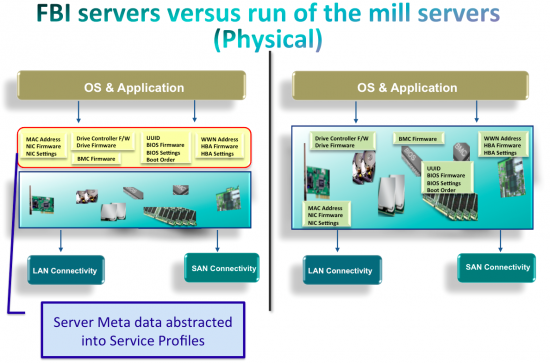
Let’s dig a bit deeper and start by looking at the difference between a FBI server and a run of the mill server. FBI essentially lets us define the profile of a server in software. The profile here refers to as many as 120 attributes of a physical server stored as meta data in a profile. These attributes include BIOS version, LAN connection parameters, SAN connection parameters, UUID, MAC Address etc.
In the case of run of the mill servers some of these attributes remain the same throughout the life of the physical server. You may be able to alter other attributes with manual operations through proprietary user interfaces. As shown in the figure above, the server identity (service profile) of a FBI server is abstracted from the physical server.
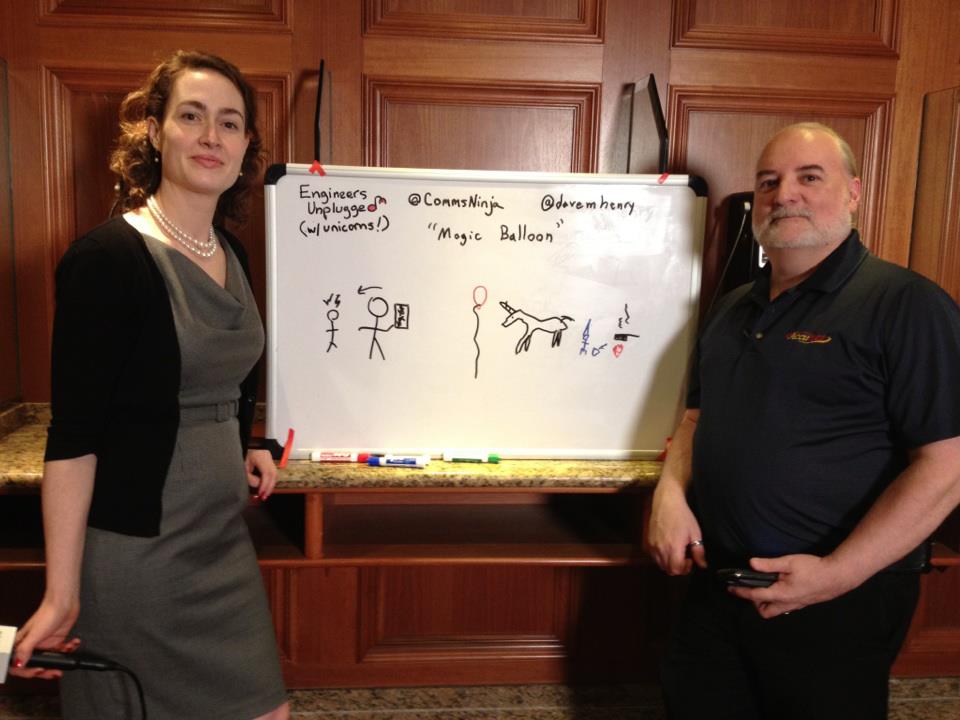
This week features another exciting double edition for Engineers Unplugged, complete with a whiteboarding game to help you hone your craft. But first, business. Listen in as Brian Gracely (VirtuStream, @bgracely) and Jase McCarty (EMC, @jasemccarty) discuss the benefits of secure hybrid cloud:
The Catalyst Compact Switch gives you the the flexibility of connecting and powering networking devices without running long Ethernet cables from the wiring closet. It is a small form factor switch that can be powered over Ethernet, and is silent, secure and resilient. Amongst other verticals, the compact switch has been very successful in diverse environments in retail, hospitality and enterprise. A new Lippis Report details how the compact switch extends the borderless network services to the furthest endpoints. Continue reading “Humorous New Video – Catalyst Compact switch deployments in Enterprise, Retail, Hospitality and Education.”
Today, I am pleased to announce Cisco’s intent to acquire Ubiquisys, a privately-held company headquartered in Swindon, UK for $310 million in cash and employee retention incentives. Ubiquisys is a leading provider of intelligent 3G and LTE (Long-Term Evolution) small-cell technologies that provides seamless connectivity across mobile heterogeneous networks for service providers.
The acquisition of Ubiquisys exemplifies Cisco’s innovation framework based on a build, buy and partner approach. The Ubiquisys acquisition also complements Cisco’s mobility strategy along with the recent acquisitions of BroadHop and Intucell, reinforcing in-house research and development, such as service provider Wi-Fi and licensed radio. These technologies will tie together the mobility architecture that leverages the intelligence of the network from the wireless edge of the network into the wired core.
As carriers around the world increase cellular data capacity to serve the rapidly growing population of smartphone and tablet users, adding small cells is one of the most cost-effective ways to multiply data capacity and make better use of scarce spectrum assets. Ubiquisys’ indoor small cells expertise and its focus on intelligent software for licensed 3G and LTE spectrum, coupled with Cisco’s mobility portfolio and its Wi-Fi expertise, will enable a comprehensive small cell solution to service providers that supports the transition to next generation radio access networks.
The acquisition of Ubiquisys further reinforces Cisco’s commitment to service providers and strengthens Cisco’s mobility capabilities to continue to extend the intelligent mobile network.
Ubiquisys’ product portfolio and team will be integrated into our Small Cell Technology Group led by Partho Mishra.
To continue the MSE Blog Series, I’m going to take you on a journey to dig deep into one of the features of Release 7.4, wIPS!
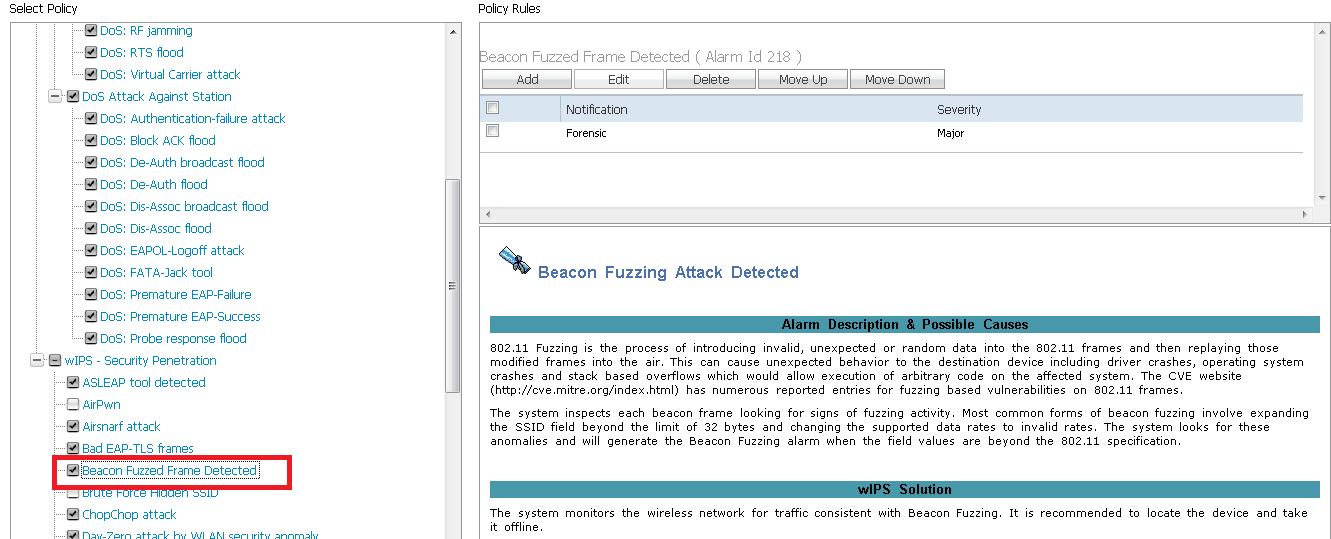
With the increasing popularity of BYOD, wireless security has become an eminent concern for Network Administrators. Cisco Unified Wireless Intrusion Prevention Solution (WIPS) is dedicated to protecting the wireless network security and provide a secure wireless experience to the clients. Cisco, allied with Flukes Networks, to constantly monitor new wireless intrusion techniques, develop new signatures and provide preventive solutions. In 7.4 release, we added the capability of detecting 802.11 frame fuzzing attacks. The new signatures patterns, for detecting such attacks, are available through WIPS profile configuration in NCS. These signature patterns are enabled by default and provide the full level of security. The user, however, could tune them to get the desired protection level.
Why the Network Will Drive the Next Wave of Mobility
Forty years ago, the first phone call was placed on a handheld mobile phone. The call was placed by Martin Cooper at Motorola’s Communications Systems Division, who phoned a competitor at Bell Labs—and launched a new era. The brick-like prototype he used weighed two pounds and cost nearly $4,000.
Reflecting on the first mobile phone call also gives us a great opportunity to think about where mobile communication will take us in the years to come. In a few short decades, cell phones have evolved from a clunky appliance used mainly by high-powered businesspeople, into a key part of everyday life. Continue reading “Looking Beyond the Mobile Phone”
On March 19th, 2013 Cisco announced the best 2-socket virtualized SAP Sales and Distribution (SD) Benchmark result in a Linux environment with the Cisco Unified Computing System™ (Cisco UCS®) delivering high scalability and low latency in virtualized SAP Business Suite deployments.
Cisco’s benchmark result for the Cisco UCS B200 M3 Blade Server show support for up to 5530 concurrent users and a SAP Application Performance Standard (SAPS) score of 30,270 derived from the processing of 605,330 order line items per hour and 1,816,000 dialog steps per hour. This result demonstrates that a Cisco UCS B200 M3 Blade Server configured with a LSI 400-GB SLC WarpDrive can deliver high scalability and low latency in virtualized SAP Business Suite deployments.
The tested configuration consisted of a Cisco UCS chassis equipped with one Cisco UCS B200 M3 Blade Server running Red Hat Enterprise Linux (RHEL) 6.4 on KVM. The server was configured with two 2.90-GHz, 8-core Intel Xeon processor E5-2690 CPUs and 256 GB of 1600-MHz memory. The blade server ran both the SAP Business Suite application software and the 64-bit Sybase ASE 15.7 in a single virtual machine. SAP Enhancement Package 5 for SAP Enterprise Resource Planning (ERP) 6.0 was used in this scenario. The Cisco UCS B200 M3 Blade Server recorded the best two-way virtualized SAP SD Benchmark result on SAP Enhancement Package 5 for SAP ERP 6.0 and Sybase ASE 15.7. In the test, 5530 SAP SD Benchmark users were supported while a consistent application response of less than one second was maintained.
Many business organizations currently struggle with the cost of maintaining RISC processor–based servers running proprietary operating systems and third-party database management systems. Cisco UCS enables organizations to use lower-cost industry-standard x86-architectureservers, open source operating systems, database management systems, and allows organizations to run SAP Business Suite applications in virtualized environments. With Cisco UCS, organizations can easily balance workloads across a pool of servers to manage service levels according to business priorities, scale environments up and down as needed, and contain costs by consolidating workloads onto a smaller number of servers.
Using the Cisco UCS, IT departments can run virtualized SAP Business Suite applications with the flexibility, scalability, and lower cost of virtualized environments. These innovations delivering high scalability and low latency in virtualized SAP Business Suite deployments and the dramatic reduction in the number of physical componentsrequired illustrates the value created by Cisco UCS solution for customers planning migration away from proprietary RISC/Unix based systems to open source operating system software and standards-based computing infrastructure.
For additional information on Cisco UCS and Cisco UCS solutions please visit www.cisco.com/go/ucs
We’ve been actively promoting the adoption of IPv6 at various venues – back in January at Cisco Live London, and a few weeks ago at the V6 World Congress, which focused on the adoption of IPv6 in mobile networks.
Our next big venue is Cisco Live in Orlando, Florida June 23-27, 2013 and I want to take the opportunity to reflect on how IPv6 is becoming an increasingly important component of the event agenda, infrastructure and look forward to some of our future ideas for Orlando.
I have personally participated in Cisco Live for over 15 years as a speaker but this was my first time as a member of the IPv6 Team. For those of you who do now know I am the Product Manager for IPv6 in Cisco’s Core Technology team that we call Network Operating Systems Technology Group.









 By Steve Simlo, IPv6 Product Manager, Cisco