Connected Industries shows off the entry level Industrial Switch, the IE2000
https://www.youtube.com/watch?v=IQLx3cnrGz0
Yuta Endo, Cisco Connected Industries Product Manager, discusses the newest version of the IE2000 range of products that addresses the growing trends of Industrial and Enterprise Network convergence; connectivity across Industrial equipment; and the heightened security concerns that are burgeoning.
Yuta talks about the product features and benefits, such as support for IEEE standards such as the IEEE 1588 PTP v2 Motion Control standard.
The product is available now for customers in the Manufacturing, Oil and Gas, Mining, Transportation and Energy industries, and is already in use by many Cisco manufacturing customers.
Recently the product line added Power over Ethernet (PoE), so that both the IE2000 and IE3000 ranges have PoE in both the fixed and modular versions. More on that in my next blog!
We’ve been doing quite a bit of work recently with our strategic partners Intel, NetApp, and Microsoft on Microsoft oriented private cloud solutions. Specifically we’ve been focusing on new innovation going into our joint FlexPod with Microsoft Private Cloud reference architecture.
A great way to learn about these joint development activities is to join in on an upcoming executive roundtable – Simplifying Your Journey to Private Cloud – on Wednesday, April 17 at 2 p.m. EDT. Leaders from Cisco, Intel®, NetApp, and special guest Microsoft, will examine key areas where businesses can gain the best return and biggest competitive advantage while adopting a private cloud model.
Our expert panel will spotlight the innovative FlexPod with Microsoft Private Cloud, solution through customer results and open dialog, to sharing of essential insights. Please feel free to registerhere for this event.
Navigating social media can be an intimidating challenge for many people, but particularly for company executives who may not be naturally inclined to communicate using social channels or have the time to learn how to use them.
Sheila Jordan, Cisco Senior Vice President, IT Communications and Collaboration
My own experience with social media has evolved – initially by watching my teenage children use it to communicate, share photos, and catch up on the big news event of the day – and by watching others. For me, I find it easier to separately my personal and work life by using Facebook solely for family and friends, and Twitter and blogging for business topics.
Twitter is a fantastic way to reach a very broad audience. There are now four generations of people in the workforce and Twitter is a channel they all use!
And I really enjoy blogging because it allows me to express my opinions and points of view on IT topics that are top of mind with CIOs and IT leaders. I do many, many customer executive briefings and get input directly from customers and learn what’s most of interest and important to them. I use that information as an opportunity to express my and Cisco’s point of view on a variety of IT topics – collaboration, mobility, cloud and social.
So for those of you who need some encouragement, here are my top 10 tips for executive social media:
Be relevant – be timely. It’s most important to get your point across while the topic is hot – if you tinker endlessly with your message, you’ll have missed the moment.
Be provocative – use analytics and data points to back up your theories. Don’t be afraid to express your point of view.
Use social media as a channel to message your organization and teams’ work and as a form of recognition. Colleagues will enjoy following you so use this channel as a way to express your appreciation!
Show thought leadership (provide value)
Use as an ongoing opportunity to connect with others – your peers, influencers and colleagues inside and outside your company
Let’s Chat! #CiscoSMT Social Media Training Series: Executive View on Social Media Experiences
Listen to feedback and responses – have you resonated with your audience? This is a way to instantly get feedback. And don’t worry about responding to each and every comment; not everyone expects you to reply and when you do they are pleasantly surprised!
Don’t spam. Enough said.
Personalize your social media – offer insights to how you think. Be authentic and human. If you’re asked to re-tweet a company message, be sure it reflects your own thinking.
Don’t be afraid to be an expert!
Have fun. Go for it – it’s a new medium and we are all still learning; don’t be shy!
In this installment of the “We’re Listening” blog, Steve Young discusses how Cisco’s Technical Assistance Center (TAC) teams are using collaboration processes to solve customer problems faster. Steve is Director of the TAC’s Service Delivery Transformation efforts.
Mobile devices have quickly become a mainstay in enterprise environments and continue to be consumer driven, and yet they find their way into our day-to-day business lives. As these new devices are being brought into the work environment by employees, enterprise IT is increasingly being forced to accommodate for business use. This is not new news. We observe this pattern through our customers today and live this phenomenon within our own everyday work environment at Cisco. Here at Cisco, employees have the flexibility to choose their device and to securely connect to voice, video and data services from anywhere under an Any Device policy. Cisco manages over 64,000 mobile devices today.
When Cisco integrated our Identity Services Engine (ISE) platform with leading mobile device management (MDM) systems, it was clear from the start that we had struck a chord among IT administrators trying to wrestle with the onslaught of employee-owned mobile devices accessing their networks. First and foremost for IT organizations was gaining visibility to all mobile devices — rogue or authorized — that were present on the wireless network. Cisco ISE delivered that capability, providing IT staff with a detailed view of what types of mobile devices were on the network. Coupling that with ISE’s native BYOD enrollment capabilities or the active management capabilities of MDM platforms — as well as network intelligence from the Cisco Wireless Network — was key to gaining full control over this Wild West of mobile devices
Cities around the world are facing some big and complicated problems, with few easy answers at the ready. Rising energy costs, environmental concerns, and new government initiatives have inspired a focus on sustainable IT operations. But how can cities be expected to solve these crises, while also improving citizen services and ensuring future economic success?
Advanced information and communications technology (ICT) is a great answer, but this is easier said than done. Cities frequently face logistical hurdles on the road to becoming Smart Cities. I believe the key is creating a more effective “connected transformation,” harnessing the power of cloud computing for cost reduction and the delivery of vital services.
We’ve seen this in the enterprise sector: An intelligent IP-enabled information network provides a single, multiservice infrastructure to support productivity and cost initiatives—all achieved remotely, via cloud management. Government agencies are beginning to follow this lead. The public sector, for example, is finding new ways to measure such things as power consumption, thereby controlling energy output, reducing costs, and increasing operational efficiency. For government as well, the cloud is becoming an important tool for achieving greater sustainability.
Overall, the cloud is helping to create more effective city management, and it enables the network to become:
Observable. Cities can monitor systems, power flows, and equipment, with no physical or location constraints.
Controllable. Providing remote two-way communications and data between stations, systems, and equipment will maintain effective operations.
Automated.Hands-off processes allow for greater cost efficiency.
Secure. Layers of defense throughout a cloud grid will assure service reliability, prevent outages, and protect citizens.
The result is an intelligent, integrated cloud infrastructure that is pivotal to a Smart City’s evolution. Some amazing technology advances are making it possible for complex systems to be managed—and self-managed—remotely and efficiently. A flood of recently published case studies show how, in practical terms, high connectivity is essential to a new future for buildings and cities, and to the urban economy as a whole.
The Big Data revolution continues to make inroads into the healthcare space, where it’s helping reduce hospital readmissions, improve point-of-care decisions and advance research, among other benefits. Take a look at this sampling of topics on offer at the 2013 Annual HIMSS (Healthcare Information and Management Systems Society) Conference & Exhibition in New Orleans, La. last month: “Using Data Analytics to Improve Patient Care and Safety,” “Data Warehousing for Healthcare,” “Extracting Value from Healthcare Big Data with Predictive Analytics,” “Leveraging Data as an Asset.”
Clearly, Big Data is making its mark in the healthcare world, as it is in just about every other aspect of our world—a reality that’s compellingly illustrated in the recent Cisco-sponsored project, The Human Face of Big Data (HFOBD). Consisting of a book and an iPad app, the project is designed to illustrate how data transforms the way we perceive ourselves and our world.
The project’s premise? That real-time visualization of data streaming in from billions of sensors, RFID tags and GPS-enabled cameras and smart phones is beginning to allow us, as individuals and collectively as a society, to sense, measure and understand aspects of our existence in ways never before possible through data in motion or at rest. This is a big deal. In fact, many data experts believe this global ebb and flow of data—a planetary nervous system, if you will—will soon have a greater impact on our lives than the Internet.
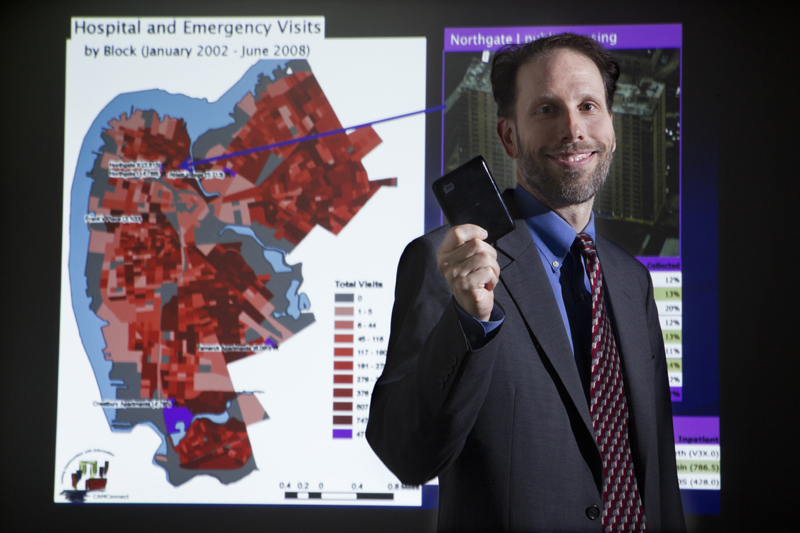
Back in the world of healthcare, consider this example from HFOBD of how one doctor used the power of data to gain insight into hospital and emergency room visits. Troubled by the soaring costs of healthcare in America, Dr. Jeffrey Brenner of Camden, NJ, used the records of 600,000 hospital visits to build a map linking hospital claims to patients’ addresses. Analyzing the data, he made a startling discovery—that just 1 percent of patients accounted for 30 percent of hospital bills due to repeated emergency room visits.
To help address the issue, Brenner founded the Camden Coalition of Healthcare Providers, which can dispatch caseworkers to care for the patients with the most problems. Once caseworkers began making proactive home visits and encouraging high-risk patients to stay on their medications, the target group’s hospital bills fell dramatically. In one instance, a single patient who had run up over US$700,000 in hospital bills in 12 months didn’t need another visit after the coalition’s intervention[1].


 Yuta talks about the product features and benefits, such as support for IEEE standards such as the IEEE 1588 PTP v2 Motion Control standard.








 By Guest Contributor Steve Young