Avatar

Years ago I was standing next to the Chief Trauma Surgeon (CTS) in an Emergency Department while the team worked feverishly to resuscitate an injured EMT.  The EMT had been struck by a speeding car while at the scene of an accident. In one split second he went from being a first responder to being a patient.  My job was to relay information to the Operating Room to make sure the Trauma Suite was prepared appropriately should this patient survive long enough to make it to surgery.  The code had been going on for almost an hour and all the efforts of a dozen brilliant and highly trained professionals seemed to have no impact.  In fact, things just seemed to be getting worse.  Finally the resident came over and asked the CTS if we should ‘call it’.  In hospital speak, that means to admit defeat and acknowledge that the patient cannot be resuscitated.  It means, literally, to call the time of death.  I watched while the weight of the decision spread over the face of the CTS and change his posture as if an actual physical weight had been put on his shoulders.   After a few minutes, he turned without a word to walk towards the waiting room to speak to the family.  He had only taken a few steps when he turned around and came back.  “No, keep going.”  The commitment and compassion I saw in his face that day has never left me.  He was there for that EMT.  The power of truly being there to make a difference hit home.

https://youtu.be/tRe4eOF-P5M

At Cisco, we are working to make it easier to “be there”.  To bring knowledge and expertise right to where it is needed, no matter where you are, no matter who you are.  We are using technology to connect not just machines and data bases, but people.  Today, we see the powerful forces of social, mobility, the cloud and information coming together.  Gartner describes this as the Nexus of Forces. This nexus is disrupting old models and creating new market transitions. Scaling these technologies is making things possible that were not possible before.  And Cisco is working to be there, to help you be there.

Continue reading “Connected Health – It’s About Being There”

Avatar

Alas… the much anticipated FCS (First Customer Shipment) of the earth shattering Cisco 3548 Switch is now available. When your business depends on nanoseconds, this switch enables unprecedented advantages in lowest latency with a full feature set.

Customers should also bear in mind that in conjunction to announcing shipping units, our ecosystem partnership is more robust than ever. Our Nexus Engineering Team released a whitepaper detailing how the partnership validated end-to-end latency with real time NASDAQ market data from Universal E-Business Solutions, leveraged precise measurement tools from TS-Associates, Feed Handler processing from Enyx FPGA, and Network Test Access Points from Datacom Systems.

Read the whitepaper below in its entirety to see how Cisco continues to work with best of breed infrastructure vendors to deliver a complete solution in High Performance Trading.


Avatar

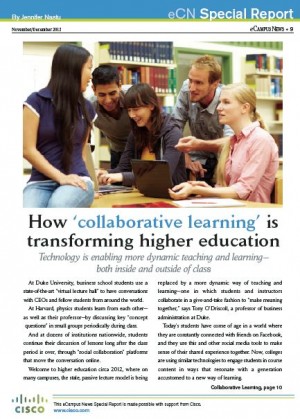
Collaborative learning was on display this week at Educause 2012 in Denver.  As colleges and universities are embracing technology to enable more dynamic teaching and learning, inside and outside of the classroom, it is clear that the “stale, passive lecture model” is transforming to a collaborative model of instruction.

A just published eCampus News special report on collaborative learning details how universities such as Duke, San Jose State University, Case Western, and West Texas A&M are embracing video, flipped learning and social collaboration platforms, like Cisco’s recently announced WebEx Social for Higher Education, to help faculty and students interact  “in much richer ways’.

Continue reading “Collaborative Learning on Display at Educause 2012”

Avatar

Chet Namboodri, Cisco’s Director of Global Industries for Manufacturing and Automotive and long-time Automation Fair participant shares his evolutionary perspective.

https://youtu.be/x8MXgjqDHwo

Cisco and IP have transformed the way we do business. 

Consider how IP has unified communication services – phone calls, faxes, voicemail, web conferencing can all be delivered to any handset.  IP lowers infrastructure costs by allowing voice and data to run over a single network.

In commerce, IP maximizes mobile user productivity by allowing businesses to support anytime, anywhere and any device access.

IP is now making an impact on industrial networking.  It’s allowing businesses to maximize their operational efficiency and quickly adapt to change. Cisco and IP (Internet Protocol) are helping industrial customers develop robust, secure, future-ready and cost effective EtherNet/IP (Industrial Protocol) for their distributed network applications.

The evolution of Cisco’s impact on industrial networking is evident in how our participation has changed and grown at Rockwell’s Automation Fair. Continue reading “A 6-year evolution of Cisco at Rockwell’s Automation Fair”

Authors

Avatar

Cisco submitted the following Letter to the Editor of the Washington Post:

October 17, 2012

Washington Post

Letter to the Editor,

In a page one article last Thursday entitled, “US rivals lobby against Chinese firm,” the Post implies that Cisco engaged in a lobbying campaign against Huawei on Capitol Hill regarding national security issues, and describes a Cisco marketing document that compiled published views and concerns from around the world regarding  Huawei.  The article reports that, “Senior Hill staffers at three separate congressional offices say an array of American tech firms have lobbied them to increase scrutiny of Huawei, using language similar to Cisco’s campaign.”

The suggestion that Cisco engaged in a lobbying campaign with the House Intelligence Committee against Huawei on national security issues, and that the marketing document was distributed or its contents used for lobbying on Capitol Hill, is false.  In response to a request we received from the Committee, we provided committee staffers with publicly available information about the private intellectual property litigation between Cisco and Huawei that occurred in 2003 and 2004. This was the extent of Cisco’s involvement.

Cisco has been engaged in China for almost twenty years, supplying internet routing and switching equipment that has resulted in billions of people being connected to the global Internet.   As we do with other competitors, we compete vigorously with Huawei in the marketplace.  The Post’s article, however, provides a misleading impression regarding Cisco’s lobbying activities.


Mark Chandler

Senior Vice President and General Counsel, Cisco

Authors

Mark Chandler

Retired | Executive Vice President

Chief Legal and Compliance Officer

Avatar

Last week, I wrote about statements made by Charles Ding, Huawei’s Senior Vice President and Chief Representative in the U.S., Mr. Ding explained the 2003-2004 intellectual property litigation between Cisco and Huawei as follows: “Huawei provided our source code of our products to Cisco for review and the results were that there was not any infringement found and in the end Cisco withdrew the case . . . the source code of the issues was actually from a 3rd party partner that was already available and open on the internet.”

In my blog, I let Huawei and Mr. Ding know that Cisco would waive any confidentiality provisions from that litigation  so the world could learn what really happened and suggested they publish the expert’s report from the litigation.   Huawei and Mr. Ding have so far ignored my offer.  Under the agreement that resolved the litigation, we are entitled to act on our own, so we now do so.

Two things are clear about the Cisco – Huawei dispute:

  • The litigation was between two private companies, not between governments. It’s not about the US or China and we respect the efforts the Chinese government is making to increase intellectual property protection.  Rather, this dispute involved a very simple claim that one company used the other’s trade secrets and copyrighted materials without permission.
  • Unlike the smartphone patent battles, where parties try to protect and grow their market share by suing each other over broad patents where no direct copying is required, let alone even knowledge that a patent exists, this litigation involved allegations by Cisco of direct, verbatim copying of our source code, to say nothing of our command line interface, our help screens, our copyrighted manuals and other elements of our products.

The agreement that ended that lawsuit allows either party to make a reasonable response to improper or impermissible statements by the other.  Mr. Ding’s statements of two weeks ago indeed misstate the facts and therefore merit a direct, factually accurate and proportionate response. Rather than providing Cisco’s interpretation of the facts, we think it better simply to set forth the facts themselves.  To that end, the following are verbatim excerpts from the Neutral Expert’s Final Source Code Report, dated June 15, 2004:

Continue reading “Huawei and Cisco’s Source Code: Correcting the Record”

Authors

Mark Chandler

Retired | Executive Vice President

Chief Legal and Compliance Officer

Avatar

Recently,  Mr. Charles Ding, Huawei Corporate Senior Vice President and Chief Representative in the United States spoke publicly about Huawei’s use of Cisco’s intellectual property.

While Huawei’s statements were in a context unrelated to the competitive relationship that Cisco and Huawei have, they nonetheless bear directly on issues that anyone concerned about fair competition in the networking industry ought to be thinking about. Mr. Ding contended that Cisco’s litigation with Huawei in 2003 and 2004 was unjustified. This is the litigation in which Cisco claimed unauthorized use of Cisco’s source code in Huawei products.

Mr. Ding said: “If I remember well, that happened in 2003, when Cisco sued Huawei for intellectual property rights infringement …at that time, Huawei provided our source code of our products to Cisco for review and the results were that there was not any infringement found and in the end Cisco withdrew the case…this is the basic situation of that case.”

When asked, “didn’t Huawei admit that Cisco’s code was in your equipment?”, Mr. Ding stated, “As specifically to the source code, the source code of the issues was actually from a 3rd party partner that was already available and open on the internet.”

In fact, within a few months of filing suit, Cisco obtained a worldwide injunction against sale by Huawei of products including our code for a Cisco-proprietary routing protocol called EIGRP, and Huawei publicly admitted that the code had been used in their products and they pledged to stop.  They even said they had removed that code from the products voluntarily prior to the judge’s action.  After the injunction was issued, Huawei agreed to an expert review of the balance of its code, above and beyond the EIGRP module.  More than a year later, the litigation was indeed concluded.  What happened in the interim, how many reports a court appointed expert released, and what was done as a consequence, were all covered by a confidentiality agreement.

Our legal advisers tell us that given Mr. Ding’s statements, we would be justified in releasing the full report.  To facilitate the understanding about what actually happened in the litigation and allow Huawei to itself clear up any confusion, we waive any confidentiality requirement for the report and suggest that Huawei itself have the expert’s complete final report put into the public domain.   Fair competition, indeed, requires transparency of business practices and a respect for intellectual property rights.

Authors

Mark Chandler

Retired | Executive Vice President

Chief Legal and Compliance Officer

Avatar

Like many in the tech industry, I closely followed the recent Apple-Samsung litigation and believe that the case will have meaningful implications for years to come.  What I find most interesting is not the jury’s decision – which could have gone either way for purposes of this commentary – but the underlying premise of this case, which is exactly the type of issue our patent system was designed to handle. I can even picture Thomas Jefferson, our nation’s first Commissioner of Patents, sitting in his study at Monticello, reading about the case on his iPhone and texting a note to Judge Koh congratulating her for her conduct of the case.

This case involved two companies with competing products, and each believed they had intellectual property that should exclude the other from participating within their marketplace. More importantly however, at least some of the patents being litigated were essential to the products’ design. In other words, they were inherently the reason that consumers would want to buy those specific products. This important concept – that true innovation must be tied to consumer preference – played out in a court of law, in front of a jury, and in a way that will have great significance for how the marketplace treats companies that innovate.  Unfortunately, this is a far cry from a majority of patent litigation we see in our system today.

Continue reading “Why Apple-Samsung Proves that the Patent System Can Work”

Authors

Mark Chandler

Retired | Executive Vice President

Chief Legal and Compliance Officer

Avatar

The friend who inspired me to embrace social media does not follow me on Facebook, Twitter or LinkedIn.  She follows me around the house.

When I was 25 years-old, I had an amazing job as a marketing project manager.  I traveled to new cities and countries to meet with global team mates, partners, and clients.  True, most of my time in those exotic locales was spent in conference rooms, but we eventually got the chance to go out for lunch or dinner, to marvel at the natural beauty of Rio de Janeiro or Boulder. The best part of each business trip was coming home to my husband.  Sometimes I would meet him in a city far from home, where he had traveled for business.  These were the early days of our marriage, when we spent many days apart, staying in touch via email and trying to manage our hotel and mobile phone bills wisely.

Working Mom

It has been said many times that the inside of a conference room looks pretty much the same anywhere in the world.  I got tired of business travel.  I also became increasingly broody.  Although I wasn’t ready for the responsibility that comes with a human baby, I was ready for the next logical step: getting a dog.  This would mean changing my work routine to remove business travel.  It also made me realize that my hour-long commute would keep me away from my puppy, to whom I had made a life-long commitment.  As much as I loved my job, I had to find something closer to home.

It’s thanks to my dog that I quit a perfectly good job, and found another just 5 miles away from my house.  That’s when I became a Marketing consultant at Cisco.  Since then I have participated in many exciting projects in localization, collaboration, and sales enablement.  My first day on the job, I was happily surprised to discover that all Cisco buildings had Wi-Fi.  Eight years later, I’m also grateful for Cisco technology that has allowed me to work from home, so that I could keep close watch over my puppy and the human baby that eventually followed.

In 2004, I made a decision to find a new way to work so I could have greater work-life balance.  Also in 2004, a Harvard undergrad launched a website with the goal to connect everyone in the world.  These are two good examples of choosing to use technology to achieve a better human experience.  Social Media isn’t a new concept, it’s a collection of new tools to help us stay in touch with our best friends.  Cisco collaboration tools have made it possible for me to work from home.  I have a family, a career, and friends all over the world.  I thank my dog for that.

What tools do you use to stay social?  Who is your inspiration for collaboration?

Follow Silvia Spiva @silviakspiva
http://www.linkedin.com/in/silviakspiva


Authors

Silvia Karina Spiva

No Longer at Cisco