

As the “Gold Medal” winner in Cisco’s internal London 2012 Olympic Video Contest, Systems Engineer Steve Cramer won a trip of a lifetime—six nights in London during the 2012 London Olympic Games. Before learning about his notable participation using video, let’s start off by watching his award-winning video that answers the question, “What do YOU make possible in your daily life for your family, friends, and community—or at work?” Continue reading “Meet Steve Cramer: An Engineer Who Won A Trip To The London Olympics With His Video Skills [VIDEO]”

Authors


In the months since I attended the Smart Cities event organized by Qualcomm and CommNexus in San Diego, the buzz about “Smart Cities” and the use of machine-to-machine (M2M) wireless technologies has only grown louder and more intense. Which Smart City-relevant innovations are under development inside Qualcomm?
Known primarily for mobile chipset technologies, Qualcomm is working to optimize wireless networks and sensors that support M2M solutions and, ultimately, Smart Cities of the future. An often-overlooked part of this initiative is the company’s work in preparing the wireless industry for the imminent tsunami of data that will come when countless “things” equipped with M2M wireless sensors—part of the “Internet of Everything”—hit wireless networks. Qualcomm calls it the 1000x Challenge, referring to wireless industry predictions about a 1000x increase in mobile data usage between 2010 and 2020.
Last month, Qualcomm Executive Vice President and CTO Matt Grob presented at Meeting of the Minds 2012 in San Francisco. His presentation, “Next Big Innovation: The Mobile Internet Transformation—Meeting Network Capacity Needs of Cities,” showed how wireless connectivity is revolutionizing the way people live and interact with each other in cities.
A few examples of Qualcomm tech in this arena:
- From Qualcomm’s perspective, a “smarter grid” employs digital wireless technologies that allow utility companies to safely and securely deliver prepaid electric services that save homes and businesses money through real-time monitoring of power usage over existing cell networks, thus reducing deployment costs for the utility and saving energy for the planet. At the same time, smarter grids enable customers to better manage their own energy usage.
- One recent Smart Grid example is Qualcomm’s work with Duke Energy, the largest electric power holding company in the United States. The success of this collaboration has enabled Duke Energy to install hundreds of thousands of communications nodes, which interface with electric and gas meters, line sensors, transformers, and other end points, meters, sensors, and distribution automation equipment, and optimize energy usage in five states.
- Working with ECOtality, a maker of electric vehicle (EV) charging stations, Qualcomm participated in The EV Project, the largest deployment of electric vehicles and charge infrastructure in history. The project, now in nine states plus the District of Columbia, leverages cellular technology incorporated into charging stations, enabling EV car drivers to easily find charging stations with their smartphones. Moreover, the solution allows users to reserve stations as well as receive alerts users when the charge is finished or if it the charge has been interrupted.
- Another exciting development, also involving EVs, is Qualcomm Halo’s teaming with Renault and Delta Motorsport in London. Qualcomm Halo, a subsidiary of Qualcomm, produces wireless charging mats that enable EV drivers to simply drive up and park over the charging mat—no exact alignment necessary (e.g., you have to line up your electric toothbrush perfectly on the charger in order for it to charge). Initially, the benefit is no longer having to deal with tangled charging cables. But looking beyond that, Qualcomm Halo envisions embedded chargers in the roadway. Even further out is the idea that these mats could be built into the road and connected to the overall Smart Grid. Depending on the time of the day, more or less energy resources could be devoted to that specific roadway, effectively channeling energy to where it’s needed most.
Cisco IBSG is also engaged with the Internet of Everything in a variety of ways, such as through the Connected Vehicle.
I’m interested in hearing your thoughts on how M2M connections—and the Internet of Everything—can enable Smart Cities of the future.
Authors

A recent blog by Sue Nolin discussed the EtherNet/IP Network Infrastructure on display in the joint partner booth at Automation Fair this week.
In this video Paul Didier, Cisco’s Solution Architect, tells us about the partners in that booth and how their combined technologies provide the core foundation for successful standard IP network deployments in a plant environment.
https://www.youtube.com/watch?v=qVfjWzXfWWs
Authors


Going to Salt Lake City for Supercomputing 2012 next week? So are we!
Be sure to drop by and see us in the Cisco booth (#2517). I’ll be there, demonstrating and talking about our latest developments in ultra low latency Ethernet (hint: it includes 250ns port-to-port Ethernet switch latency and our latest MPI/OS-bypass technology on the Cisco Virtualized NIC in Cisco UCS servers).
In short: everyone assumes Ethernet is slow. Everyone is wrong.
I’ll also be co-hosting the Open MPI State of the Union BOF with George Bosilca from the University of Tennessee in the Wednesday noon timeslot (room 155B).
I’ll also be one of the judges in the Student Cluster Competition. Be sure to drop by and see the teams; they make an amazing effort every year.
Finally, this isn’t really SC-related, but Cisco will be hosting the MPI Forum meeting again in December. Register and come join in the discussion that shapes HPC for the next 10 years.
Authors

Over the past two weeks, Tom Nallen introduced the concept and benefits of the Cisco Validated Design , then Laszlo Bojtos, illustrated this concept with the Cloud Service Assurance for Virtualized Multi-Services Data Center 2.2 Cisco Validated Design, with a specific emphasis on the integration with Cisco Intelligent Automation for Cloud .
 This week I talked with John Kennedy, a Cisco engineer who put a lot of energy on the FlexPod CVDs.
“So John, what is FlexPod ?
FlexPod is the result of collaboration between NetApp© and Cisco to create a cost-effective, scalable solution for cloud applications as well as standard virtualization support. The FlexPod(t), a pre-defined, pre-tested solution, includes the compute, networking, and storage customers need in a validated (as in CVD) package. But unlike other validated solutions, FlexPod can be scaled up or out, not just one or the other.
What need does FlexPod address ?
It’s probably been a while since you had to source a motherboard. Many of us have done this in the past, in order to get desktop computer system that met our needs. Pre-configured systems were limited in their abilities, and custom design was beneficial.
But choices of personal computer systems have increased, and most folks don’t need to customize anymore, preferring to buy an entire computer system that’s been tested and designed to meet their needs. On the other hand, customers want to be able to expand the system they have to keep up with new technology, or to add capabilities.
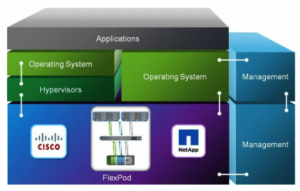 Customers need to support multiple types of applications and have multiple purposes for their infrastructure, and the Cisco Validated Designs (CVDs) for FlexPod reflect that need. The architectures have been validated by engineers from both companies to ensure performance and stability.
But that’s just the beginning. The Cisco Validated Design documents include multiple configurations with multiple types of application and operating systems Continue reading “Cisco Validated Designs for Cloud – Part 3 – Flexpod”
Authors
 In today’s SME Champion blog post, we meet the so-called “Queen of Cisco WebEx Social for IT.” WebEx Social (WxS), previously known as IWE (Integrated Workforce Experience), is the company’s internal collaboration platform that exhibits social networking, content creation and real-time communication features. A Program Manager within the IT Customer Strategy & Success (CS&S) group, Shannon is quite involved with the Client Experience, Governance and Adoption of WxS within IT.
Shannon Practices and Preaches Internal Social Media Usage
Shannon started using WxS when she first joined the company three years ago. Since then, she has been an active member of the WxS for IT program team while leading projects as well as providing consulting & support to IT employees and other functional teams. Her efforts have the ultimate goal of demonstrating business value and telling the Cisco on Cisco story in order to accelerate internal adoption and increase sales of WxS with external customers.
Shannon is a change agent responsible for evangelizing WxS and fostering collaboration within IT by helping her “customers” (IT employees) find relevant ways to utilize WxS in their everyday work lives. She does this internally by hosting brown bags, creating viral campaigns like “I love IWE” and blogging internally to share her best practices. What’s more, if someone approaches her with a question regarding WxS or needs help finding information, she is always willing to help and is just a click away.
Not only is Shannon an active on this internal platform herself, but she also acts as a fantastic advocate to enable and encourage others at Cisco to excel on WxS as much as she does. She preaches that this internal platform is a great tool for project management and practices what she preaches by using WxS communities and Posts to manage all of her projects. Such dedication and hard work has been awarded more than once by others at the company. Lance Perry, VP of IT CS&S at Cisco, recognized her with the “IT CS&S Above & Beyond Award”: “You are one of Cisco’s most valued partners, and we love working with you. Your tireless efforts championing IWE, decommissioning CEC sites, training, consulting and advocating the use of WxS—not just within IT but across the enterprise—has proved to be valuable.”
What drives you to be so active on WebEx Social?
Continue reading “Meet Shannon Fuller: Queen of Cisco IT WebEx Social”
Authors

Just concluding today is the WiFi Global Summit in San Francisco, hosted by the Wireless Broadband Alliance.
Billed as the world’s largest carrier-grade WiFi event, the Summit was very successful. More than 400 people attended; all the sessions were well attended, with many of them packed; and feedback was positive.
Attendees included industry analysts, media, leading telcos, Wi-Fi and cable operators, roaming hub providers and vendors. The attendance and feedback underscored the growing importance and visibility of WiFi from both the service provider and enterprise perspectives.
Cisco’s Kelly Ahuja delivered one of the keynotes, and other Cisco people participated.
Also exciting from our perspective was that Cisco won two awards, and a key partner – BT – earned one.
Cisco, with its partner operator True (Thailand) won for:
- Best Next-Generation Hotspot (NGH) Initiative Award
Cisco also won for:
- Best Wi-Fi Technology Innovation Award (vendors) . . . for the Cisco Aironet 3600 Next-Generation Design
BT won for Most Innovative Hotspot Venue, as the operator ensured that the whole of London was connected during the 2012 Olympic Games. The BT system is based significantly on Cisco solutions.
Much more to come from Cisco on the WiFi front . .
Authors
A quick note to make sure that you don’t miss the last weekly leg of this 6 weeks contest –
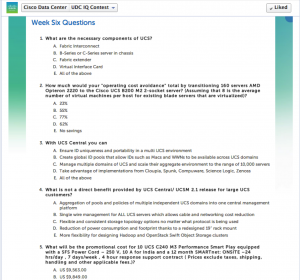
Last week on November 1st was a big milestone for our customers with the announcement of Cisco UCS Central – I hope you has a chance to check the blogs on this topic , including the analysis of partners bloggers. Check here you will find all the clues you need to answer the questions and get a chance to win the iPAD .
So naturally our questions are about UCS and UCS Central.
To enter the contest and answer the 5 easy questions with multiple choices, just go to http://www.Facebook.com/ciscodc and click on the tab “win an iPad !”
Here is one additional clue : To answer the question number 2 about cost avoidance, you definitely want to discover our UCS TCO tool
Just a quick reminder of how this contest works :
Continue reading “Unified Data Center IQ Contest : Last chance to win – It’s all about UCS”
Authors

As part of the comprehensive desktop virtualization portfolio, Cisco is providing a solution for the small and medium business customers, typically up to 500 desktops environment. The Cisco Solution for Citrix VDI-in-a-Box offers a simple and affordable desktop virtualization solution combining the benefits of Cisco UCS C-Series Rack servers with Citrix VDI-in-a-Box software.
SMB businesses account for more than 70% of the PC install base and significant proportion of these are potential candidates for desktop virtualization. Many of the SMB environments have uniform workload, defined workload characteristics and nominal application requirements.
The Cisco Solution for Citrix VDI-in-a-Box integrates connection brokering, load balancing, desktop provisioning, HA, and management functions in a single software appliance that runs on Cisco UCS C260 M2 server – this server is based on Intel Xeon processors and provide expanded memory configurations for the most demanding VDI workloads.
There are 2 defined solutions – Balanced Configuration targeting 60 to 70 users and Performance Configuration targeting 140 to 150 users per server node. Customers can scale either of these solutions by adding servers in a grid or cluster fashion. Cisco provides simplified single SKU ordering process for the Balanced and Performance configurations.
This solution is apt for small service firms, healthcare institutions, educational institutions, state and local government organizations.
For more details on the solution, please refer to the Solutions Brief and for Cisco desktop virtualization offerings please visit http://www.cisco.com/go/vdi
Authors