
Consider a bustling coffee shop chain. To keep every guest connected, IT teams need centralized visibility into every access point—real-time performance and bandwidth insights, plus automated firmware updates and security patches across every location.
The physical security cameras installed just inches away play an equally critical role. They help protect people and assets, but when networking and physical security are managed in separate environments, teams may lack a unified view of device health, updates, and issues requiring attention.
Cisco and Axis Communications are helping close that operational gap. By aligning cloud-managed networking from Cisco with intelligent physical security devices from Axis, organizations can bring greater visibility and consistency to both environments, helping teams manage, secure, and scale connected locations with more confidence.
To bring IT and physical security closer together, Cisco is announcing an integration with Axis, a leader in network video security. Built with Axis Cloud Connect, the integration enables customers to securely deploy, connect, and manage Axis devices through the Meraki dashboard within Cisco Cloud Control.
Through close collaboration, Cisco and Axis are advancing a shared vision for the future of physical security and IT. The integration is built with privacy by design, with protections such as encryption and secure boot helping safeguard data from the edge to the cloud. All data collected and processed through this integration is fully anonymized to protect individual privacy and ensure compliance with data protection standards. Importantly, the data remains the sole property of the customer; neither Cisco nor Axis claims ownership or control over customer data.
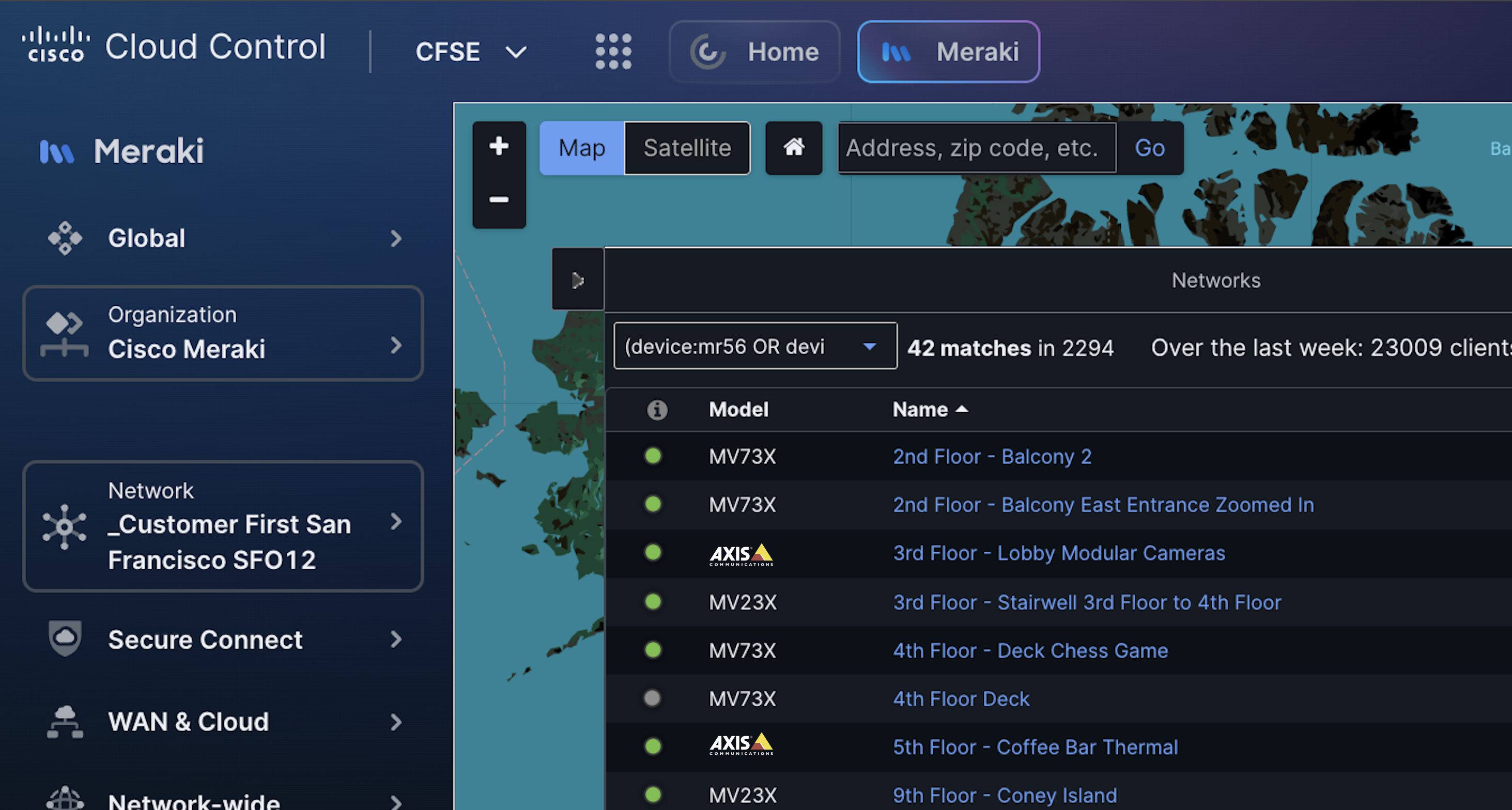
Figure 1. Snapshot of the Meraki dashboard showing Cisco Smart Cameras alongside Axis devices within Cisco Cloud Control
IT and physical security teams can manage Axis devices alongside their Cisco network and Cisco Smart Cameras. Customers can continue using their existing Axis devices while gaining centralized visibility into device health, firmware, patches, and connectivity, reducing the need for separate, site-by-site management and creating a more consistent operating model across networking and physical security.
“Axis and Cisco share a commitment to innovation, security, and seamless interoperability,” said Christian Andersson, Global Product Manager, Axis Communications. “Together, we’re delivering a solution that modernizes physical security and unifies IT and security teams under a single, scalable joint platform enabled by Axis Cloud Connect, which provides organizations with simplified management, real-time insights, and a foundation for future hybrid-cloud workflows.”
The challenge becomes more difficult as organizations scale across hundreds or thousands of locations. Checking whether every security device is online, recording, patched, and available for investigation isn’t practical when each device is managed locally.
Cloud management closes this gap by allowing IT and physical security teams to monitor and manage security devices remotely from a dashboard, using an operating model similar to the one they already use for their networking solution. Through the Meraki dashboard, teams can see which Axis devices are offline, which need firmware updates or security patches, and which require attention without visiting each location manually.
Cloud-managed security devices still represent a relatively small portion of the overall market, approximately 6%, but adoption is accelerating, with the cohort growing at a 30% compound annual growth rate (CAGR) through 2030. As organizations expand across locations, cloud management provides a path to reduce manual maintenance, simplify scaling, and support faster critical incident management.
A practical path to a hybrid-cloud physical security solution
This transition does not have to be all-or-nothing. A hybrid-cloud approach allows organizations to keep their existing deployed security devices and move to cloud management at their own pace while gaining centralized visibility, updates, maintenance, and access. This gives teams a way to modernize existing environments without replacing every device or changing every site at once.
This reduces the need for separate, site-by-site on-premises management. IT and physical security teams can work from a shared view of the physical security environment, identify issues earlier, and coordinate maintenance across locations. They can also apply more consistent policies governing permissions, access, and footage management.
Centralized management can also bring loss prevention, safety monitoring, and business analytics into a shared operating view. Physical security teams can investigate incidents more efficiently, while IT teams can monitor lifecycle information about the devices, maintain device health, apply updates, and manage access consistently. This can reduce manual effort, training requirements, and the risk of inappropriate access to security footage.
The result is not simply another device management system. It’s a way to apply the same operational practices used for network infrastructure to physical security devices. Organizations can reduce manual management, scale their environments more easily, and manage critical incidents faster by improving access to relevant video and analytics.
The strategic move to cloud-managed physical security
Physical security is becoming more connected to the broader IT environment. Physical security devices are no longer isolated; they’re networked systems that require software updates, security controls, connectivity monitoring, and ongoing maintenance. As physical security teams and IT teams work more closely together, organizations need management tools that support both groups.
Security devices are smart devices that provide capabilities such as video and visual analytics, helping physical security teams investigate incidents and understand what happened across a location via Vision Portal, accessible through the Meraki dashboard. Managing security devices alongside Cisco networking devices means they become more visible, accountable, and part of the connected environment. The Cisco and Axis integration extends the Cisco cloud-managed operating model to include Axis devices and their broad device portfolio.
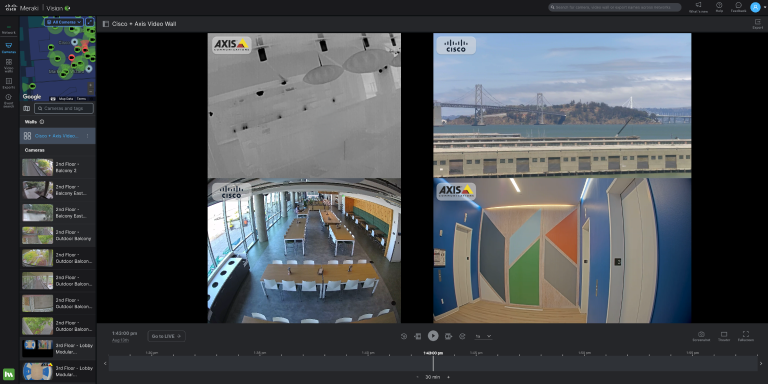
Figure 2. Snapshot of Vision Portal, available through the Meraki dashboard, showing Cisco Smart Cameras alongside Axis devices footage
Within Cisco Cloud Control, customers can manage Axis devices through the Meraki dashboard and choose the capabilities that match their operational needs.
The Essentials tier is for organizations seeking distributed device management and foundational visibility, while the Advantage tier includes everything in Essentials, plus historical video, video analytics, 30-day cloud storage, and more.
These gradual changes are important for organizations operating a mix of newer and older locations. IT and physical security teams can standardize how they monitor, secure, and support devices over time while preserving investments that continue to serve the business. As capabilities expand, customers can add cloud-enabled analytics and storage where they create the most value.
By bringing Axis devices into the Meraki dashboard, the Cisco and Axis integration helps organizations reduce manual management, scale physical security operations, and respond to critical incidents faster. Together, Cisco and Axis are helping customers build a more unified and future-proof operating model for network and physical security without requiring every location to change at once.
Axis Communications enables a smarter and safer world by improving security, safety, operational efficiency, and business intelligence. As a network technology company and industry leader, Axis offers video security, access control, intercoms, and audio solutions. These are enhanced by intelligent analytics applications and supported by high-quality training.
Cisco has an unmatched ability to unify and transform network and physical security in the cloud through a single dashboard. Cisco encompasses technologies and portfolios such as Splunk and Webex to help future-proof the workspace. Let’s begin that journey by modernizing physical security with Cisco today.
See how Cisco and Axis Communications are reimagining physical security together.

Get More from Cisco Networking
Customer stories, technical demos and more await!
Check out our Networking video channel
Multidomain Architecture
Learn how to integrate your networking domains and get more out of an enterprise-wide, intent-based network.
Discover multidomain integration