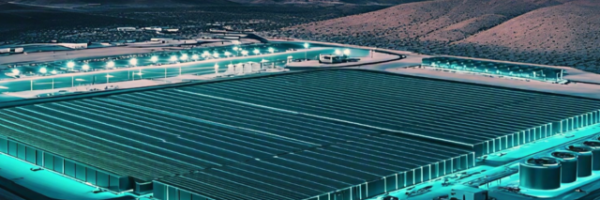
The data center industry is transforming faster than at any point in its history. For decades, the story of the data center was a story of steady, predictable growth with more racks, more servers, and more power each year. That era is over. Artificial intelligence (AI) workloads are driving infrastructure demands to unprecedented levels.
Behind that surge lies an equally urgent challenge: the unseen supporting infrastructure that connects, secures, and keeps the AI systems operational. It is not glamorous, yet it quietly determines whether an AI data center stays online, efficient, and secure.
Anatomy of the Modern AI Data Center
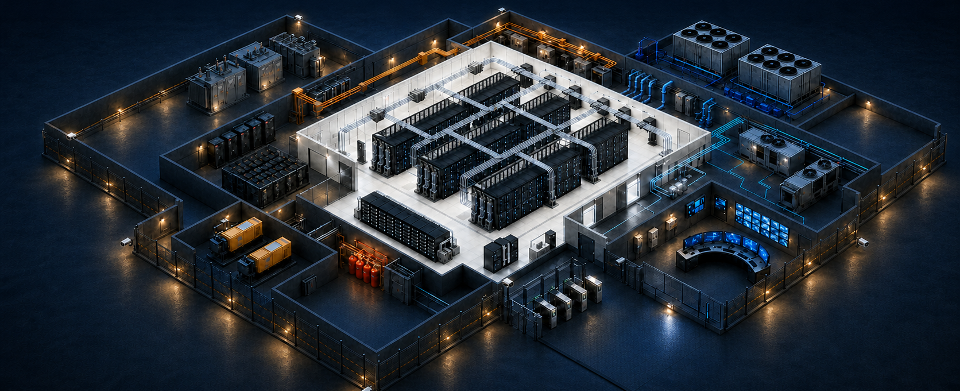
The modern AI data center is composed of two distinct but deeply connected worlds: the white space and the gray space.
The white space is what most people imagine when they think of a data center: servers, network gear, and the high-speed IT fabric that stitches them together into a single compute core. It is the domain where AI models are trained and served, and as such, draws the most attention and investments.
Conversely, the gray space is easy to overlook precisely because it is designed to be invisible. This domain includes the industrial facilities that surround and sustain the compute engine. There are four groups that make up the gray space:
- Power and distribution
The lifeblood of the AI data center, these systems manage and deliver electricity to the entire data center. Here, resilient and redundant connectivity is everything. It keeps power telemetry flowing continuously and allows subtle warning signs, like abnormal power surges, to surface before they become emergencies. - Cooling and thermal management
Systems like cooling towers where the network must be redundant and fast converging to ensure vital telemetry data is transmitted to control systems in real-time to prevent thermal runaway which can hamper uptime and create safety incidents. - Building management
Building Management Systems (BMS) are responsible for monitoring and coordinating HVAC, environmental sensors, lighting, alarms, and other facility systems. It gives operators centralized visibility and control to maintain safe conditions, respond quickly to issues, and operate the data center efficiently. - Physical security and access controls
Since AI data centers concentrate high-value compute, sensitive data, and critical digital services, unauthorized access or security disruption are especially consequential. Perimeter cameras and access control systems require reliable PoE and high-bandwidth connectivity to maintain continuous surveillance and protect the facility and the people in it.
The discipline of tying these industrial subsystems together (e.g. networking, monitoring, and security on a single observable, standards-based system) is referred to as ‘gray space automation’. It is the practice of taking dozens of independent operational technology (OT) systems that historically ran in isolation and connecting them into one coherent whole. In the AI era, that connective tissue is as critical as the compute core it powers.
The criticality of gray space automation
The gray space brings together the physical systems that determine whether AI infrastructure stays available, secure, and efficient. Four interconnected challenges must be addressed together as weakness in any one facility can reduce compute capacity or take critical systems offline.
Continuous operations in demanding environments: Gray space systems extend into electrical rooms, pump areas, rooftops, and outdoor locations where heat, moisture, vibration, and electrical noise can challenge conventional networking. As AI densities rise, even a brief communication failure can create operational blind spots or interrupt critical coordination. Uptime Institute reports that one in ten data center outages still cause serious or severe disruption.
Growing, interconnected attack surface: Every connected controller, sensor, camera, and vendor-access pathway creates operational value, but it also creates new risk. Limited network visibility, flat communications, and fragmented security policies can allow a compromised device to threaten adjacent systems. Operators need to identify assets, restrict unnecessary communications, and detect threats without disrupting critical processes.
Complexity compounded by skills shortages: Gray-space domains are often built by different vendors and managed through separate tools, creating inconsistent architectures and heavy manual workloads. Nearly two-thirds of operators report difficulty finding or retaining qualified staff. Scaling requires familiar tools, repeatable designs, automation, and shared visibility across IT, security, and facilities teams.
Growing pressure to operate efficiently: Rising power and cooling demands make static operating models increasingly costly and unsustainable. Reliable telemetry from gray space systems is essential for preventive maintenance, capacity planning, and improvements in PUE and WUE. Without it, emerging failures go unnoticed and efficiency opportunities remain out of reach.
One Cisco foundation for the entire AI data center
Cisco brings the entire AI data center on one foundation, bridging the white space where AI workloads run and the gray space systems that continuously power, cool, monitor, and protect them. By extending one trusted networking and security foundation across both environments, Cisco helps operators reduce silos, apply consistent policies, and oversee the entire infrastructure supporting AI capacity.
It starts with Cisco Cloud Control, the AI native operations layer that brings inventory, topology, alerts, identity, and workflows from supported domains into one governed experience. It preserves the depth of specialized domain tools while connecting operations at the management layer: AI Canvas to bring teams and insights together, Nexus Dashboard and Intersight for deep control of white space networking, and Catalyst Center and Meraki Dashboard from Cisco Cloud Control to extend familiar operations into gray space. Together, they turn separate domains into one coordinated operating model, helping teams see more and do more in a collective effort to protect uptime, capacity, and efficiency.
Extending the Cisco foundation into the gray space domain
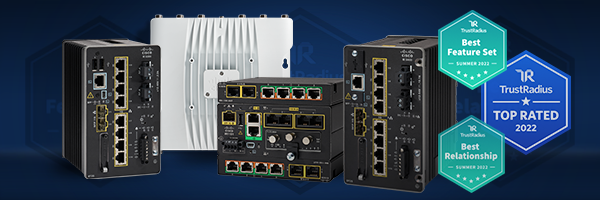
Cisco IIoT extends the one foundation from the compute core into the operational backbone of gray space systems that keep AI infrastructure running. Cisco Industrial Ethernet (IE) switches pair rugged, low power, fanless designs with lossless industrial resiliency protocols that keep critical systems connected even when something goes wrong. With Cisco Cyber Vision embedded directly into the switches, the network becomes the defense layer passively discovering every connected asset and creating segmentation policies that IE switches then enforce to isolate gray space systems from one another and from IT. And because IE switches integrate with the Meraki Dashboard or Catalyst Center, IT teams can comfortably deploy, onboard, and manage gray space facilities using tools and skills they already possess.
- Industrial-grade resilience for continuous AI through ruggedized networking engineered to thrive where standard networking fails to ensure constant, reliable connectivity
- Security embedded into the network that turns the network itself into the defense layer and establishes a security checkpoint at every connection across the gray space facilities
- Industrial networking simplified for IT ensures IT expertise transfers directly into the OT world to streamline onboarding, management, and maintenance of gray space facilities.
- Engineered for efficiency at every connection to help achieve new benchmarks in sustainability metrics and optimizing every system for peak performance.
Where a multi-category vendor stitches together disparate products, Cisco treats the network itself as both the connectivity layer and an embedded security sensor. Cisco offers a single, battle-tested networking architecture that’s backed by a technology ecosystem that spans design, deployment, support, and lifecycle guidance for every data center.
Built the foundation for continuous AI
For over 20 years, Cisco has helped connect and secure industrial environments where downtime carries serious operational and safety consequences, from manufacturing floors and energy grids to transportation systems. Combined with decades of data center networking leadership, Cisco is positioned to unite the white space where AI runs with the gray space systems that keep it running. The result is a proven foundation that strengthens resilience, embeds security, simplifies operations, and improves efficiency across the entire AI data center.
Cisco is already helping some of the biggest names in AI bring their data center facilities onto a unified architecture. Connect with a Cisco Networking expert to learn about how we’re helping to unlock the future of AI data centers.
Explore Cisco Industrial IoT
Improve business outcomes with our end-to-end Industrial IoT solutions. Securely connect assets, applications, and data in real time to apply transformative business changes.
Explore our portfolio