


As AI workloads, cloud-native applications, and massive-scale infrastructure push networks to their limits, the pressure to prove interoperability in multivendor environments has never been greater. Cisco addressed that requirement head-on with the Cisco N9000 Series at the European Advanced Networking Test Center (EANTC), demonstrating industry-leading performance across VXLAN EVPN and Time Synchronization test streams.
Cisco at EANTC Transport and Cloud Networks Interop Test 2026
As the industry’s most rigorous proving ground, the annual Transport & Cloud Networks Interop Test at EANTC in Berlin serves as an independent, neutral platform for validating the effectiveness of open, standards-based networking. By convening leading hardware and software vendors to stress-test interoperability, performance, and security, EANTC helps ensure that diverse technologies integrate seamlessly. This rigorous evaluation confirms that new solutions are ready for immediate, reliable deployment in the most demanding service provider and enterprise networks.
In 2026, Cisco participated in every EANTC Transport & Cloud Networks Interop Test group demonstration—including VXLAN EVPN, MPLS EVPN, SR-MPLS, SRv6, Orchestration and Automation, and Time Synchronization—utilizing both the Cisco N9300 and Cisco 8000 Series platforms (Figure 1). This blog focuses on the VXLAN EVPN and Time Synchronization test group results.
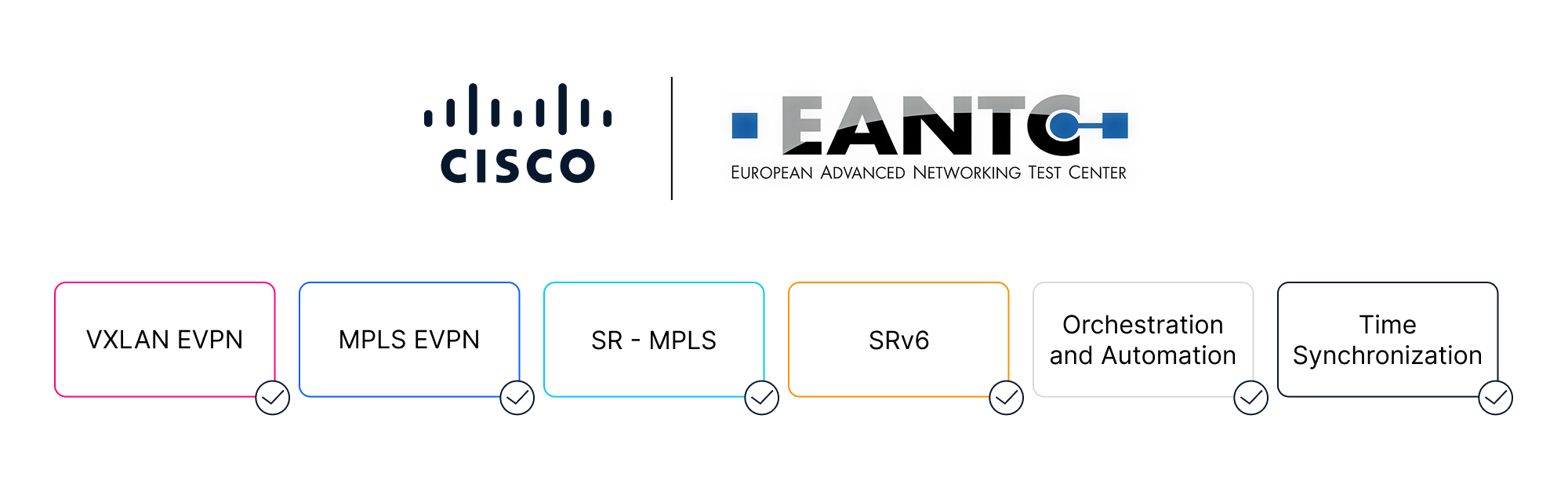
Proven, open and secure: Cisco N9300 at EANTC 2026
In addition to Cisco N9000 Series Switches, for the first time Cisco N9300 Smart Switches were used in the VXLAN EVPN and Time Synchronization test group demonstrations. While the event covered a wide range of technology and Cisco solutions, this blog post focuses exclusively on the participation with Cisco N9300 Series Switches.
Consistent with previous years, most of the participating vendors agreed on the following set of VXLAN EVPN test scenarios:
- Symmetric IRB with VLAN-based
- BGP unnumbered underlay
- VXLAN EVPN with IPv6 VTEPs
- EVPN and IPVPNv4 interworking
Highlights from the EANTC Interoperability Test 2026
VXLAN EVPN Group Policy
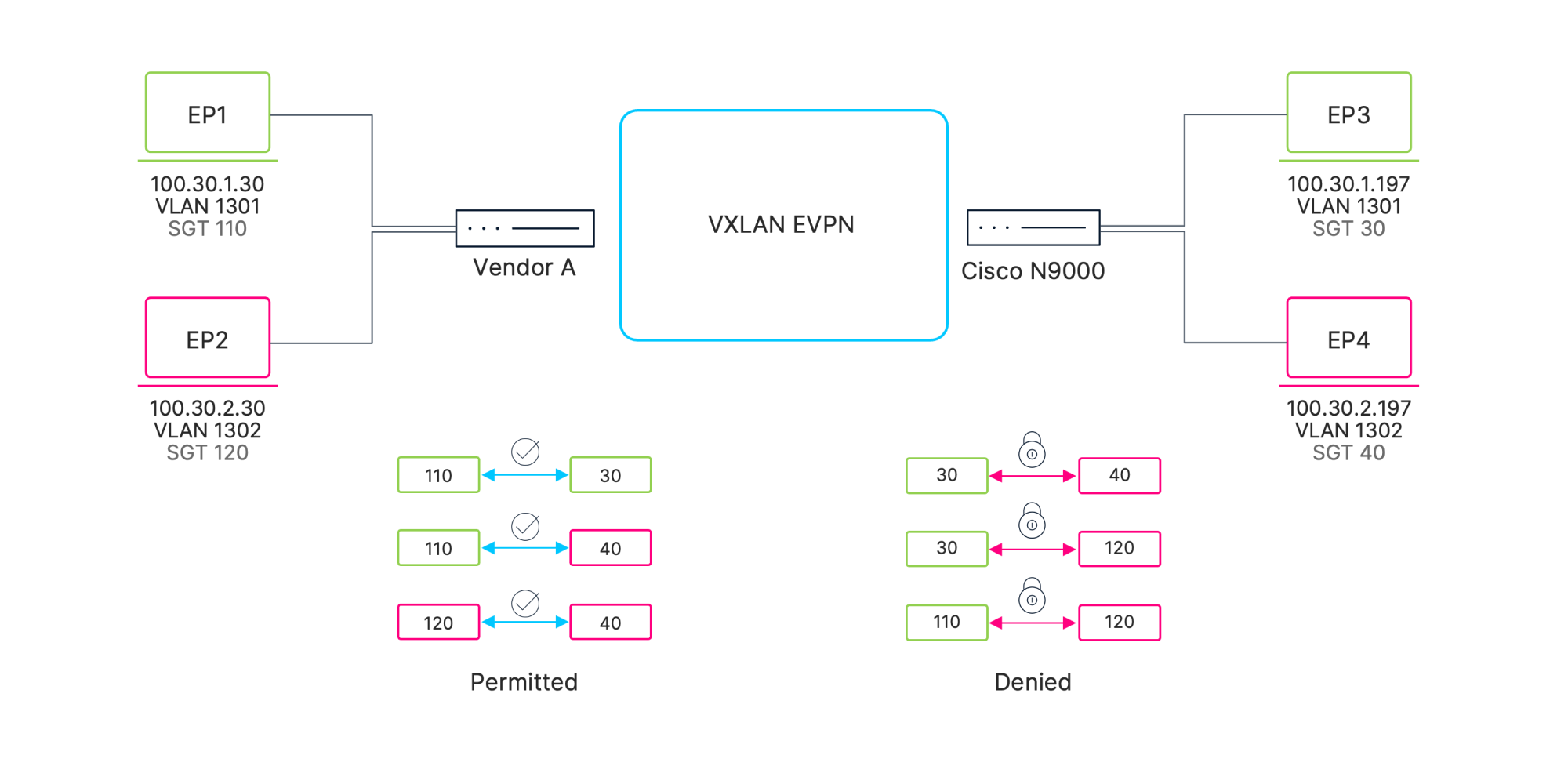
The VXLAN Group Policy enables the classification of connected endpoints (EPs) and external resources into distinct Security Groups (SGs). By defining and applying Security Group ACLs (SGACLs) between these groups, administrators can effectively govern communication across the fabric. Figure 2 shows that a device from Vendor A can send traffic to a Cisco N9000 switch across a VXLAN EVPN fabric, and the security rules (based on the Security Group Tags) will still be enforced correctly to permit or deny communication between the EPs.
These constructs provide a robust solution for Cisco NX-OS-based standalone N9000 switches to ensure consistent security posture. As an early adopter of VXLAN Group Policy Option (GPO), Cisco successfully demonstrated interoperability with other vendors that are now developing similar feature sets.
Interoperability between symmetric and asymmetric IRB
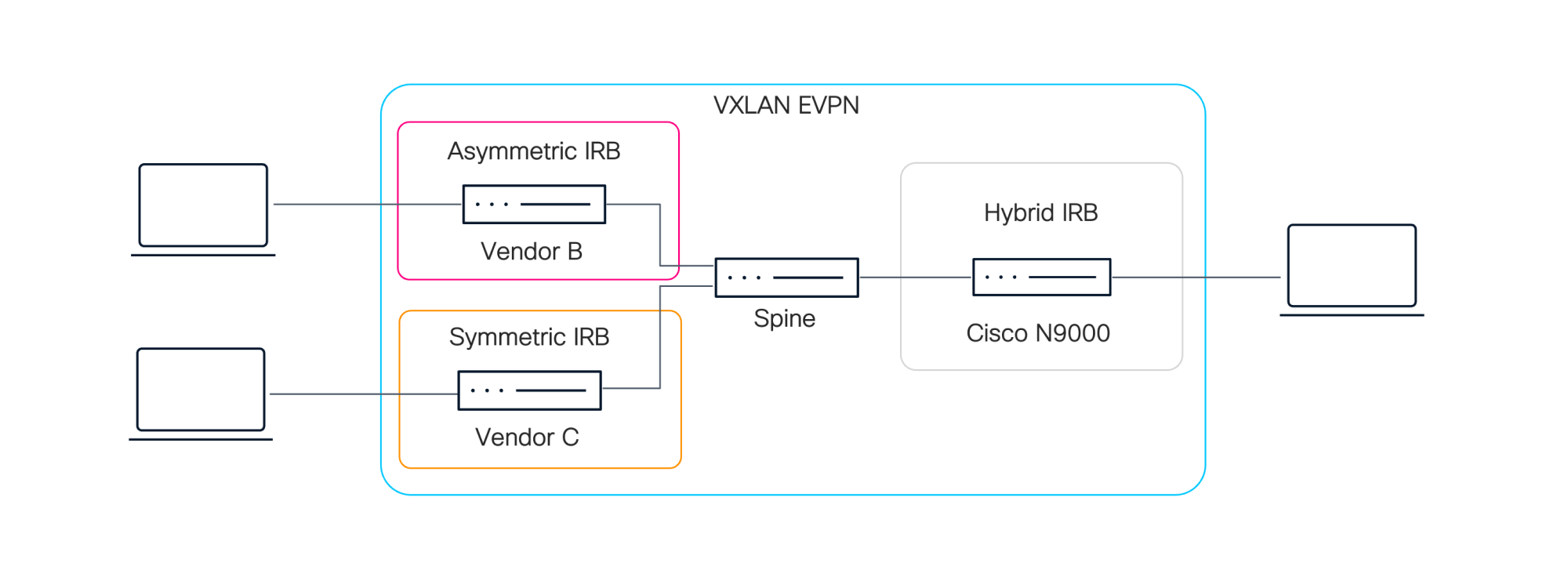
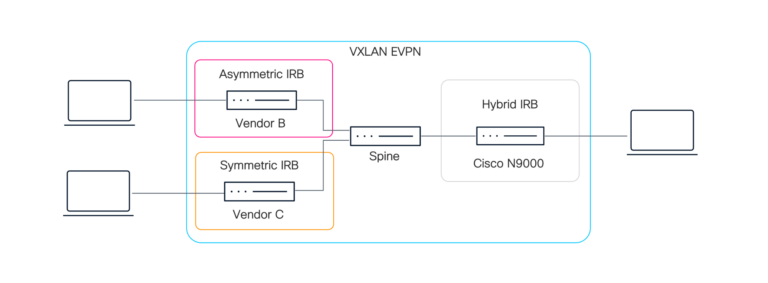
Integrated Routing and Bridging (IRB) operates in two primary modes: symmetric and asymmetric. In real-world deployments, it is common to encounter environments where devices within the same EVPN domain are configured with different IRB modes. To ensure seamless communication, these modes must interoperate in accordance with the standards defined in draft-ietf-bess-evpn-modes-interop. During the testing, Cisco showcased successful end-to-end interoperability in a hybrid scenario, where a Cisco device functioned seamlessly alongside a partner vendor configured for asymmetric IRB (Figure 3).
N9300 Series Smart Switches and VXLAN EVPN test
Today’s data center operators need simpler, more secure ways to scale their environments without the complexity of managing multiple, disparate security solutions. Cisco redefined data center networking with the N9300 Series Smart Switches, a single platform that unifies networking and security into a unified, future-proof architecture.
The N9300 Series provides robust Layer 4 segmentation across both single- and multi-fabric deployments. By embedding advanced security directly into the fabric, this platform enhances visibility and reduces total cost of ownership (TCO).
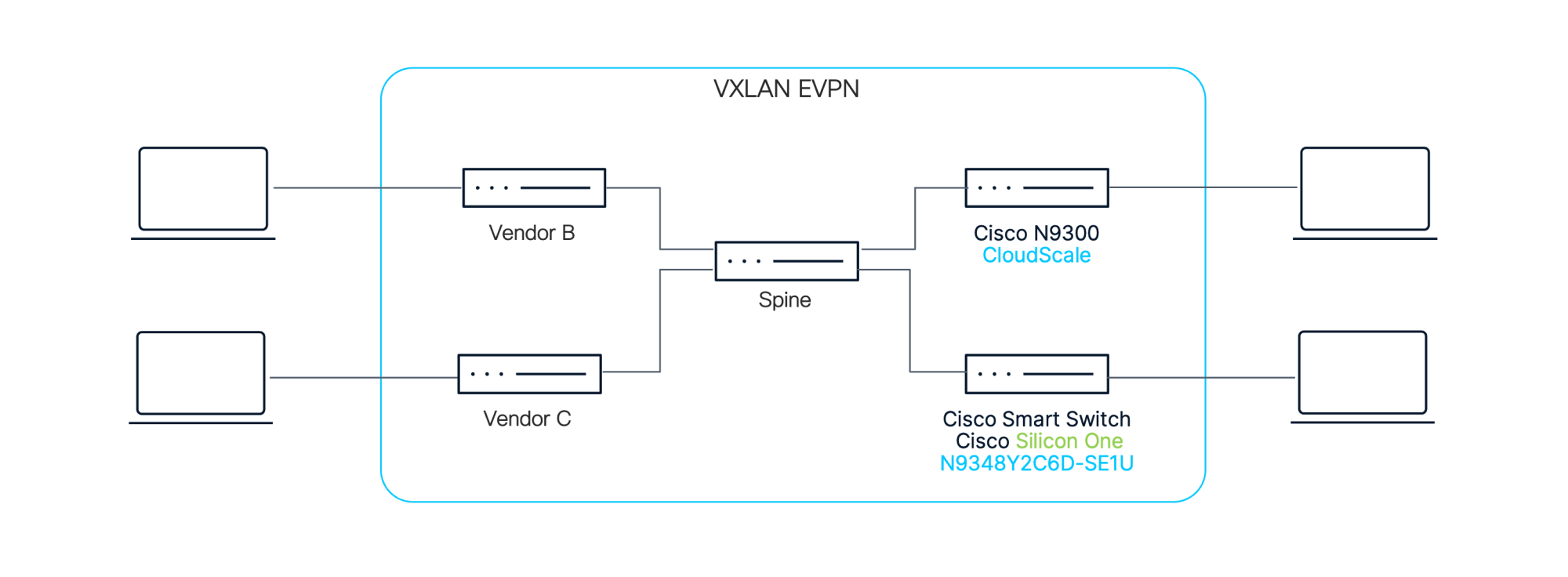
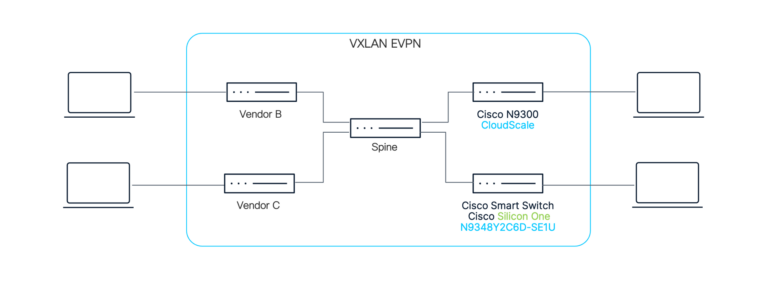
This commitment to integrated security was further validated during the recent EVPN interoperability tests, where Cisco successfully participated in the Symmetric IRB test with the Cisco Silicon One–based N9348Y2C6D-SE1U smart switch (Figure 4).
PTP over MACsec
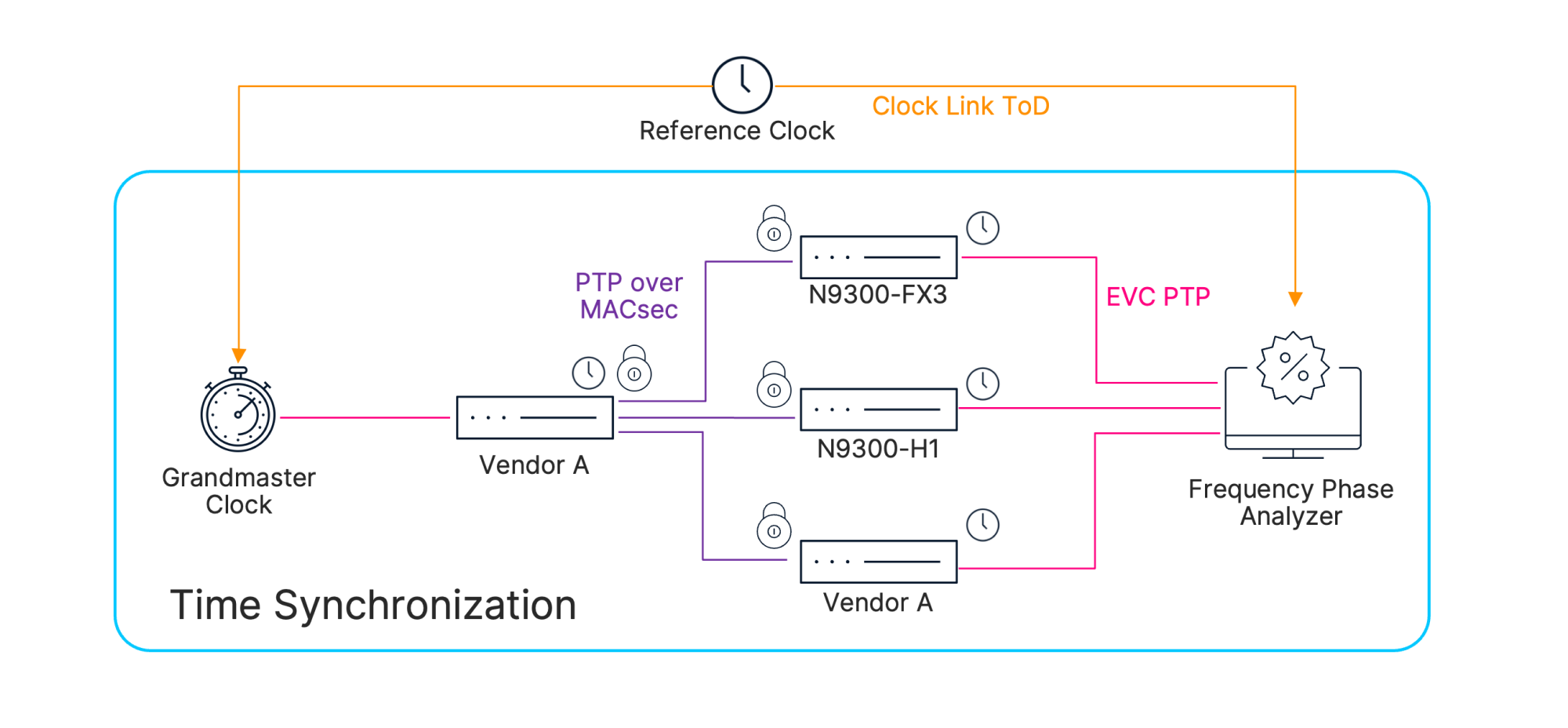
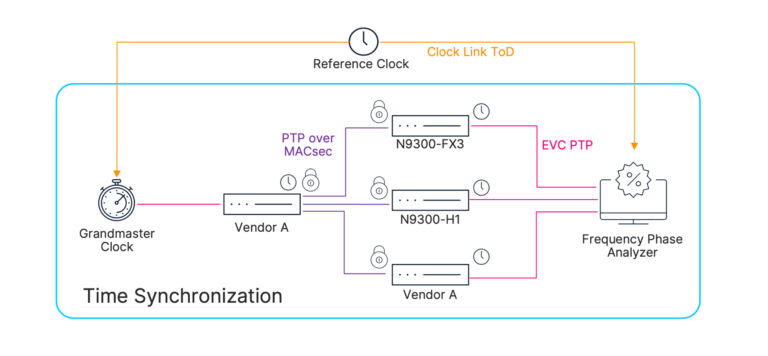
MACsec (IEEE 802.1AE) secures Precision Time Protocol (PTP) traffic by providing Layer 2 encryption, ensuring confidentiality and integrity while protecting against eavesdropping and tampering. Cisco successfully exhibited PTP operation over MACsec at 100GE using the N9K-C93400LD-H1 and N9K-C93180YC-FX3 switches (Figure 5).
While enabling MACsec introduced inherent path asymmetry and time error, Cisco precisely characterized these effects and applied the necessary delay and asymmetry compensation to meet the test’s rigorous timing performance requirements. These results mark a significant advancement in PTP security, confirming that functional interoperability can be achieved over MACsec without compromising the strict time-error limits required for demanding synchronization applications.
The power of multivendor choice
Interoperability empowers organizations to mix and match technologies to align with specific business requirements, whether they are adopting new innovations or refreshing existing infrastructure. This is where VXLAN BGP EVPN multivendor interoperability testing is essential, as it validates how solutions from different manufacturers function together in real-world scenarios. This year, 12 vendors, including Cisco, participated in these rigorous tests. As an industry leader, Cisco remains a dedicated participant in these interoperability events and continues to contribute actively to global standardization bodies (Figure 6).
From EANTC to the Upperside World Congress
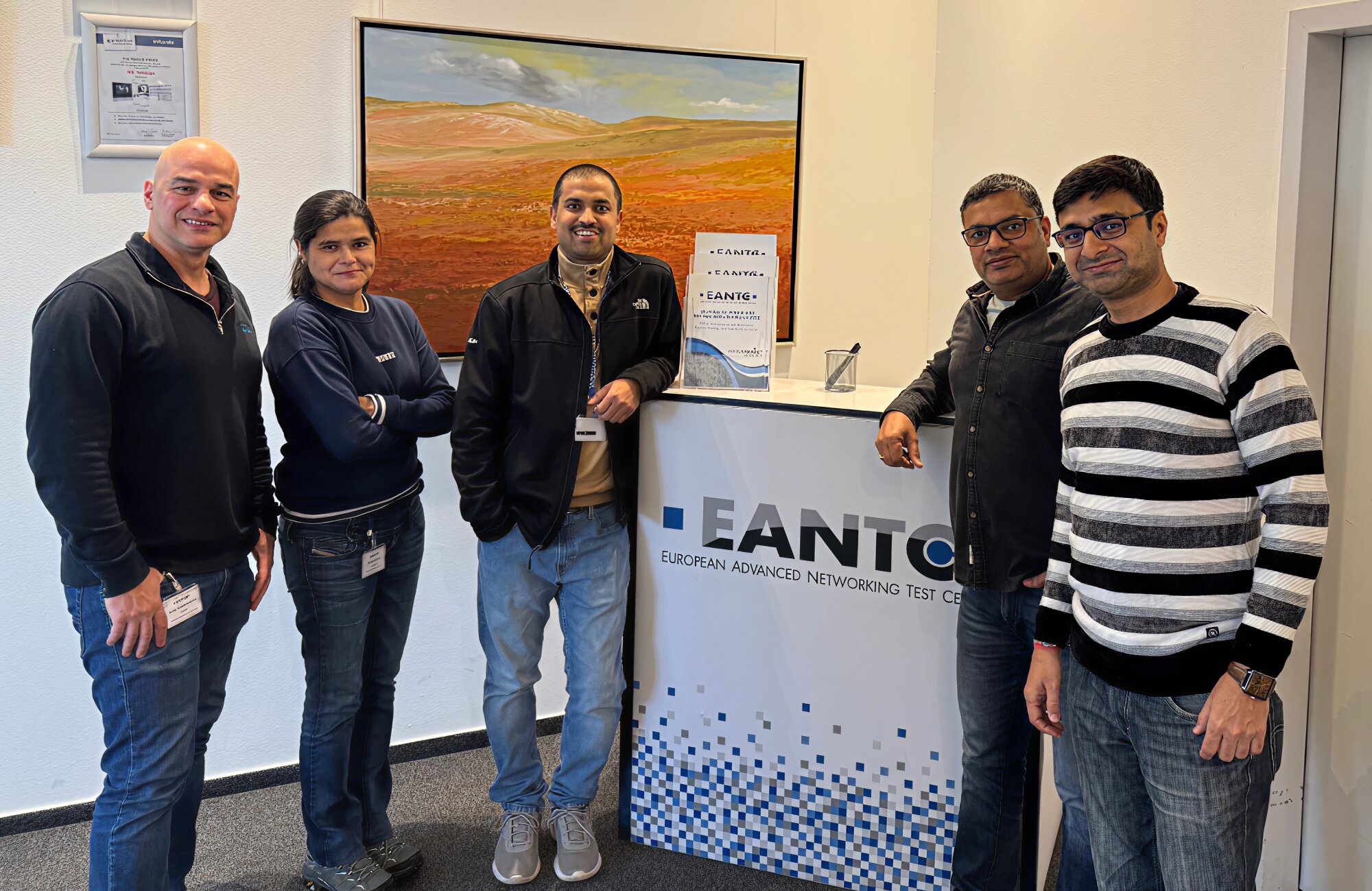
After successfully hot staging the Cisco N9300 Series Switches at EANTC in Germany (Figure 7), Cisco also showcased a live demo on the VXLAN GPO interoperability at the Upperside World Congress (formerly the MPLS World Congress) in Paris, March 24–26. The demo video highlights this interop test case.
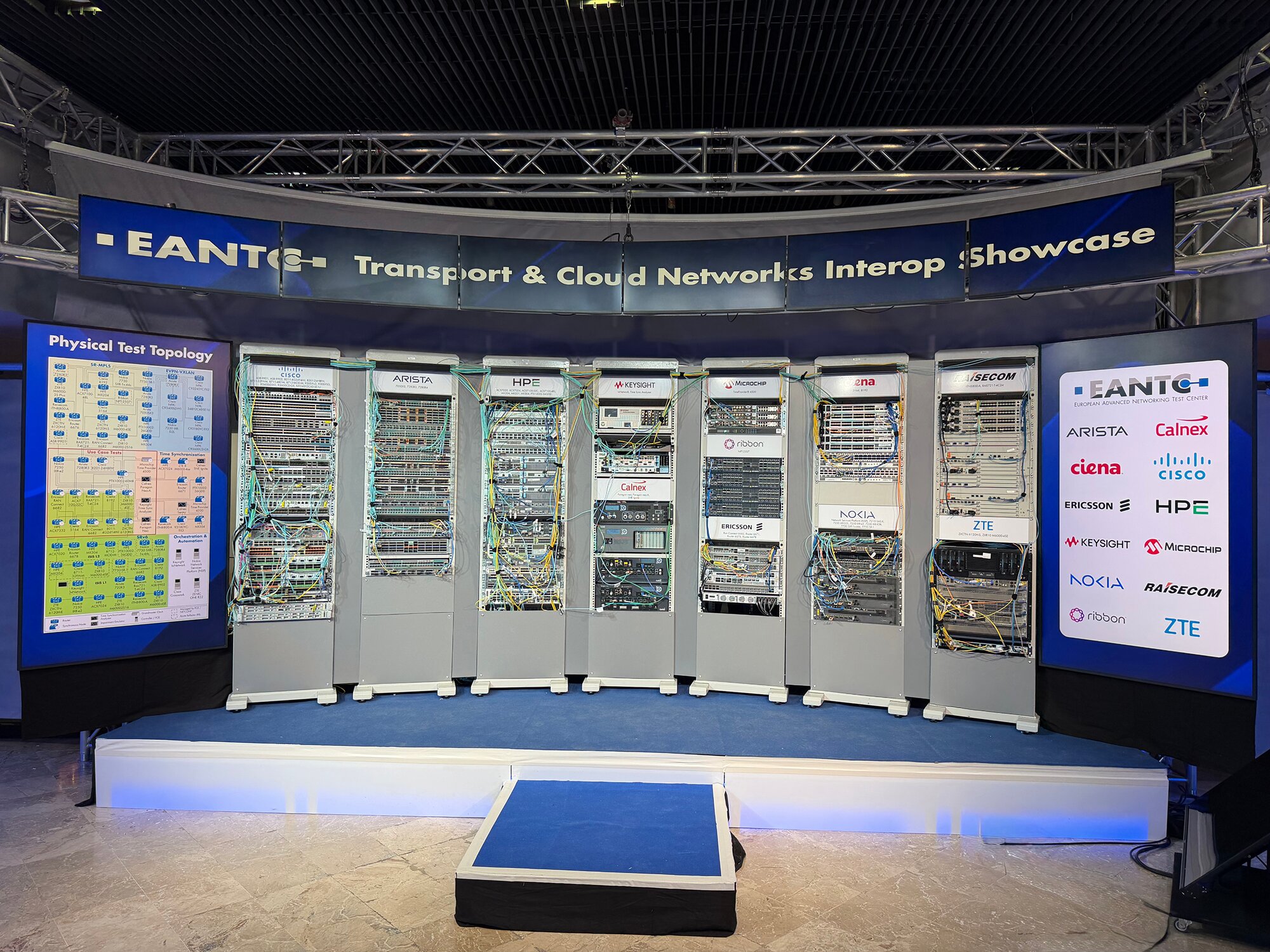
EVPN continues to evolve, proving its versatility and widespread adoption through successful multivendor interoperability events like those hosted by EANTC. While the standard continues to be refined by its original authors, the participation of a dozen vendors proves that it has broad industry acceptance. Looking ahead, each new year and set of test scenarios will undoubtedly drive further innovation, uncovering new use cases and solutions that are essential for customer success.
For more details on the test results, read the full EANTC-Interop 2026 report.
Architecting the AI-ready data center for the future
Cisco delivers an open, interoperable architecture designed to scale innovation across your entire ecosystem—from the data center to the edge. We’ve eliminated the compromise between high performance and ironclad security by infusing security directly into the network fabric. With Cisco, you are doing more than building a network; you are architecting the intelligent, resilient future of your enterprise.
Find out more about accelerating AI deployments at scale in your data center
Additional resources:
- Securing Data Centers with Microsegmentation using VXLAN GPO
- Cisco Unveils the Latest Security Innovations for Modern Data Center Networks
- EANTC 2026: Showcasing Cisco’s Timing & Synchronization Excellence in Multi-Vendor Interoperability
- Cisco Leadership in SRv6 Interoperability: EANTC 2026 Report
- Cisco 8000 at EANTC Multivendor Interop Event 2026
- From Interoperability to Insight: Crosswork Assurance at EANTC 2026


