Encrypted data traversing your WAN today is already vulnerable to future quantum decryption. Cisco’s new CNSA 2.0 blueprint for Cisco 8000 Series Secure Routers delivers a practical, standards-based path to safeguard your routing infrastructure against harvest now, decrypt later (HNDL) attacks.
CNSA 2.0: The deadline driving enterprise action
In his Cisco Live keynote, Chuck Robbins noted, “Quantum is the next major technology disruption.” In almost every post-quantum cryptography (PQC) session I lead with network architects, that reality dominates our discussion: the security risks are arriving before the actual rewards of quantum.
In Part 1 of this series, we explored how threat actors are executing HNDL attacks—stealing encrypted data today and waiting for the day when a cryptographically relevant quantum computer (CRQC) can break it, often called “Q-Day”. The goal for enterprise networks must be a full transition to PQC.
Under the National Security Agency’s Commercial National Security Algorithm Suite 2.0 (CNSA 2.0) mandate, national security systems must ensure all new purchases are quantum-safe by 2027, with a full transition by 2031. While this mandate directly governs federal networks, it sets the de facto timeline for commercial enterprises—especially across finance, healthcare, utilities, and transport where data confidentiality and hardware longevity must span decades.
Your blueprint for quantum resilience
To help organizations navigate this transition, Cisco is introducing the industry’s first comprehensive blueprint for quantum resilience on Cisco 8000 Series Secure Routers (Figure 1).
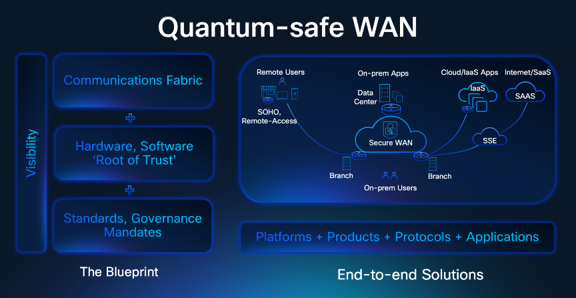
Figure 1. Cisco multilayered quantum defense: Hardware root of trust → control and data plane communications across secure WAN
Every network layer that relies on classical public-key cryptography (RSA and elliptical curve) must modernize. Our blueprint delivers an unbroken chain of trust across three core pillars:
- Hardware root of trust: Securing the foundational bootloader and operating system from initial device power-on.
- Control and data plane encryption: Protecting transit traffic against passive eavesdropping and HNDL interception.
- Crypto-agility and visibility: Practical phased migration and end-to-end visibility to audit, track, and verify cryptographic posture in real time.
Built strictly on open NIST and IETF standards, this architecture delivers market-leading quantum protection with full multivendor interoperability across the entire enterprise routing stack covering platforms, products, protocols, and applications.
Comprehensive post-quantum capabilities in IOS XE
Starting in Cisco IOS XE software releases 26.1 and 26.2, we have integrated the latest NIST-standardized algorithms directly into the protocols your WAN relies on every day:
ML-KEM (FIPS 203) encryption for data in transit
To protect data in transit against HNDL attacks, Cisco has implemented the Module-Lattice-Based Key-Encapsulation Mechanism (ML-KEM). This ensures quantum-safe key exchanges across a comprehensive suite of WAN and management protocols, including:
- Enterprise WAN and SD-WAN: IKEv2 IPsec, DMVPN, FlexVPN, and Catalyst SD-WAN IPsec
- Line-rate link security: LAN and WAN MACsec (IEEE 802.1AE)
- Secure management: SSH and TLS 1.3 control sessions
ML-DSA (FIPS 204) authentication for PKI-based VPNs
Classical digital signatures (RSA/ECDSA) are vulnerable to real-time quantum forgery. In Cisco IOS XE release 26.2, Cisco integrated the Module-Lattice-Based Digital Signature Algorithm (ML-DSA) to secure PKI-based site-to-site VPNs. By adopting ML-DSA, organizations ensure that router identities, certificate enrollments (EST/SCEP), and IKEv2 tunnel authentications remain immune to quantum impersonation, maintaining an uncompromising zero-trust posture.
Quantum-safe secure boot for hardware integrity
Hardware lifecycle management is a critical vulnerability in the quantum transition. The routers you deploy today will likely still be in your network when Q-Day arrives. If an adversary compromises firmware verification, they gain persistent sub-OS control.
To ensure immutable hardware integrity throughout a router’s operational lifespan, Cisco has engineered an industry-first quantum-safe secure boot for Cisco 8000 Series Secure Routers (Figure 2):
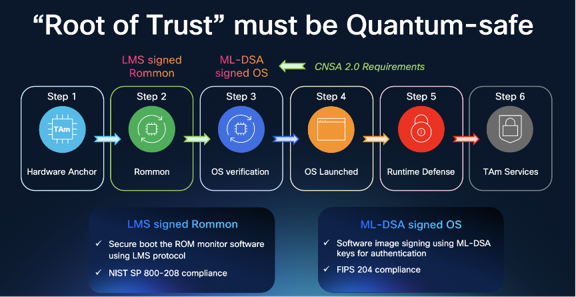
Figure 2. The unbroken boot chain of trust: Hardware anchor -> LMS signed ROMMON -> ML-DSA signed IOS XE
- LMS (NIST SP 800-208) signed ROMMON: We use stateful, hash-based Leighton-Micali Signatures (LMS) to sign and validate the ROMMON software, securing the foundational hardware bootloader
- ML-DSA (FIPS 204) signed IOS XE: We utilize ML-DSA to authenticate the IOS XE software image at every OS reload
Zero architectural disruption with hybrid PQC
Enterprise architects cannot simply flip a switch and migrate a global WAN overnight. Interoperability and backward compatibility are essential.
Cisco delivers hybrid PQC based on RFC 9370, combining classical key exchange (such as Diffie-Hellman / ECDH) with post-quantum KEMs (ML-KEM-768/1024) in a single handshake (Figure 3).
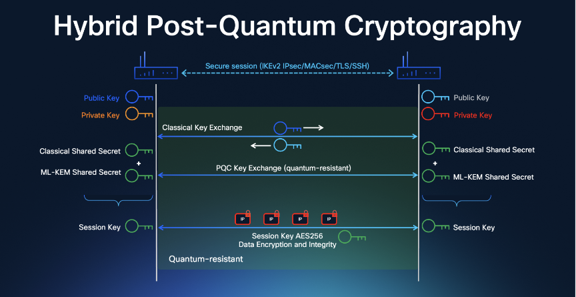
Figure 3. Hybrid PQC dual key exchange (Classical + ML-KEM) deriving a single quantum-resilient session key
This hybrid approach allows your infrastructure to maintain strict compliance with existing FIPS 140-3 mandates while seamlessly layering on quantum protection, preventing data drops and ensuring phased, risk-free migration across multivendor networks.
A new mindset for NetOps and SecOps
As AI-driven attack tools accelerate vulnerability discovery, adversaries will increasingly target cryptographic weaknesses. To stay ahead, NetOps and SecOps teams need to shift toward crypto-agility: the operational capability to rapidly adopt, update, and rotate cryptographic algorithms through software configuration without hardware replacement.
We built the Cisco 8000 Series Secure Routers to be powerful, flexible, and purpose-built for the crypto-agile future that is now mandatory (Figure 4).
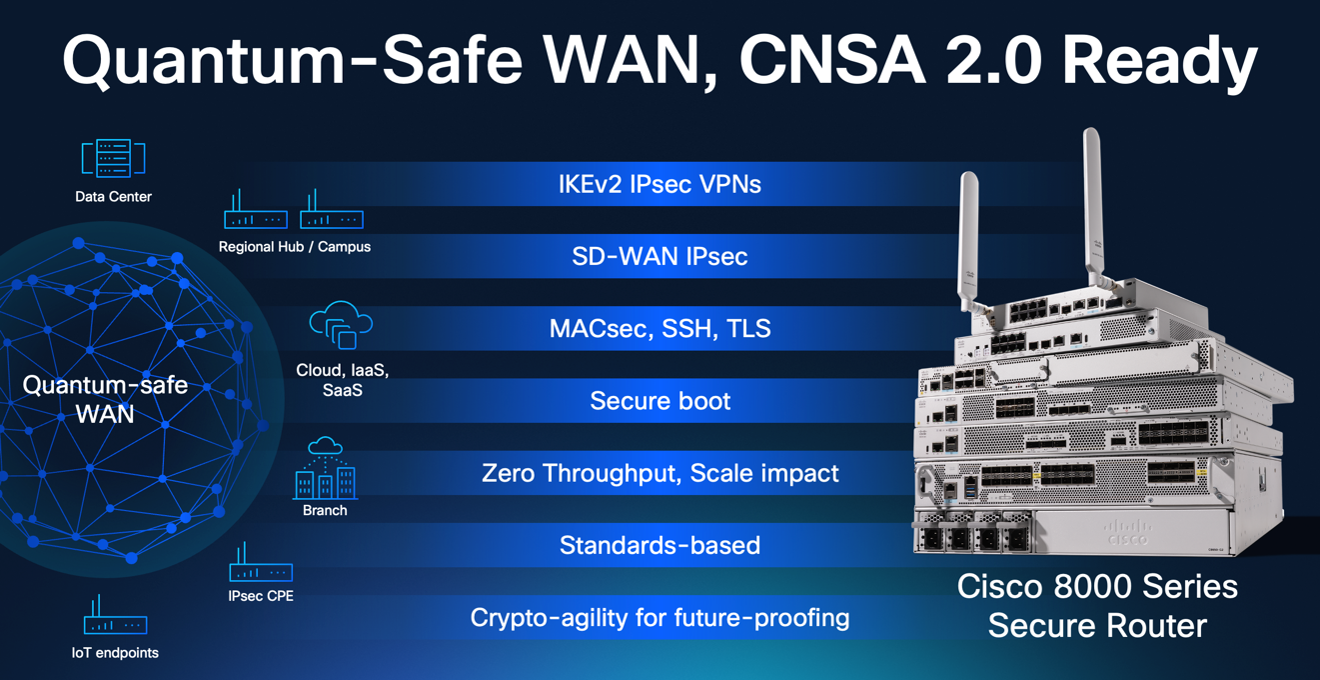
Figure 4. Cisco 8000 Series Secure Routers family across branch, campus edge, and data center
Security benefits of Cisco 8000 Series Secure Routers in the quantum era include:
- Immediate protection against harvest now, decrypt later (HNDL) data theft to safeguard long-term data confidentiality
- Hybrid PQC for phased migration to seamlessly bridge current FIPS 140-3 compliance with quantum safety
- Accelerated hybrid cryptography with high computational power to ensure performance does not degrade during dual-handshake key exchanges
- Dedicated crypto engines built to handle the heavy lifting of line-rate payload encryption without data-plane throughput penalties
- An immutable trust anchor that establishes a foundational root of trust for quantum-safe firmware and software verification
- Standards-based interoperability validated to work across your broader multivendor ecosystem
- Built for a crypto-agile future with a roadmap of incremental defense enhancements designed for the evolving quantum era
The time to act is now: Your three-step migration plan
The quantum threat is not a distant hypothetical—it is an active risk to data confidentiality today. Network and security leaders should take three practical steps now:
- Audit your cryptographic inventory: Identify where legacy public-key algorithms protect high-value, long-retention enterprise data. You can begin with the Cisco IQ Quantum Readiness Assessment.
- Prioritize the WAN edge: Begin by deploying quantum-safe transit encryption (ML-KEM) across external, untrusted WAN and cloud-interconnect links.
- Activate PQC on your Cisco 8000 Series Secure Routers: With Cisco IOS XE 26.1 and 26.2, you can enable hybrid PQC and quantum-safe secure boot today through simple software configuration—achieving immediate CNSA 2.0 readiness with zero architectural disruption.
References:
Crypto Agility: Why PQC Is Not a One-Time Upgrade
Safeguard Your WAN from Quantum Computing Threats, Part 1
The Journey to Post-Quantum Cryptography in WAN Infrastructure (PDF)
The Journey to Post-Quantum Cryptography in WAN Infrastructure
Get white paper (PDF)

Get More from Cisco Networking
Customer stories, technical demos and more await!
Check out our Networking video channel
Multidomain Architecture
Learn how to integrate your networking domains and get more out of an enterprise-wide, intent-based network.
Discover multidomain integration