


Ask a network architect what their data center will run in three years, and you’ll get an honest answer: they don’t fully know. Virtual machines, certainly. Kubernetes, absolutely. Bare metal will remain essential. AI will add new traffic patterns and new operational pressure. The architecture still has to behave like one system.
In his recent post, Will Eatherton described Cisco Nexus One, our next-generation data center networking architecture built for standardization, flexibility, and choice. That matters because the hardest networking problem in the private cloud is no longer connecting a single environment. It is about interconnection and simplifying operations across all the environments customers already have and the ones they are adding next in a consistent, secure, and scalable way.
A few recent developments extend this architecture from the fabric up into the platforms that run on it. The first is Cisco Nexus One interoperability with VMware Cloud Foundation (VCF), announced in November 2025 and now reflected in the standards-based fabric model in VCF 9.1. The second is Cisco’s integration of Isovalent Networking for Virtualization with Nexus One, introduced at Cisco Live 2026. One extends the Cisco Nexus One operating model into VCF private cloud. The other brings Kubernetes-hosted virtual machines and pods into that fabric as first-class participants. Together, they demonstrate what Nexus One was designed to be: a unified network architecture that helps teams operate heterogeneous infrastructure as one system.
Private cloud is heterogeneous by design
Most enterprises are not choosing between virtual machines and containers, or between brownfield and greenfield. They are running them together. A single application may span a VCF-based VM tier, Kubernetes services, physical databases, storage, security appliances, and increasingly, AI infrastructure. Each domain can be well automated on its own, yet the boundaries between them still create static mappings, gateway dependencies, fragmented policy, and blind spots during troubleshooting.
For a decade, connecting a virtualized private cloud to the network fabric meant stitching two worlds together at fixed points. Reachability between virtual and network fabric was configured statically VLAN by VLAN, VRF by VRF. And each side ran its own control plane, its own tooling, and its own on-call rotation. It worked, but every application change that crossed the boundary carried coordination overhead, and every packet that crossed it took a detour through a centralized choke point.
Cisco Nexus One and VCF: Open at the control and data planes
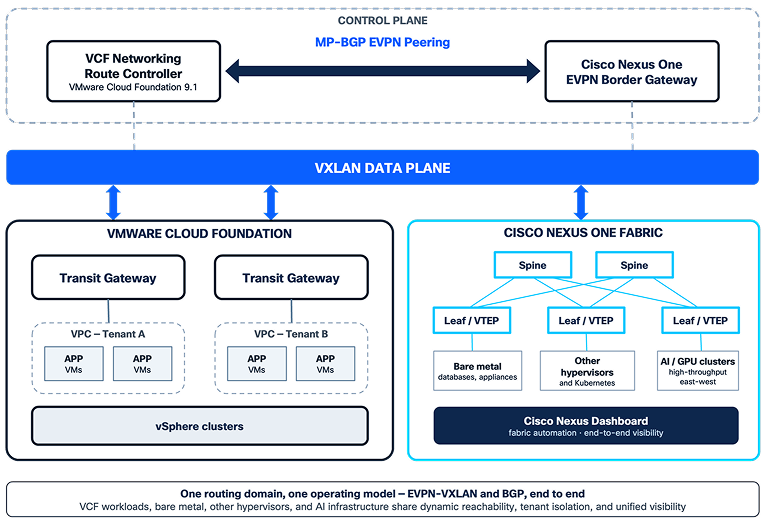
With VCF 9.1 and shipping Cisco Nexus One, that boundary effectively disappears. The Cisco–Broadcom work starts with protocols the industry already knows. The VCF Networking Route Controller peers directly with a Nexus One EVPN Border Gateway using MP-BGP EVPN. Each VCF Transit Gateway is associated with the corresponding Layer 3 VNI in the fabric, so tenant isolation carries through one-to-one. EVPN Type 5 routes dynamically exchange VCF workload prefixes and external fabric prefixes. And in the data plane, VXLAN provides direct Layer 3 reachability from the ESX transport endpoint to the fabric Border Gateway. This connectivity removes dedicated edge nodes from the distributed data path, reducing infrastructure footprint, and avoiding a centralized scale point in the virtual infrastructure.
Most importantly, this is not proprietary stitching. The integration runs on standard, shipping Nexus One capability, the same EVPN Border Gateway function Nexus customers already deploy with no bespoke integration layer on the fabric side. It works off the shelf, on the hardware customers already own, and EVPN-VXLAN and BGP form a durable contract between VCF Networking and the fabric.
What this means for your teams
- Network teams keep one architecture. The same topology, protocols, and configuration practices apply across virtual and physical workloads with end-to-end visibility.
- Cloud and VCF admins keep the VPC-based self-service consumption they expect. Application teams deploy VPCs and workloads without needing deep networking expertise or virtual appliance management because dynamic route exchange has replaced the static, manual work that used to sit between the domains.
- The business gets performance and economics. Host-to-fabric connectivity maximizes throughput for VM and AI traffic, while eliminating edge node infrastructure reduces both capital cost and the operational overhead of managing it.
Open standards create choice. The operating model creates advantage.
Cisco engineers have led the industry’s EVPN work from BGP EVPN (RFC 7432) to its data center overlay application (RFC 8365), and VXLAN itself (RFC 7348) was co-authored by engineers from Cisco and VMware. Cisco continues to contribute innovations such as Group Policy for standards-based segmentation to the IETF.
Cisco Nexus One encompasses and extends Cisco ACI, supports NX-OS and SONiC choices, and brings on-premises and cloud-managed operating models through Nexus Dashboard and Nexus Hyperfabric respectively. It carries forward brownfield investments while standardizing how fabrics interconnect. The VCF integration shows what that foundation is for: the same fabric, the same EVPN control plane, and the same operational tooling now serve vSphere-based private clouds alongside bare metal, other hypervisors, and AI infrastructure—any workload, any hypervisor, one operating model.
One foundation for what comes next
The private cloud will continue to evolve. Kubernetes platforms and CNIs will mature. AI will add new traffic patterns, security requirements, and operational pressure. The network cannot be redesigned every time one of those layers changes.
That is the larger Nexus One story. It is an architecture designed to meet customers where they are, connect the environments they run today, and preserve a consistent network operating model as those environments evolve. VCF and Isovalent integration with Cisco Nexus One are proof points.
See it at VMware Explore
If you’re at Explore this week: visit us to see the VCF and Cisco Nexus One integration live. The future of the data center network is open, identity-aware, and unified—and it’s shipping today.
Meet the Experts: VCF Networking & Physical EVPN Integration with Cisco Nexus [CLOM1543LV]
Skip the slides and join our whiteboard roundtable to address your toughest connectivity and routing challenges in a small-group discussion.
📅 Tuesday, Sep 1 | 1:00 PM – 1:30 PM PDT | Titian 2201B, Table 1
AI-Ready Private Cloud with Cisco and VMware [CLOB2686LV]
Join Lukas Krattiger (Cisco Fellow) and Sabina Anja (Chief Technologist, VCF, Broadcom) for an unscripted technical talk on self-service VPCs, zero-trust security, and fabric-wide automation.
📅 Wednesday, Sep 2 | 10:15 AM – 11:00 AM PDT
📍 Bellini 2105, Level 2


