


Midsize CIOs are being asked to deliver enterprise-grade security, AI adoption, operational resilience, and employee experiences—without enterprise-sized teams or budgets.
The challenge is rarely a lack of ideas. It is translating sound architectural guidance into a practical sequence that works with the people, infrastructure, and investments already in place.
Cisco’s new Midsize CIO Blueprint series is designed to help close that gap. Created by the Cisco team focused on small, midsize, and growing organizations, the five guides turn proven enterprise-grade architectural patterns into phased plans that lean IT teams can use to address their most pressing priorities.
Written for the way you actually deploy
You do not need to begin with a greenfield environment or commit to a large transformation program. Start with your current environment, identify the phase that fits, and advance as business value and requirements justify the next step.
Each blueprint combines an executive-level business case with a phased approach that IT teams can evaluate and execute. The guidance begins with the capability required and the criteria to consider before introducing a Cisco architecture.
That makes the series useful even if you operate a mixed environment, rely on another vendor in parts of your infrastructure, or work with a managed service provider. Keep what is working, identify the gaps that matter, and adopt the phases that support your business priorities.
Estimated read time for each blueprint is 15-20 minutes.
Choose the blueprint that matches your priority
| If your immediate priority is… | Start with… |
| Reducing operational complexity and tool sprawl | Run Lean: Turning Operational Simplicity into Compounding Value |
| Strengthening resilience against faster-moving threats | The Lean AI-Era Cyber Defense |
| Enabling AI adoption while improving visibility and governance | Accelerate AI First, Govern as You Grow |
| Modernizing your data center for AI and other demanding workloads | The Lean AI-Ready Data Center |
| Improving hybrid meetings and simplifying collaboration operations | Make Every Meeting Equal |
Run Lean: Turn operational simplicity into compounding value
Point solutions may look affordable individually. Their larger cost emerges between the tools: separate consoles, duplicated policies, manual handoffs, longer troubleshooting cycles, and specialized skills for every platform.
That is the fragmentation tax.
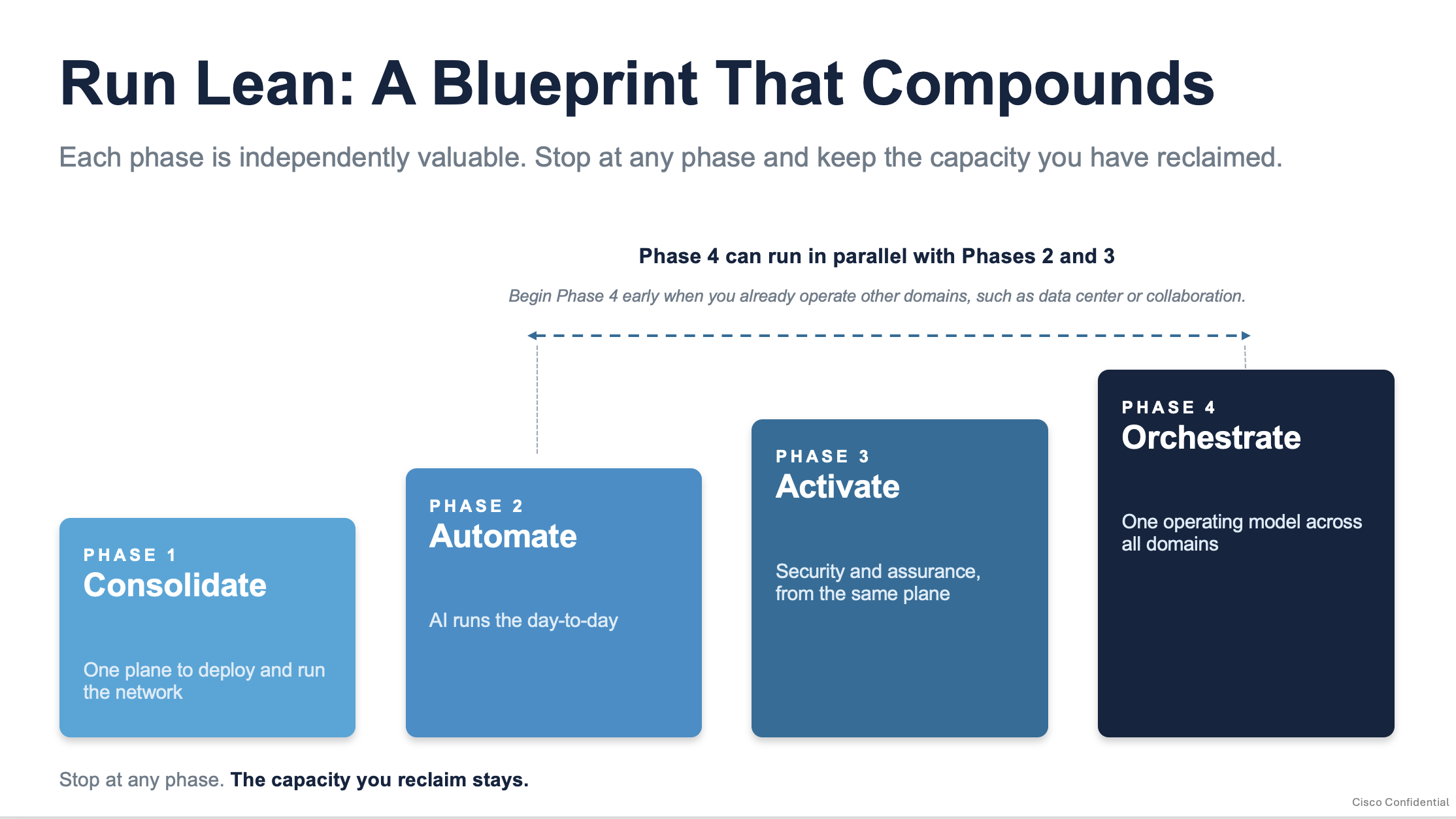
The Run Lean blueprint addresses it through four phases: Consolidate, Automate, Activate, and Orchestrate. It helps CIOs identify where complexity is consuming capacity and build an operating model in which every added capability increases the value of existing investments.
Read the Run Lean blueprint →
https://www.cisco.com/c/dam/en_us/partners/downloads/run-lead-cio-blueprint.pdf
The Lean AI-Era Cyber Defense
AI is accelerating security innovation—and attacker activity. Lean teams can no longer depend on manual processes and reactive patching to keep pace.
The priority is resilience: reducing exposure, verifying defenses, and containing incidents quickly. Through Assess, Modernize, Verify, Contain, and Outpace, this blueprint shows where aging infrastructure and fragmented controls create risk—and where modernization can make the greatest difference.
Read the security blueprint → https://www.cisco.com/c/dam/en_us/partners/downloads/lean-ai-cyber-defense-blueprint.pdf
Accelerate AI First, Govern as You Grow
Employees are already adopting AI, often through applications and accounts IT did not provision. Blocking usage can eliminate visibility without eliminating demand, while uncontrolled adoption puts corporate data at risk.
This blueprint offers a path to move quickly without losing control: gain visibility, give employees a preferred corporate experience, standardize usage, and apply governance as adoption grows. Invest in infrastructure only when a specific workload earns it.
Read the AI blueprint → https://www.cisco.com/c/dam/en_us/partners/downloads/accelerate-first-govern-grow-blueprint.pdf
The Lean AI-Ready Data Center
The Lean AI-Ready Data Center
Cloud-based AI may be the right choice today, but workload requirements can change quickly. The time to prepare your network is before a business-critical application is waiting for it.
Through Design, Deploy, Migrate, and Extend, this blueprint shows how a lean team can build and operate a modern, cloud-managed data center fabric. On-premises AI compute remains optional; readiness becomes part of the network rather than a future emergency project.
Read the data center blueprint → https://www.cisco.com/c/dam/en_us/partners/downloads/lean-ai-ready-data-center-blueprint.pdf
Make Every Meeting Equal
In a hybrid meeting, audio, video, applications, and network performance determine whether everyone can participate equally. A poor experience is both a productivity issue and an IT support burden.
This blueprint treats the meeting room as a managed network endpoint. Across Equip, Unify, Elevate, and Consolidate, it shows how AI-enabled experiences and integrated management can improve meetings while helping IT identify why they degrade.
Read the collaboration blueprint → https://www.cisco.com/c/dam/en_us/partners/downloads/every-meeting-equal-blueprint.pdf
Start with the environment you already have
These blueprints do not assume a hypothetical greenfield.
If you already use an identity provider, secure web gateway, management platform, collaboration suite, or other strategic technology, you may already have the foundation for one or more phases. The “Where to Start” guidance in each blueprint can help you identify that foundation and determine what should come next.
If your organization has standardized on a productivity suite, keep it and address the requirements that sit outside it. If you operate a mixed-vendor environment, apply the capability model while preserving investments that continue to deliver value. If you rely on a Cisco partner or managed service provider, use the phase boundaries as natural points for planning, validation, and review.
The aim is not to replace everything. It is to establish a practical sequence based on your current business priorities, operational capacity, and technology estate.
Choose your next step
Start with the blueprint that addresses the most urgent issue in front of you. Use its phased model and “Where to Start” guidance to assess where your organization stands today.
If you would like a second perspective, contact your Cisco account team or Cisco partner for a blueprint working session. Together, you can map your current environment to the relevant phases, identify important gaps, and define a practical next step—without assuming a greenfield redesign.
Request a blueprint working session →
We’d love to hear what you think. Ask a Question, Comment Below, and Stay Connected with #CiscoPartners on social!
Cisco Partners Facebook | @CiscoPartners X | Cisco Partners LinkedIn


