
AI-powered Radio Resource Management (AI-RRM) from Cisco has delivered measurable improvements in network performance while significantly reducing the time required for configuration. This feature, along with others in the portfolio, has become a fundamental rethinking of how wireless networks should be managed in an era where Wi-Fi is no longer a convenience but part of mission-critical infrastructure. AI-RRM is a fast-adopting AgenticOps solution—faster than other technology within Cisco. Today we are seeing thousands of customers achieving throughput increases with almost no effort other than configuring the solution on their dashboard.
Wi-Fi used to be “best effort.” That era is over.
For years, the industry operated under a quiet assumption: wireless is inherently imperfect, and users would tolerate it. Post-pandemic, that assumption collapsed. Employees now expect office Wi-Fi to perform at the same level as their high-speed home connection, where only a few devices connect vs. a campus network supporting hundreds or thousands. Hospitals, warehouses, and stadiums all run on wireless. “Best effort” is no longer a defensible design philosophy. Yet the dominant approach to managing wireless infrastructure, radio resource management (RRM), added a lot of complexity over time. Keeping up with emerging wireless technologies, such as 6 GHz, automated frequency coordination (AFC), Wi-Fi 7, and ultra-high-density deployments, makes it increasingly difficult for network administrators to achieve optimal network outcomes.
Optimizing with traditional RRM
Traditional RRM is fundamentally reactive and rule based. It works by taking periodic snapshots of the radio frequency (RF) environment and then applying a predefined set of algorithms with conditional weights and cost functions to adjust power levels, channel assignments, operational bandwidth, and radio configurations. However, traditional RRM must collect and recalculate the next-best RF parameter every 10 to 15 minutes, but doesn’t retain long-term RF trending data. It cannot differentiate between a Wednesday morning at 7 a.m. and a Wednesday afternoon at 3 p.m. It sees a snapshot, applies a rule, and makes a change, regardless of whether that moment is your network’s busiest hour.
The result? Traditional RRM could have been disrupting networks precisely when users needed them most. A reconfiguration triggered at peak hours intended to help was causing dropped connections and channel contention and disrupted real-time application performance. What was designed as an optimization mechanism could become a source of instability. Administrators often spend hours manually configuring channel assignments and transmit power levels to avoid interference.
Challenge 1: This service cannot go down—ever
RRM is not a peripheral solution. This version of Cisco RRM underpins a massive global installed base of access points. It manages channel assignments and power levels that are fundamental to radio operation. If the service fails, it significantly degrades wireless capacity and negatively impacts client experience.
That constraint defined the entire engineering challenge: how can our customers deliver 99.9995% service-level agreements (SLA) while dealing with a perpetually dynamic RF environment. Most artificial intelligence for IT operations (AIOps) solutions are additive. They sit alongside a network and provide insights. AI-RRM is different. It sits in the control path. The AI is not making a suggestion you can ignore; it is actively making a change that affects every radio in your deployment. Engineering for that level of criticality required an entirely different architecture than typical cloud AI services.
Challenge 2: Building one service that works everywhere
Cisco provides unified networking support for both enterprise and SMB environments, offering the flexibility to choose between cloud managed or on-premises managed networks. These platforms build a unified AI-RRM service that could serve both deployment models at scale, with consistent behavior, while adapting its recommendations to the specific organizational context of each customer segment. That meant the AI could not be “one-size-fits-all”—it had to be contextually aware of the network it was managing.
Challenge 3: RF context is not optional—it is everything
Large language models (LLMs) and generic AI platforms can process telemetry, but they aren’t designed to process millions of real-time RF telemetry data points. Wi-Fi operates over the air. You cannot see the medium and you cannot directly control the client. Setting a “30% performance improvement” SLA for wireless is inherently difficult because the RF medium introduces variables—interference, attenuation, client behavior—that are outside the direct control of the network operator.
Building AI that could make intelligent decisions in this environment requires deep domain expertise embedded into the model architecture—not borrowed from a general-purpose AI framework.
Challenge 4: How do you avoid making things worse?
Legacy RRM only had the benefit of the last 10 minutes of data. That’s 144 snapshots throughout the day. All organizations’ networks have different demands dynamically throughout the day; that’s the beauty of a “mobile” network. By trending the data, we have come to know that the normal rhythms of an organization demand much better. We can take the time to analyze the data and form an opinion on what’s normal for this network. This helps us make better decisions if a change is needed and when that change should be applied.
Because traditional RRM operates snapshots without trend awareness, it was generating unnecessary configuration changes. Each change carries a risk. In a high-density enterprise environment, a poorly timed channel change can cascade into widespread client disruption.
Trend-based optimization: Learning before acting
The foundational architectural shift in Cisco AI-RRM is the introduction of temporal awareness. Rather than reacting to instantaneous snapshots, AI-RRM continuously learns the behavioral patterns of each network over time.
The system observes RF conditions, client density, application demand, and interference patterns across a rolling time window. It builds an understanding of what “normal” looks like for your specific network, at your specific location, and at each specific time of day.
The practical outcome of this design is significant: AI-RRM learns during the day and optimizes at night. If your network’s peak utilization is between 3–4 p.m., the AI recognizes that pattern, holds off on disruptive changes during that window, and executes its optimization actions during low-traffic hours—typically overnight. This is the inverse of traditional RRM behavior, and it reflects a fundamental philosophical shift: do not disrupt the network when people need it.
AI-RRM does not rely on a single optimization algorithm. It runs six algorithms simultaneously, each evaluating different dimensions of RF performance—power levels, bandwidth optimization, channel selection, radio role assignment, and radio mode conditions. The orchestration layer determines which recommendations to apply, in what sequence, and with what priority.
Critically, Cisco has built a human-in-the-loop capability that allows network administrators to preview the impact of AI-driven changes before they are applied. This is addressed with power features such as AI-RRM Insights and RF Simulator. RF Simulator allows AI to evaluate the current RF profile configuration and service outcomes and advise customers to change the RF profile configurations for better Wi-Fi performance.
Customers can see exactly what the AI intends to change, why it intends to change it, and what the projected outcome is. This is not just a user experience (UX) nicety—it is the reason customers who were initially reluctant to enable AI services became confident adopters.
At its core, AI-RRM is continuously making four types of decisions for every radio in the network:
- Channel selection—which channel should this radio operate on given current and predicted interference patterns?
- Power management—which transmit power level balances coverage and co-channel interference for this radio at this moment?
- Bandwidth optimization—what is the optimal bandwidth required to handle future traffic requirements?
- Radio role assignment—should this radio be active or turned off? In high-density deployments, too many active radios create more interference than they resolve.
These decisions are made with per-radio granularity. AI-RRM is not applying a policy to a floor or a building; it’s making individualized decisions for each radio, informed by that radio’s specific history and its relationship with neighboring radios.
A single-service architecture across cloud and on-premises
One of the least discussed but technically demanding achievements is the unified service layer. AI-RRM operates as a single service that supports both Catalyst Center (on-premises) and the Meraki dashboard (cloud managed). The underlying AI models, telemetry pipelines, and optimization logic are shared and the deployment surface adapts to the platform. This means a small retail chain and a large university are both benefiting from the same AI capability—scaled and contextualized to their respective environments.
Meeting the SLA requirements for a service this critical required the team to architect specifically around failure scenarios. The AI service uses a closed-loop architecture that isolates failure domains, ensuring that the system defaults to safe, stable configurations, even in degraded states, rather than applying uncertain recommendations. The engineering discipline here was not just about uptime, it was about ensuring that when something goes wrong with the AI layer, the wireless network continues to function.
What customers get with Cisco
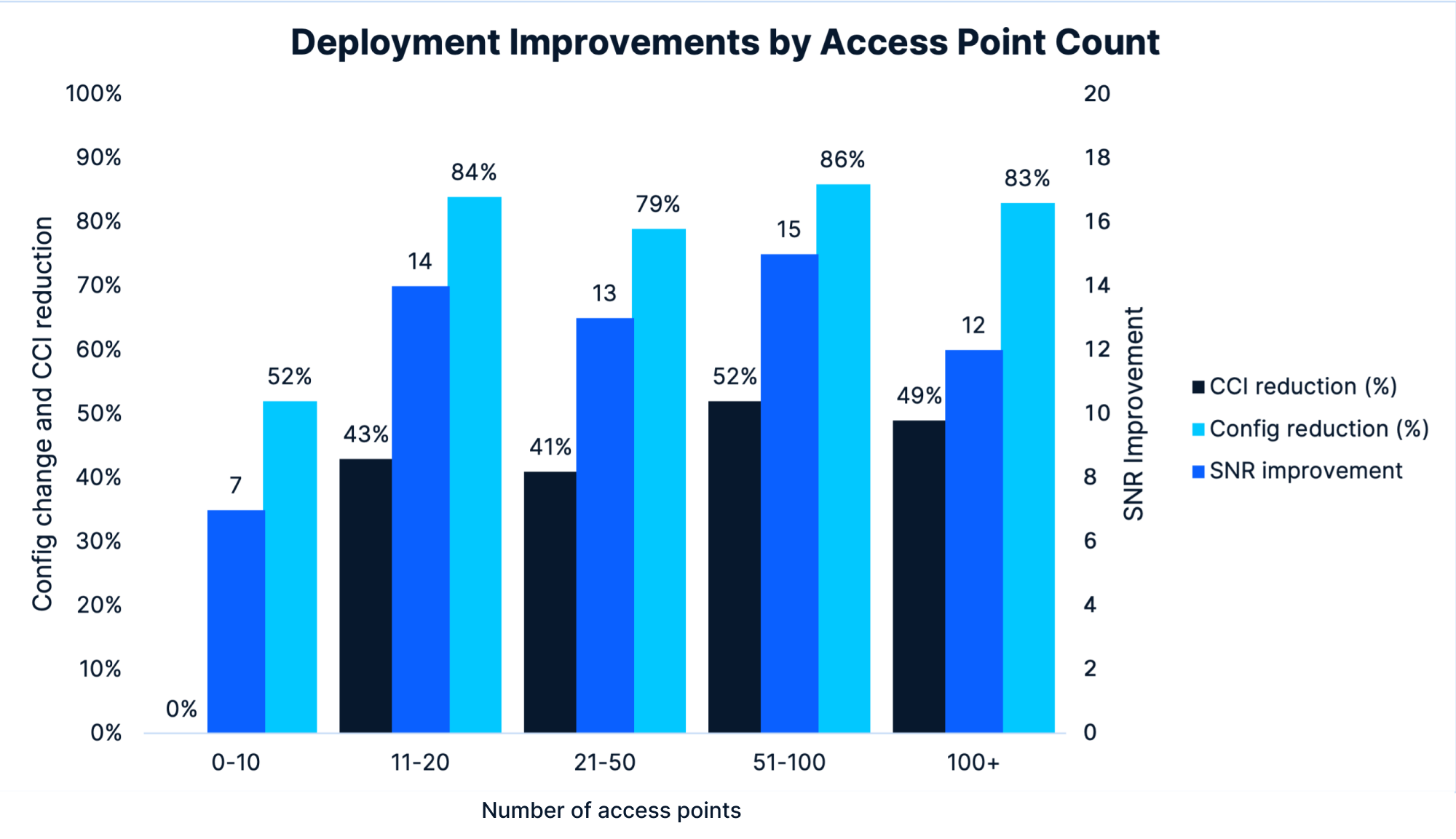
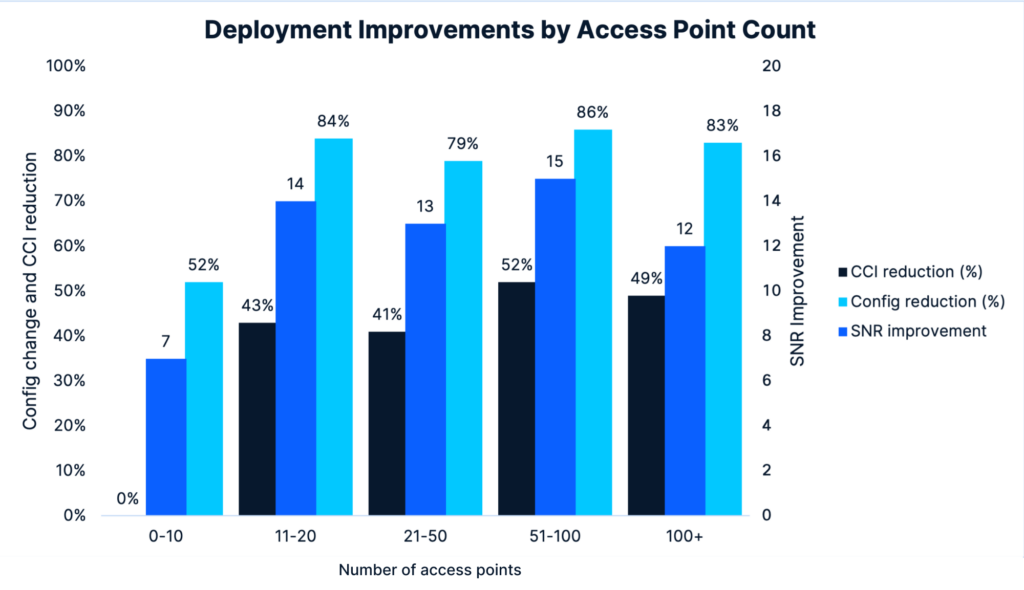
Cisco AI-RRM telemetry spans data captured from a large-scale global fleet of access points, and the outcomes being observed are measurable and consistent. On average, customers often see significant throughput improvements, with peak gains potentially reaching up to 10x, in wireless performance on AI-RRM-managed networks compared to traditional RRM baselines.
Application load times improve across the board and users experience faster Wi-Fi because the RF environment is better managed.
Before and after enabling AI-RRM
Cisco strategically empowers IT administrators to visualize the full impact of AI-RRM through concrete before-and-after comparisons highlighting key metrics such as RF score, co-channel interference, and channel changes. Most customers begin seeing measurable Wi-Fi capacity improvements within 24 hours of enabling AI-RRM. By automatically optimizing radio frequency (RF) settings for every access point in real time, AI-RRM removes the need for constant manual adjustments, saving IT teams significant time.
AI-based actionable recommendations
AI-RRM takes intelligent networking a step further by delivering AI-based actionable recommendations that are tied directly to specific RF control knobs, often visualizing the expected impact before any recommended change is applied. IT administrators remain fully in control with the flexibility to accept, reject, schedule, or tune each recommendation to their liking, striking an ideal balance between AI-driven intelligence and human decision making.
Simulated RF changes
Before applying RF changes, Cisco uniquely enables users to simulate network-wide impact, ensuring that large-scale changes are strategically made during off-peak hours. This proactive approach eliminates guesswork, empowering IT teams to make confident, data-driven decisions that safeguard network performance and minimize disruption to end users.
Transparency as a trust mechanism
Much of the industry’s current approach is leveraging AI for the network. Reinforcement learning, neural networks, and model architectures are compelling narratives, but they obscure a fundamental question: what is the network actually doing better?
Cisco AI-RRM leads with the outcome. When a customer enables the solution, they see quantifiable improvements in their wireless key performance indicators (KPIs). The AI explanation comes second, helping customers understand why their network got better, not as the primary value proposition.
The industry has learned that customers do not automatically trust AI operation as a black box, particularly when AI is making changes to mission-critical infrastructure. Cisco’s continuous service outcome evaluation, combined with visibility into projected change impacts, gives customers the confidence to enable AI-driven automation at scale. Industry events featuring AI-RRM in action were instrumental in shifting the narrative—customers became advocates after seeing the solution managing large-scale deployments in real time.
Beyond RRM: The broader AI-driven operations vision
AI-RRM is one of the foundational components of Cisco’s broader AgenticOps portfolio. AI Config Recommendations and Experience Metrics extend similar principles beyond RRM to broader network configuration optimization. The integration roadmap with Experience Metrics—both pre-connection and post-connection—is designed to close the loop further: AI-RRM optimizing the RF environment and Experience Metrics providing the application-layer context that defines what “good” looks like for end users.
The convergence of these services points toward a closed-loop automation model where the network continuously learns, adapts, and optimizes—not just the radio layer, but the full stack of factors that determine application performance over wireless.
How much better is a customer’s wireless network today than it was before AI-RRM? The answer, consistently, is measurably better. Faster applications. Fewer tickets. More stable networks during peak hours. Intelligent optimization during off-peak windows. And a service that scales from a small single-site deployment to a sprawling global enterprise without compromise. The hardest problem was building an AI that earns the trust of a network it cannot afford to break.
Learn more about Cisco AI-RRM.