Hello from sunny San Diego! We are in full swing here at Cisco Live US with 25,000 attendees from our Cisco community of customers and partners, showcasing how we are enabling the digital economy today and well into the future.
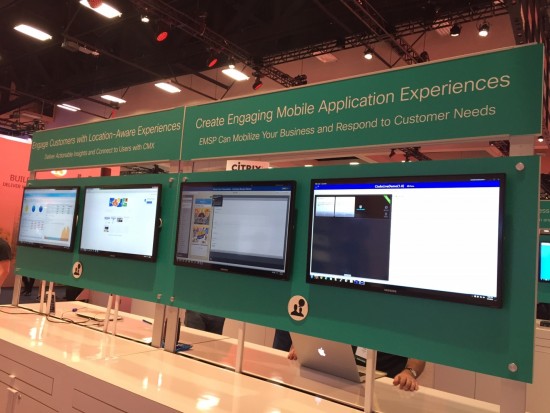
Chances are that if you know anything about Cisco, you know we’re the networking leader and a major player in the wireless world. But did you know that beyond wireless networking, Cisco has mobility solutions for every step of the mobile journey – from wireless infrastructure to personalized end user experiences? In fact, Mobility is leading the way as we all leap into the digital era and changing the way we live, play, work, and learn.
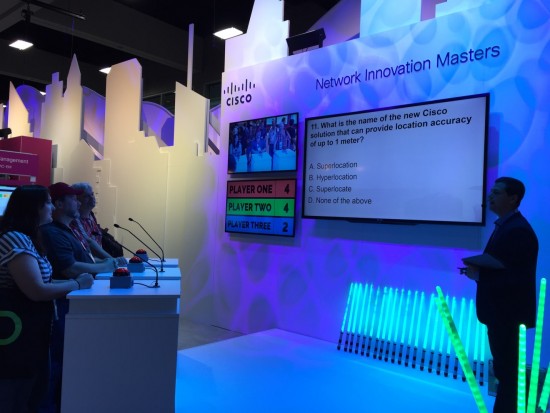
If you are at Cisco Live this week, I hope you had a chance to get a glimpse of how Cisco Mobility solutions can transform your workstyles and lifestyles. At the Future of the Network – Innovation Talk, you may have seen how mobility transforms customer and workforce experiences, as well as provides powerful insights to organizations to make smarter and decisions. A fun demo that involved the audience Continue reading “Going Beyond Wireless: Mobility at Cisco Live San Diego”
Cisco Corporate Social Responsibility aims to empower global problem solvers with the skills they need to thrive and speed the pace of social change around the globe, but that mission wouldn’t be possible without the help of our partners, many of whom are here at Cisco Live US 2015.
At the Cisco CSR Booth in the World of Solutions, our partners are sharing their stories of creating social change around the world.
If you haven’t had a chance, stop by the Cisco CSR booth (#1441) in the World of Solutions and meet six of our partners, including CyberPatriot, Digital Divide Data, NetHope, Water for People, NetDev Group, and Good World Solutions. Together, we’re bringing unique programs and services to people around the world and helping solve pressing social issues, from a growing IT skills gap to the global water shortage.
With these partners, you can become a global problem solver and make an impact in any corner of the world. Below, they share their stories of global impact and how Cisco is helping to speed the pace of social change.
It sounds a bit of an oxymoron – Securing and Explosive. Indeed, security is what enables growth, actually, explosive growth in video delivered to multiscreen devices. Video viewing will make up 80% of global IP traffic by 2019, according to Cisco’s latest VNI report, and that traffic is expected to cross over 24 billion connected devices. This explosive growth of multi-screen IP video is Continue reading “Securing Explosive Growth in Video… Service Providers need all the Firepower.”
Interest in Software Defined Networking (SDN) continues to grow through the ability to make networks more programmable, flexible and agile. This is accomplished by accelerating application deployment and management, simplifying automating network operations and creating a more responsive IT model.
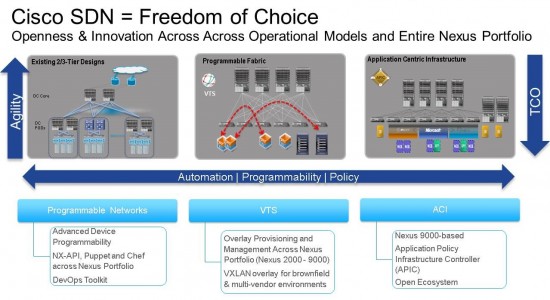
Cisco is extending its leadership in SDN and Data Center Automation solutions with the announcement today of Cisco Virtual Topology System (VTS), which improves IT automation and optimizes cloud networks across the entire Nexus switching portfolio. Cisco VTS focuses on the management and automation of VXLAN-based overlay networks, a critical foundation for both enterprise private clouds and service providers. The announcement of the VTS overlay management system follows on Cisco’s announcement earlier this year supporting the EVPN VXLAN standard, which underlies the VTS solution.
Cisco VTS extends the Cisco SDN strategy and portfolio, which includes Cisco Application Centric Infrastructure (ACI), as well Cisco’s programmable NX-OS platforms, to a broader market and for additional use cases, which includes our massive installed base of Nexus 2000-7000 products, and to customers whose primary SDN challenge is in the automation, management and ongoing optimization of their virtual overlay infrastructure. With support for the EVPN VXLAN standard, VTS furthers Cisco’s commitment to open SDN standards, and increases interoperability in heterogeneous switching environments, with third-party controllers, and with cloud automation tools that sit on top of the open northbound API’s of the VTS controller.
The rise of malware created specifically for endpoints like mobile devices is forcing IT Security teams to focus increasingly on endpoint security solutions. According to a survey by the Ponemon Institute[1] published in January, 75 percent of respondents (an increase from 68 percent in last year’s study) believe their mobile endpoints have been the target of malware over the past 12 months. Continue reading “Delivering Advanced Threat Protection with AnyConnect 4.1”
Today was another busy day in a city by a bay. With the Cisco Live gears fully engaged, there were more sessions, more classes, and more of everything going on. Our product teams did presentations and trainings throughout the day. And the Collaboration booth was hopping, even without the lure of tradeshow-trick-or-treat swag. We had a constant stream of people checking out the latest collaboration goods and digging into details with product managers. I kept expecting a lull in activity. It never happened.
Blog written by Stefan Vallin, Principal Engineer, Cisco Systems
Consider the three key steps related to provisioning and maintaining a customer network service. First, configuration of network devices according to the service intent, followed by activation tests. Finally, ongoing service level assurance monitoring to verify that the service delivered is what was committed.
Up until now, these activities have lived completely isolated from each other, in separate silos. Not surprising, it’s just human nature to break down complex systems and processes into separate entities since it makes things easier to manage, but the time is now to collapse these silos.
On behalf of the development team. I’m pleased to announce the 0.3.0 release of Microservices Infrastructure. In the weeks since 0.2, we’ve added a number of features and improvements.
Microservices Infrastructure is software that launches servers and then configures them to support a wide range of applications – like continuous delivery or realtime data processing.
This makes it easy to run application containers alongside data-centric workloads like Kafka, HDFS, Cassandra and Elasticsearch. We take leading open-source projects (Docker, Consul, Terraform, Mesos) and integrate them to build a powerful platform.
Microservices Infrastructure deploys to multiple cloud providers in minutes. High-availability, service discovery, metrics, security, and logging are built in.
All the components are released under an Apache 2.0 license. Bug reports and pull requests are welcome.
New Features
Deployment to OpenStack, AWS and Google Cloud via Terraform
With the addition of Openstack support to Terraform, Ansible-based cloud provisioning has been deprecated. With this release we’ve included configurations for OpenStack, Amazon Web Services, and Google Cloud. Future releases will include storage, VPN, and networking configurations and support for more providers.
To make the cloud installation process smoother, we’ve included a dynamic Ansible inventory script terraform.py that automatically discovers your hosts across clouds from your Terraform tfstate file and integrates them with Ansible roles.
Logging with Logstash and collectd
This release includes support for collectd and Logstash. Collectd is used to monitor system statistics and Logstash can be used to forward system logs to a central point of a logging service.
0.3.0 includes collectd plugins for Docker, Mesos, Marathon and Zookeeper.
Simplified Vagrant runs
We’ve simplified the Vagrant process, getting rid of the need to run security setup or install python modules. vagrant up will bring up an environment without needing to run any other commands.
Mesos-consul support
To improve service discovery, we’ve developed mesos-consul, a tool that populates Consul service discovery with Mesos tasks. Mesos task <taskname> will be automatically discoverable via dns as <taskname>.service.consul.
One benefit of this approach is that Mesos leader detection is saved in Consul DNS. leader.mesos.service.consul will point to the current Mesos leader.
Future releases will support populating consul with Mesos Service Discovery and labels.
Marathon-consul support
We’ve developed a bridge between Marathon state and consul with marathon-consul. This allows us to support richer haproxy configurations (see below).
Updated haproxy configuration
Our haproxy container now supports optionally reading from marathon-consul data. This means we now support non-HTTP proxying using Marathon global ports.
Future releases will support Mesos Service Discovery and labels to fine tune the proxy configuration.
Improved security-setup script
You can selectively disable security settings at a granular level (for example, turning off Marathon authentication), or disable security entirely.
ISO image creation and Packer support for Vagrant, AWS & Google Cloud
Initial support has been added for creating ISO images that can be used on bare metal systems.
Packer builds have been added for AWS, Google Cloud, and Vagrant. Openstack Glance support will be added in a future release.
Future releases will integrate these builds with terraform in order to speed up deployments.
Tech previews
Support for Hashicorp’s Vault. Currently Vault is installed using Consul as an HA backend. This will allow us to dynamically manage credentials across servers, and keep SSL keys and secrets out of your containers.
Cleanups
Use of NetworkManager to manage dnsmasq and /etc/resolv.conf has been removed, in favor of using dnsmasq directly.
We’ve cleaned our containers and packages to be sourced from a single repository. Packages come from the bintray.com/ciscocloud account, and Docker images will download from docker.io/ciscocloud.
Ansible openstack provisioning playbooks and references are being removed in favor of terraform and dynamic inventory.
Using /etc/hosts has been deprecated in favor of using consul DNS. (For example, server.node.consul)
#CiscoChampion Radio is a podcast series by Cisco Champions as technologists. Today we’re at Cisco Live San Diego (#CLUS) talking about highlights and take-aways from the event so far.
Learn about the Cisco Champions Program HERE.
See a list of all #CiscoChampion Radio podcasts HERE. Ask about the next round of Cisco Champions nominations. EMAIL US.















 #CiscoChampion Radio is a podcast series by