Avatar

brian shodaLast month Brian Shoda, a 12 year veteran of Cisco and most recently the director of Cisco’s IP NGN architecture sales for the Asia Pacific theatre, sat for an interview with Telecom Asia magazine. During the interview he discussed the impact of programmability on the network and why dynamically configuring services is important for telecom operators. Since some of our global audience doesn’t read Telecom Asia magazine they’ve graciously allowed us to reprint the interview.

1. [Telecom Asia] What are the key trends driving the transition in SP networking?

[Brian Shoda] Over the past several years, service provider networking has primarily focused on cost reduction through network optimization and revenue generation and the development of new and innovative products. However, recently with the explosion of mobile data traffic growth many operators have struggled to control capital expenditures as they scale their networks to support demand, often diverting capital from product development to ensure the on-going scalability of the infrastructure. In many markets, this has led to the stagnation of innovation and the commoditization of network services, which, in turn has lowered revenues and reduced margins as operators compete on price to maintain and grow their customer bases.

Other factors such as Continue reading “The Impact of Programmability on Networks”

Avatar

Every day educators and students from more than 400 locations across Washington State have world-class educational resources at their fingertips, and every day they rely on the same network to access it.

In 1996, Washington legislators and educational leaders saw the Internet’s potential to transform learning. To guarantee that students across the state would always have equal access to online courses, resources, programs and degrees, they passed a bill to create a single broadband network that would connect all educational institutions.

The project, dubbed the K-20 Education Network, required a network that was high-performing, cost-effective, secure, scalable and reliable. Six years after the bill was passed, Washington State has a fast and reliable network that connects 99.8 percent of the state’s schools, community colleges, universities and libraries giving 1.5 million students access to the Internet and voice and videoconferencing services.

Continue reading “Washington State Puts Cisco Solutions to the Test”

Authors

Kerry Best

Marketing Manager

Public Sector Marketing

Avatar

I’m delighted to introduce Dan Kern to the Manufacturing Blog!

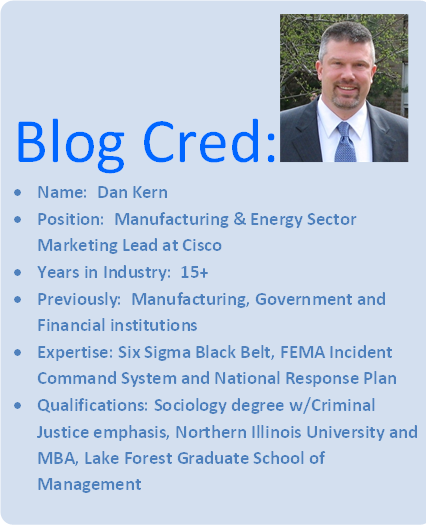
Cred Dan Kern

Dan joined Cisco five years ago and leads the Manufacturing & Energy Industry Sector marketing practice for the Americas.

He focuses on understanding the business needs of Cisco customers and drives engagements that introduce business transforming concepts to lines of business managers and executives.  Because of his industry knowledge and contributions, Dan was recently recognized as the “Industry Leader of the Year” by GDS International at the 2012 Next Generation Manufacturing Summit and also received the President’s Award at the 2012 Manufacturing Leadership Summit.

Thanks to his past experience, Dan has an intimate understanding of customer business needs.  He has a Six Sigma black belt and held roles in market and customer operations as well as product development.  Dan has also held sales, strategy and marketing positions for manufacturing, financial and government institutions.

Dan has degrees in Sociology with an emphasis in Criminal Justice from Northern Illinois University and a Masters of Business Administration from Lake Forest Graduate School of Management.

We’re looking forward to Dan’s insights and contributions to this Manufacturing blog.

Welcome Dan!

Authors

Avatar

A key trait of innovative small and medium sized businesses (SMBs) is agility– making decisions quickly, shifting direction with a customer, and swiftly working out the details with colleagues. But at the end of the day, what it all comes down to is having the right technology—to enable responsiveness, increase overall productivity, and keep SMBs competitive.

And that becomes especially important when you look at statistics around mobility. The mobile worker population is expected to reach 1.3 billion by 2015, and 71 percent of SMBs now functioning as work-from-anywhere businesses (according to IDC’s Worldwide Mobile Worker Population 2011–2015 Forecast. At the same time, this move to mobile has refocused SMBs’ attention on security.

On-the-go SMB workforces need to be able to work and collaborate securely, whether onsite or mobile. And, since SMBs generally don’t have dedicated IT departments, they need technologies that are easy to use and manage, all while fitting within a tight budget. This kind of enablement is what allows small businesses to be agile.

In response to these challenges, Cisco has introduced a host of new small business technologies designed to support the requirements of nimble SMBs that are looking to get an edge. These offerings deliver new capabilities around security, collaboration, and mobility.

To learn more about our latest small business products, visit our website. And, watch for additional blogs in the coming days that will zero in on related topics to provide more context around how you can help maximize productivity in a secure environment, however you define your workspace.

We’d also love to hear from you about your SMB challenges. What are you hoping to tackle this year from an IT perspective?

Authors

Lief Koepsel

Director

Cisco Small Business

Avatar

Today, I am pleased to announce Cisco’s intent to acquire Intucell, a privately held company headquartered in Ra’anana, Israel for $475 million in cash and employee retention incentives. Intucell provides software platforms for Self-Optimized Network (SON) that support mobile carrier networks worldwide.

This acquisition will allow Cisco to extend network intelligence and tightly align different software elements across our product portfolio. It also reinforces our commitment to service provider customers and strengthens our expertise in mobility.  In addition, the acquisition of Intucell furthers our long-standing commitment to cutting-edge innovation based in Israel.

The proliferation of connected mobile devices, faster network speeds, and growing demand for high-bandwidth applications and services are driving greater network traffic and complexity.  As mobile service providers continue to face increased end-user demand, the need to dynamically manage network bandwidth, usage and services is increasing. Intucell’s SON software platform addresses these challenges by examining the network, identifying issues, and intelligently managing network traffic in real time.  This capability brings enormous value to service providers and their customers.

The Intucell team’s deep expertise in software, radio management and optimization technologies have made it a global leader in solving some of the most complex challenges faced by mobile service providers.

Intucell’s product portfolio will be integrated into our Service Provider Mobility Group. The team will report into the Software and Applications Group led by Shailesh Shukla.


Authors

Hilton Romanski

No Longer with Cisco

Avatar

In my previous posts, I discussed with you the importance of unified policy and management as you respond to the bring-your-own-device (BYOD) trend. The Cisco Unified Access solution brings “One Policy. One Management. One Network” to help you with your BYOD initiatives. Today I’ll take a look at the third pillar of Cisco Unified Access, One Network. I’ll explore with you what it means and why it is a critical factor as you take on BYOD.

The workforce is increasingly going mobile. According to research firm Gartner, tablets will be the key accelerator to workforce mobility. A Gartner 2012 report suggested that annual tablet purchase by businesses totaled 13 million units and this number would more than triple to reach 53 million units by 2016. Such rapid mobile growth calls for major wireless network expansion. Market data from Infonetics showed that global wireless LAN equipment sales in the 3rd quarter of 2012 passed the $1-billion mark for the first time.   Continue reading “One Network for the BYOD Challenge”

Authors

Steven Song

Business Manager

Avatar

In just a couple of days, the city of London will be home again to one of the world’s most significant education events: the Education World Forum (EWF). Once more, the city will warmly receive about 480 delegates, including over 100 Ministers of Education, leaders of International, for Profit and Non-for Profit Organizations, Social Entrepreneurs, Innovators, and Practitioners from around the world, all gathering to address the big challenge of making education accessible, equitable, and relevant.

Over a period of four days (Jan 27-30), the delegates will engage in a variety of panel discussions, workshops and activities that will allow them not only to share experiences and policies, but also to exchange genuine and valuable lessons learned through the process of national education reform and system transformation. The event is hosted by the British Educational Suppliers Association (BESA) and supported by the Foreign and Commonwealth Office (FCO), the Department for Education (DfE), the Department for Business, Innovation and Skills (BIS), and the British Council. Through the Global Education team, Cisco is proudly contributing to this event as one of their Platinum Sponsors with a significant presence in the Forum’s agenda and exhibitions:

Continue reading “Education World Forum 2013: Policy making for Quantity, Quality and Impact”

Avatar

Originally posted on the Huffington Post on 01/23/2013

Stephen Ondieki lives in Africa’s second-largest slum, Kibera in Kenya, where most residents earn less than US$1 a day. However, Stephen owns a computer repair shop that not only enables him to earn US$8 a day, but also to give back to his community by turning his shop into a hang-out spot for youth, whom he mentors and teaches about IT and networking. “They see me overcoming the same challenges they face and they’re motivated to try to make some changes themselves,” he says.

Stephen acquired his IT skills through training with the Cisco Networking Academy, a program that collaborates with organizations around the world to teach hundreds of thousands of students the skills needed to build, design, and maintain networks – an increasingly crucial skill in an increasingly networked world.

Tae_BB_012313Stephen Ondieki is a graduate of the academy at Raila Education Centre in Kibera.

Stephen’s success and community outreach in Kibera would not have been possible without reliable and affordable access to a broadband connection. For Stephen and for many other individuals in developing countries around the world, broadband connectivity acts as a powerful catalyst as well as an anchor for economic and social advancement.

Read the complete post on Huffington Post Impact X.

Authors

Tae Yoo

No Longer with Cisco