Avatar

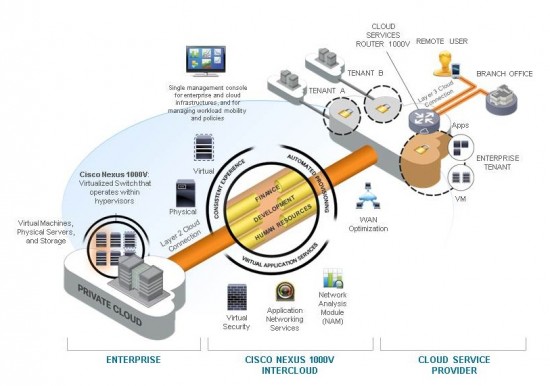
This week, as part of a major cloud launch that also introduced the Nexus 6000 series and updates to our Cisco ONE portfolio, Cisco unveiled its Nexus 1000V InterCloud solution, which provides a seamless and secure extension of virtual networks from on-premises data centers to cloud service providers. In part 1 of our introductory blog series to this new technology, we discussed the architecture and components of Nexus 1000V InterCloud for creating secure, on-demand virtual private cloud (VPC) containers in a hybrid cloud.  In a pre-launch post earlier in January, we looked at some new Forrester research data on hybrid cloud business drivers and how some organizations were looking to overcome the challenges to real hybrid cloud integration. Today, in part 2 of our InterCloud series, we are going into more depth about the hybrid cloud management component, Virtual Network Management Center (VNMC) InterCloud.
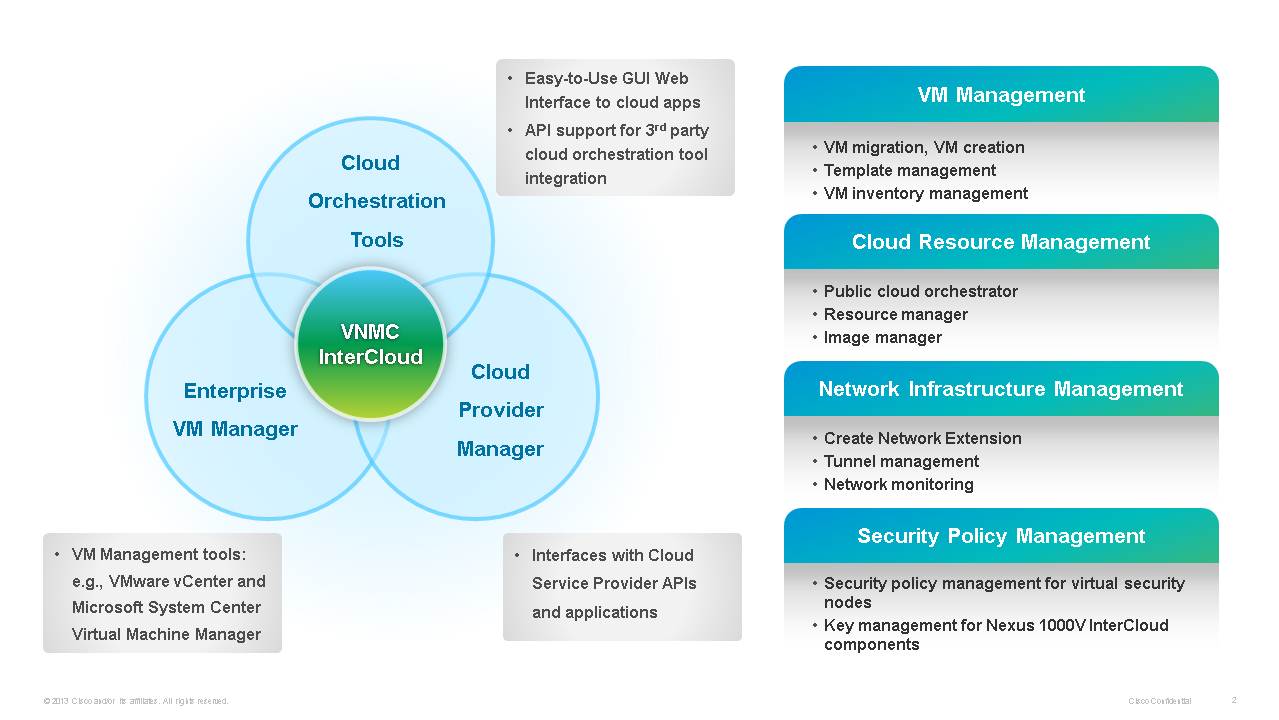
VNMC InterCloud provides a single pane view of VM and cloud resources across the on-premises resources and those at the cloud provider. It interfaces to orchestration tools and service provider management systems, as well as virtual machine managers.

Continue reading “Cisco Launches Nexus 1000V InterCloud – Part 2 (VNMC InterCloud)”

Authors

Gary Kinghorn

Sr Solution Marketing Manager

Network Virtualization and SDN

Avatar

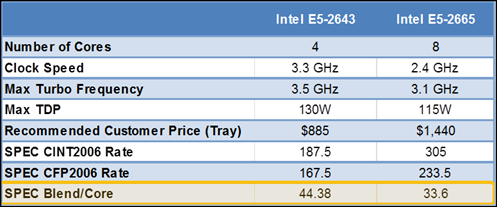
Welcome back as we continue to dive deeper into advanced CPU (Central Processing Unit – I had a “tech writer” change a document on me one time, he assumed at this day in age that people still needed to have the CPU acronym translated.. but I digress) and Memory concepts in the land of VDI. Last week Doron answered our first question and told us about Core Count vs. Core Speed for scalable VDI. This week we will focus specifically on Core Speed, bursting and introduce you to a potentially new subject called “SPEC Blend/Core” for high performance VDI. If you are just finding this blog post for the first time, I encourage you to check out the Introduction from Tony as it will help set the stage for our discussion. Here is the full table of contents:

  1. Introduction – VDI – The Questions you didn’t ask (but really should)
  2. VDI “The Missing Questions” #1: Core Count vs. Core Speed
  3. VDI “The Missing Questions” #2: Core Speed Scaling (Burst)  YOU ARE HERE!
  4. VDI “The Missing Questions” #3: Realistic Virtual Desktop Limits
  5. VDI “The Missing Questions” #4: How much SPECint is enough
  6. VDI “The Missing Questions” #5: How does 1vCPU scale compared to 2vCPU’s?
  7. VDI “The Missing Questions” #6: What do you really gain from a 2vCPU virtual desktop?
  8. VDI “The Missing Questions” #7:  How memory bus speed affects scale
  9. VDI “The Missing Questions” #8: How does memory density affect VDI scalability?
  10. VDI “The Missing Questions” #9: How many storage IOPs?

You are Invited!  If you’ve been enjoying our blog series, please join us for a free webinar discussing the VDI Missing Questions, with Tony, Doron, Shawn and Jason!  Access the webinar here!

VM’s are only as fast as their individual cores! Lets look at what this statement means. Example: Assume we have a 1GHz x 4 core processor (hey, it makes math easy for me). When we carve up a server VM or in this case a VM to be used for VDI, we can’t just give it 2 vCPU’s and say it’s got a 2GHz processor. The reality is that it has a dual 1GHz processor. This becomes an important concept in VDI when you are considering the quantity and QUALITY of vCPU’s you allocate to a Virtual Machine and ultimately the end user applications efficiency and the overall scalability of the server platform. This is not a Uni-processor vs. Multi-processor application discussion. We could easily have a very long discussion and debate on the in’s and out’s of application level efficiencies and the Operating Systems ability (and sometimes inability) to properly manage multiple CPU’s. We are going to expand upon the two CPU’s we tested and dig into per core performance.

CPU Burst vs. CPU Reservation. Let’s play around with our example 1GHz x 4 Core Processor a bit more. If we take this single processor and deploy 8 single vCPU desktops on it we will have a 500MHz CPU reservation per VM. The calculation for that is simple 1GHz x 4 Cores = 4,000MHz / 8 total VM’s = 500MHz/VM Reservation. So the Reservation is simply the average amount of CPU that is available to each VM (assuming everything is prioritized equally). But our Burst is different. Our Burst represents the maximum amount of CPU Core that any one VM could ever utilize. In this example, the Burst per VM is equivalent to 1GHz.

Continue reading “VDI “The Missing Questions” #2: Core Speed scaling (Burst)”

Authors

Shawn Kaiser

Consulting Systems Engineer

Data Center

Avatar

Cisco Gold Certified Partner Gen-i today announced the launch of ReadyCloud Collaboration, a hosted collaboration-as-a-service solution based on Cisco’s globally recognised Hosted Collaboration Solution (HCS) platform.

ReadyCloud Collaboration will bring together Cisco’s international strength and Gen-i’s proven local knowledge, coverage and infrastructure to deliver a flexible, highly secure and cost effective hosted collaboration service to New Zealand businesses.

Continue reading “Gen-I Introduces ReadyCloud Collaboration based on Cisco HCS to enable New Zealand Businesses to Harness the Benefits of …”

Authors

Linda Horiuchi

Senior Manager, Australia and New Zealand PR

Avatar

As we start the year, Cisco’s CTO for Australia & New Zealand, Kevin Bloch, shares his thoughts on the trends that are going to shape the networking industry in 2013.

1. “Mobile .. for business” – New directly connected customer channel

Organisations will make significant investments to directly connect and interact with external and internal customers via their mobile devices, as nearly everyone has at least one.

2. “Cloud .. for business” – Big hit on ICT industry

Organisations ‘get’ cloud in 2013 and reorganise (transform) around “as-a-service”. As this happens, IT becomes an operational expense and risk shifts to the provider. This will be a journey and ‘hybrid clouds’ will dominate in 2013. Everyone in the ICT industry will need to adjust.

3. “Analytics .. for (big) business” – Big Data gets bigger

Businesses actually don’t want IT – they want to achieve their business goals! However, in order to do so, they need to be able to make fast, smart decisions. The data is available (actually exploding, particularly from smart mobile devices) and technology is now able to make that data useful (“data is the new oil”).

4. “Security .. for business” – IT’s risky

With increased mobile adoption, proliferation of intelligent devices, connectivity and clouds, organisations will increase attention on the means to address vulnerability and business risk. Attacks will focus on the most popular clients – mobile Android devices.

5. “Video .. for business” – More places to see

Video is increasingly permeating business. As mobile devices now exceed desktops, video becomes more accessible, from more places, from more devices.

Continue reading “Perspective from Cisco Australia and New Zealand’s CTO: What’s in store for the networking industry in 2013?”

Authors

Linda Horiuchi

Senior Manager, Australia and New Zealand PR

Avatar

Last week, the World Economic Forum (WEF), in collaboration with the World Bank and Bain & Company, issued the report, “Enabling Trade: Valuing Growth Opportunities.”  The report concluded that reducing supply chain barriers in two key areas – border administration and transportation and telecommunications infrastructure – could increase global GDP up to six times more than total tariff elimination.   The WEF paper calls on governments and the private sector to tackle these barriers through coordinated action, something which we here at Cisco strongly support.

Meanwhile, two other studies advocate similar approaches.

First, the World Trade Organization (WTO) and the Organization on Economic Cooperation and Development (OECD) have measured trade flow in relation to value added by a country in the production of a good or service that is exported.  This approach provides insight into the importance of services, the role of imports in production processes, the reality of economic interdependencies, and the role of emerging economies.

Second, a recent paper by Bernard Hoekman and Selina Jackson at the World Bank suggests that trade policy negotiations should be structured in ways that reflect the independencies of global supply chains. This approach would improve the commercial relevance and utility of trade liberalization agreements and is being explored in the Transpacific Partnership (TPP) negotiations. This is a groundbreaking approach to trade negotiations that better-reflects the imperatives of global supply chains.

Bottom line:  With these new analyses in hand, governments have an opportunity to adjust their thinking and realign their policy and funding priorities to capture the benefits of supply chain efficiency.  In doing so, they can accelerate global GDP growth around the world.

Authors

Jennifer Sanford

Senior Director, International Trade Policy

Cisco Global Policy and Government Affairs

Avatar

borderless_challenge_header


It’s easy! Just three simple steps to be in the running to win the adventure of a lifetime.

1. Go to http://www.cisco.com/go/challenge

2. Watch a short video on Unified Access

3. Click the button: “Begin Challenge” and enter to become a Cisco VIP guest for a day.

Winners will take a cool behind-the-scenes tour in one of the main Cisco global centers—Silicon Valley, Bangalore, or London. Then venture out to the surrounding sites for your custom adventure. Or you could be one of 10 second-place winners who will receive an iPad.

Avatar

ginaBy Gina Nienaber, Marketing Manager, Service Provider (SP) Marketing Routing and Switching

The theme of this year’s V6 World Congress, happening in Paris, March 19-22, is “Going Mobile.” With the advent of the Internet of Everything and the proliferation of mobile devices well underway, there will be a lot to talk about. And this year, you will have the unique opportunity to hear from leading service providers, including Verizon Wireless and T-Mobile, who have already made the transition to IPv6 in their mobile networks.

Now that IPv6 has solidly claimed the role as the connective protocol of the future, this event is expected to attract a record number of attendees from around the world. As a sponsor, Cisco will have a strong presence on the three-day agenda and is also hosting a technical tutorial, which will give you the chance to meet one-on-one with Cisco technology experts.

Here is the current list of Cisco speakers (and the 3-day agenda): Continue reading “Get Moving to V6 World Congress 2013”

Avatar

In a recent post, I previewed some new hybrid cloud market research from Forrester that spoke to the business drivers and technical hurdles to cloud integration, and Shashi Kiran  has recently posted about lowering the barriers to hybrid cloud adoption. Today, as part of a larger cloud technology launch, Cisco is announcing a new hybrid cloud solution, Nexus 1000V InterCloud.

One of the fundamental capabilities for the world of many clouds is the ability to link various cloud environments into a single extended fabric with consistent capabilities, operations and management.  While previous Unified Fabric innovation has focused on physical/virtual consistency of the DC fabric, this announcement brings that consistency to the cloud. This new technology from Cisco extends the existing networking capabilities, L4-7 services and manageability of your enterprise into public and provider clouds to create a single consistent, reliable, predictable environment for all your physical, virtual and cloud workloads. This secure and seamless degree of integration to the hybrid cloud frees you to run and move applications where it makes the most sense, on-demand, without compromise.

[Note: Join us for a Live Announcement Webcast February 5: Register Here]

Cisco Nexus 1000V InterCloud

Continue reading “Cisco Launches Nexus 1000V InterCloud – Part 1”

Authors

Gary Kinghorn

Sr Solution Marketing Manager

Network Virtualization and SDN

Avatar

We are excited to be participating in the HIMSS13 Annual Conference & Exhibition from March 4-6 in New Orleans.  If you are going to HIMSS13, make plans now to visit the Cisco booth #2329 to see solutions to streamline clinical workflows, facilitate BYOD, enable care-at-a-distance, and improve the patient experience. 

Cisco Way-Finding
See the Cisco Way-Finding Solution at HIMSS13

Some of the featured demos include:

  • Cisco HealthPresence 2.5
  • VX Clinical Assistant
  • Bring Your Own Device  (BYOD)
  • Virtual Patient Observation
  • Way-Finding Kiosks
  • WebEx Solutions

Start your visit to the Cisco booth by attending the Connected Health Overview in the in-booth theatre.  You’ll learn about innovations at Palomar Health in San Diego and be introduced to the rich set of healthcare solutions featured in the booth.  Grab a keypad to participate in the interactive presentation, and you’ll have a chance to win a $25 American Express gift card!  One winner per session.

Visit Cisco at HIMSS13 to learn more about what’s happening in the Cisco booth, the Cisco Connected Health Summit on March 4, and the other exciting activities we have planned for you at HIMSS13.  

We’re looking forward to seeing you in New Orleans!

Authors

Mike Haymaker

Healthcare Industry Marketing

No Longer with Cisco