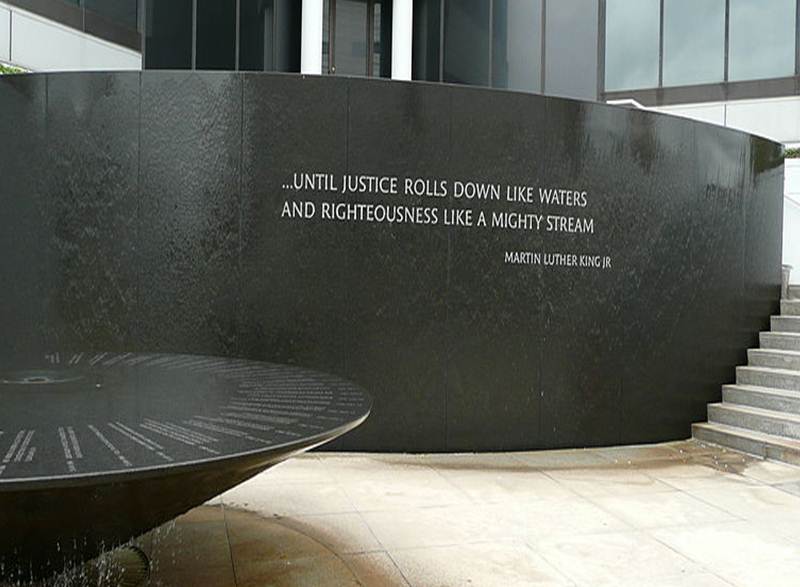
Maya Lin, creator of the Vietnam Veterans Memorial, was commissioned to design the Civil Rights Memorial at the Southern Poverty Law Center. Lin found her inspiration in the words “until justice rolls down like waters and righteousness like a mighty stream,” a paraphrase from the Book of Amos that Dr. Martin Luther King Jr. used in his “I Have a Dream” speech and at the start of the Montgomery bus boycott. Photo used with permission from this source.
It was a printer jam that made me realize the full power of Martin Luther King Jr.’s “I Have A Dream Speech.” Growing up in the United States, I had studied Martin Luther King Jr’s outsize impact on civil rights and American history. That said, I had never heard the entire speech he gave in 1963 to 200,000 people from the steps of the Lincoln Memorial during the March on Washington for Jobs and Freedom.
Then, a few years ago, the printer at work jammed. I pulled out the crumpled paper and power cycled it. While I was waiting, I started reading the poster hanging in the hallway. It was the full text of the “I Have A Dream” speech. I was truly moved by the strength of the writing and the ideas it put forth. I couldn’t believe that I had missed out on this powerful work for so long. Kudos to people that put up guerilla art in offices!
“We believe economic progress without social development is not sustainable, while social development without economic progress is not feasible.” – Klaus Schwab, Founder and Chairman of the World Economic Forum
Historically individuals and institutions have often been limited to the results of their individual efforts to make an impact. With the advent of the Internet and widespread broadband connection, however, it is now possible to efficiently join with others to act collectively – pooling global resources and talents to solve problems too big to solve alone. This is the power of collective knowledge, creativity, and commitment in a connected age. This is what Cisco believes as we consider, plan, and execute our Corporate Social Responsibility (CSR) activities.
One way in which Cisco works collaboratively to make a global impact is by participating in events like this week’s World Economic Forum (WEF) in Davos, Switzerland. Cisco is one of the strategic partners of the event and our Chairman and CEO, John Chambers, will be speaking as part of a panel addressing Leading through Adversity on Wednesday, January 23 from 9 to 10 a.m. (CET) (midnight to 1 a.m. PST/3 to 4 a.m. EST).
Helder Antunes is Managing Director, Smart Connected Vehicle, CIG . He is a 15-year Cisco veteran with a background in both network security and the automotive industry.
Helder is currently working closely with all the global automobile manufacturers, in order to explore a partnership between Cisco and the OEMs in defining the next generation Smart Connected Vehicle platform, a key initiative within Cisco’s “Internet of Things” strategy.
Outside of Cisco, Antunes is also a General Partner at Pereira Ventures and a counselor to the Regional Government of the Azores, Portugal.
Helder is no stranger to the cutting edge of the automotive industry. He raced cars for many years and designed some of the early data acquisition systems for race cars. On a personal level, Helder was born on the island of Terceira (Azores, Portuguese Territory) in the middle of the Atlantic Ocean, and traveled to Mozambique, Macau, and other former Portuguese colonies before his family settled in Rhode Island.
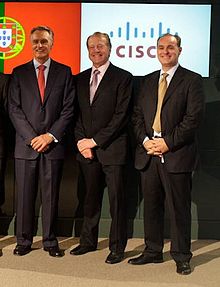
President Aníbal Cavaco Silva, Cisco CEO John Chambers, and Antunes at Cisco HQ, during the 2011 Portuguese Presidential Visit to California.
He has been published in many industry publications on Automotive and other topics including:
What an exciting time to be in the tech industry. We are at the beginning of a major transition to the Mobile-Cloud era. Trends like bring your own device (BYOD), access anywhere, virtualization, and machine-to-machine connections have given way to a new breed of applications. We estimate that approximately 50 billion devices will be connected by 2020. In 2010 alone, more than 350, 000 applications were developed with more than three million downloads. A 44-fold increase in data creation is predicted from 2010 to 2020, with 34 percent of it in the cloud. All of this leads to a world of intuitive connections between people, processes, data and things on the network – the Internet of Everything.
Once again this year Cisco will be a Platinum sponsor at Microsoft’s Management Summit 2013 (MMS 2013) in Las Vegas, April 8 – 12. At the event we will showcase new Cisco solutions and technologies applicable to the world of Windows Server, System Center, and Hyper-V.
We’re participating in a small way via sponsorship with Microsoft in their Cloud OS Trivia Challenge. Join your peers in the Microsoft Cloud OS Trivia Challenge; test your knowledge with trivia for a chance to win some excellent prizes-including a trip to MMS 2013. You also have a chance to win a Microsoft Surface, Windows 8, Windows Server, or a Linksys Router. Play Now!
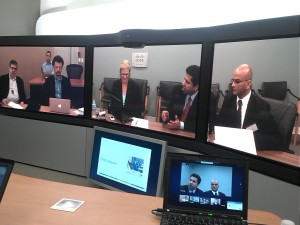
Yesterday, via Cisco TelePresence and WebEx, Cisco hosted an international roundtable examining the current demands placed on the healthcare industry and how technology is addressing many of these issues. A panel comprised of Cisco executives and customers discussed how connected technologies and services can enable healthcare providers to help improve patient care, address security and patient privacy, and manage BYOD devices all while increasing efficiency and lowering costs.
Kathy kicked off the discussion by offering several eye opening healthcare statistics. Did you know, for example, that 41% of patients would switch hospitals for a better experience? Or that in 95% of countries, the rising cost of medical care exceeds the rate of general inflation?
These statistics illustrate the difficult challenges many of our healthcare customers face today. Therefore, during the healthcare roundtable, Cisco unveiled two new connected health offerings – Cisco HealthPresence 2.5 and Cisco Services for Connected Health. These solutions help enable efficient, convenient, high-quality patient care, and more collaboration across the healthcare continuum.
Roderick Bell II spoke directly to the successful deployment of Cisco HealthPresence at Resolute Health – so successful, in fact, that local schools are now connecting nurses to students across the district, thereby lowering costs and expanding the access of nurses to students in need. Roderick expects local businesses and county jails to join Resolute Health’s HealthPresence initiative later this year. Likewise, via Cisco TelePresence, Fundación Peluffo-Giguens in Uruguay has connected 10 hospitals in the country with the central hospital in the Montevideo, improving access to specialists and avoiding travel and logistics complexities for remote patients and their families. Similarly, the implementation of Cisco’s TelePresence endpoints in Brazil have allowed Albert Einstein Israelita Hospital to deliver care from a distance to seriously ill patients if no specialists are available at the public hospital or if a second opinion is required to provide a more extensive assessment.
Wes Wright, CIO of Seattle Children’s spoke to his overall success with Cisco. When tasked with building a virtual desktop infrastructure program at the hospital, he found that Cisco’s Unified Computing System is the best out there: During the event he said, “I wanted the power of Cisco behind me… and it’s worked!”
Yesterday’s roundtable further demonstrates Cisco’s commitment to connecting the previously unconnected with an intelligent network at the foundation.
You can view the discussion here on YouTube and we’d love to hear your thoughts about the future of healthcare delivery. How do you think video collaboration tools will transform the way your health is monitored?
I wish the topic of Server management was as juicy as Lance Armstrong’s confession or as intriguing as Manti Te’os girlfriend hoax, but it is NOT. It is, however, intertwined with two of the domains– 1) infrastructure management and 2) automation and orchestration described in the Cisco Domain Ten model. Server management was also one of the topics in a series of discussions with Mike Spanbauer from Current Analysis.
http://www.youtube.com/watch?v=6YTh-C0RFIA
Cisco UCS Management addresses the problems of complexity and scaling which the panel discussed. Service profiles ease the deployment of policy based server management and simplify routine setup tasks as well as server repurposing tasks within the typical server lifecycle. The Cisco UCS is architected for automation from the very core with an open API. The operational benefits can usually be quantified in $$ and cents as some of these customers have experienced.
Travelport – “86 percent savings in total support hours”
These days, the generation of data has become almost as constant as breathing. With every click or swipe, today’s mobile, hyperconnected consumers exhale an ever-expanding trail of digital details, revealing troves of information about their wants, needs, interests, well-being, and aspirations.
All of that data offers great promise for retailers looking to know their customers in deep, new ways in order to provide carefully targeted products and services. But it is also a source of headaches. Those same retailers are wrestling with a complex new realm of Big Data analytics, where a deluge of information from new sources like video, mobile, and social media threatens to swamp their capacity for processing. That is, if they can properly access those new data streams in the first place.
By Kate Griffin, Principal Consultant, IBSG Service Provider
Big Data has become top of mind among CxOs,but service providers (SPs) and most businesses today are just beginning to explore data analytics. “Big Data” generally refers to the growing scope of data analytics in terms of the variety, velocity, or volume of data involved. When this flood of Big Data is harnessed and refined, it has the power to transform economies, make businesses more efficient, and improve our daily interactions as consumers.
To assess service providers’ interest and readiness to take part in Big Data’s growth, the Cisco® Internet Business Solutions Group (IBSG) conducted in-depth interviews with executives from 12 global communication service providers. The SPs we interviewed see data analytics as a key opportunity. Some 80 percent of them consider Big Data an important strategic priority for their companies over the next three years. Cisco IBSG also tested key concepts concerning Big Data with 200 senior SP executives at the Telco 2.0 conference in London last summer through in-session polling questions. Eighty-eight percent of these delegates also view Big Data as a “very important” or an “important” strategic priority for the next three years (see Figure 1). Continue reading “Service Providers Are Just Getting Started with Big Data”