
Every November, Lisbon turns into the capital of tech with Web Summit. The event covers everything from cybersecurity and energy to developers, policy, health, and (of course!) AI. Students, journalists, investors, CEOs, and founders looking for funding all end up in the same hallways.
I was there representing Cisco with a session called “Democratising AI Platform Engineering with Open Source”. My goal was to explore what AI platform engineering is, why it matters whatever you use your agents for, and how open source can get you there.
AI Platform Engineering, the Open Source Way
If you want AI agents to be a real part of your Monday, working side by side with your team, you need some solid foundations: authentication, authorization, observability, and plenty more, so your agents, tools, and skills run responsibly. You have three options:
- Build it yourself (or vibe code it), and own the plumbing and maintenance.
- Pay for a black box you can’t change.
- Adopt a mature open-source project with the plumbing ready and the batteries included.
My session was all about option three.
CAIPE (pronounced “cape”) is a CNCF Sandbox project: an open-source AI platform that helps teams build, govern, and operate secure AI agents and workflows. It brings authentication, authorization, MCP tools, RAG, and workflows together under a single pane of glass (WebUI, APIs, Slack, Webex, and more). You deploy it your way (kind, Helm, Docker Compose) and tinker at will.
My favorite part is that every component is FOSS and swappable. Swap the default Keycloak for the Duo you already use, bring your LLM of choice, or index your knowledge from Confluence, Slack, or any URL into a RAG built on the included Neo4j.
There is no silver bullet, of course. Every team has different needs and trade-offs. But a project like this gives you a head start, and contributions from people in the trenches make it better for everyone.
Talking to AI Leaders
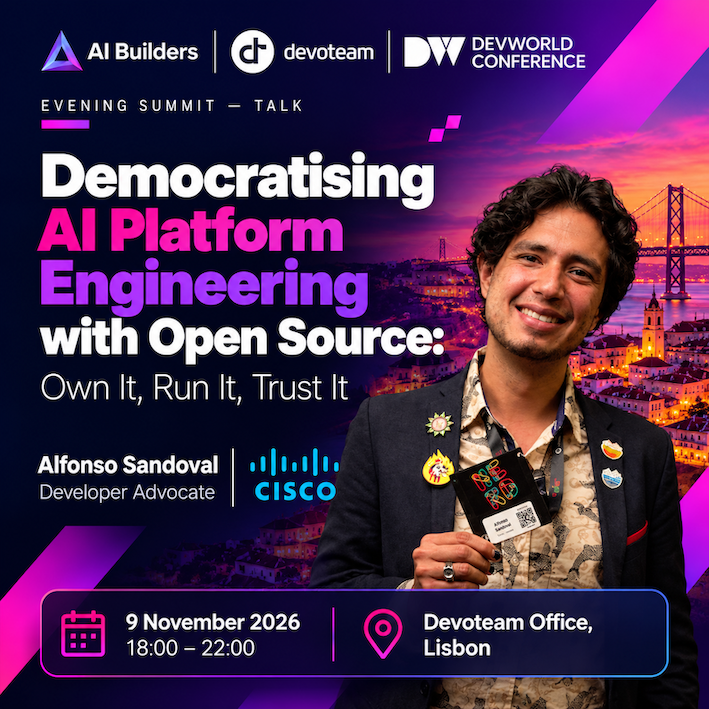
The Monday before Web Summit, I was invited to the AI Engineering Night for Leaders in Tech by AI Builders. The audience was mostly founders, CEOs, and CTOs of startups and mid-size tech companies. As an engineer and Developer Advocate, I had to switch gears and talk their language: how open source can bring value to your team, starting with the bare minimum and scaling at the pace of your company.
Enter Storm Charles
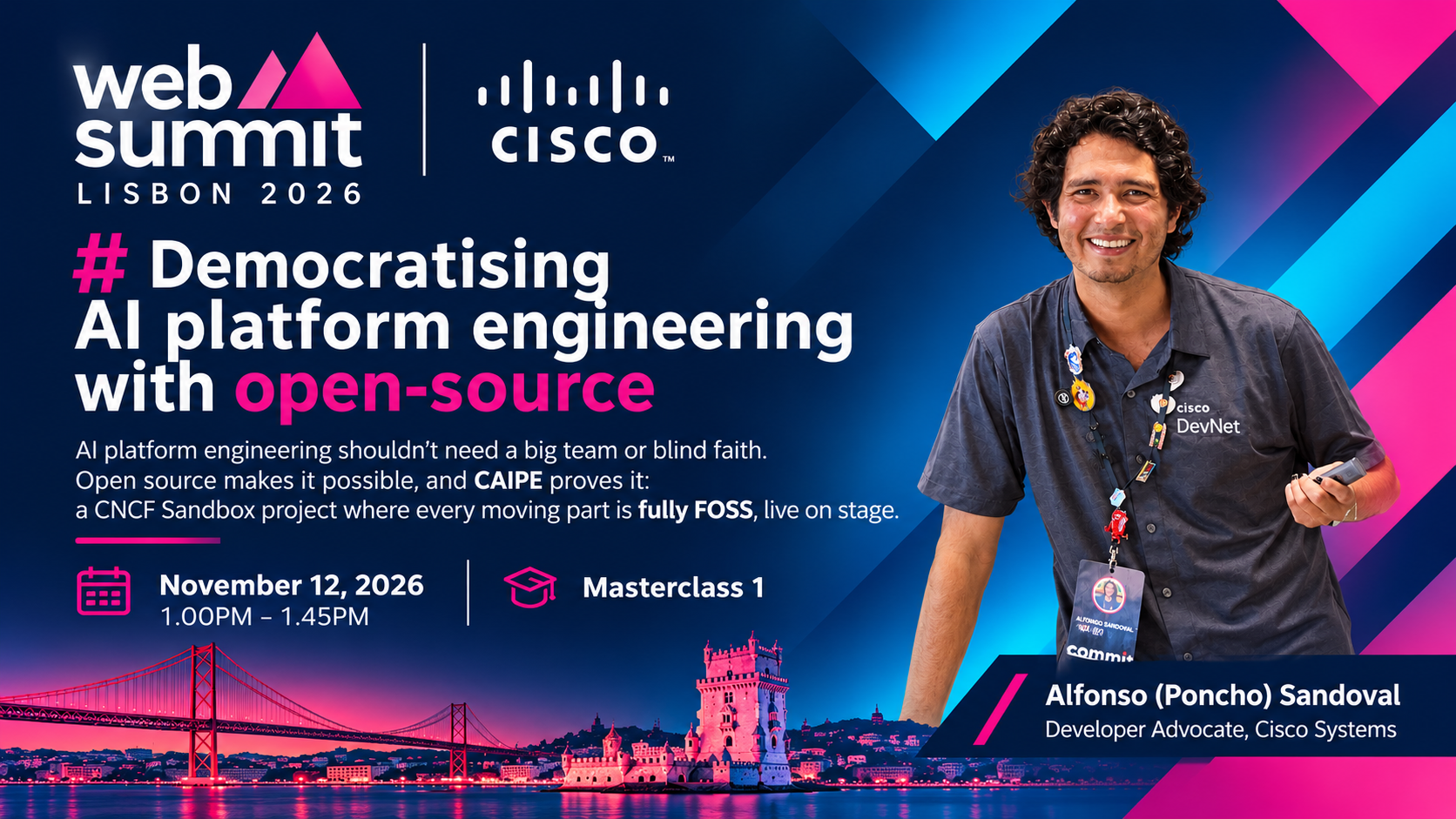
Web Summit’s second day was canceled! Storm Charles was heading straight for Lisbon, so an emergency state was declared and non-essential business (Web Summit included) shut down. Charles came and went, the city held up, and the next day was the big one for my masterclass.
I had 45 minutes and 111 attendees in a room built for a hundred, and I loved every minute: the energy, the vibe, the follow-up conversations. The weeks of preparation were worth it.
In Conclusion
If you want to bring AI agents to your environment the right way, give open source a chance. CAIPE is a robust alternative to building and maintaining everything yourself, or relying on proprietary services.
One honest caveat: open source isn’t free. You pay in a different currency. The tinkering is on you and the support comes from the community, but so does the roadmap, and ultimately the benefit is shared by everyone.
Sidenote: Record Your Demos!
I’m a true believer in live demos. I love the adrenaline. But they can bite back. Midway through my demo at the AI Builders event, none of my LLM API requests were working. I didn’t even try to troubleshoot live: I accepted defeat, apologized, and moved on. During Q&A, someone told me that an OpenAI outage had caused it. What are the odds of that happening at that exact moment? The moral: record your demos, or run your LLMs locally. Whichever suits you best.
Curious about AI platform engineering and CAIPE? Your starting point is the official CAIPE website. Try the DevNet Learning Lab right in your browser, for free! And here’s a small, silly video about my Web Summit Lisbon 2026 experience.