
Open-source networking gives organizations greater flexibility and control. As data center demands grow, teams need to choose the right network operating system (NOS), manage it through a unified automation platform, and adapt as their needs change without having to build the entire support infrastructure themselves.
Cisco-validated SONiC on the Cisco N9000 Series Switches, managed through Cisco Nexus Dashboard, helps organizations bring open-source networking seamlessly into production while making it easier to move between supported NOS options throughout the lifecycle. Cisco validation, enterprise-grade reliability, and Cisco TAC support help teams operate with confidence.
Open-source NOS needs a better operational model
Open-source networking was never intended as an architectural belief. It was meant to be a business and operational strategy. For web-scale operators and neocloud providers, decoupling the network operating system (NOS) from hardware created a compelling path to lower CapEx, eliminate vendor lock-in, and control the network stack. However, as open-source networking expands into broader enterprise and high-density AI environments, many organizations are discovering that adopting an open-source NOS is not a turnkey solution, rather it comes with its own hurdles.
Adopting an open-source NOS model requires the right foundation: clear operational ownership, in-house teams skilled in networking, automation, and software engineering, and upfront planning for lifecycle management. By assessing these needs early and aligning the operating model with the architecture, organizations can capture the benefits of open source while managing complexity, support, performance, scale, and time to market.
Adoption barriers for open-source SONiC for critical enterprise workloads
Building an open-source NOS on commodity white-box hardware may sound compelling at first. The picture changes when engineering and operations teams must absorb the burden of keeping that environment stable from pilot to production and accumulate the associated operational costs. Three issues stand out:
- The multi-vendor debugging complexity: When an outage affects a multi-terabit AI training fabric at 2 a.m., identifying the root cause is rarely straightforward. A packet drop during a microburst may stem from an unpatched Switch Abstraction Interface (SAI) driver, a BGP route flap in the control plane, or an unoptimized ASIC buffer profile. This kind of troubleshooting drains critical engineering cycles and slows resolution when time matters most, a challenge the open-source community support model is not equipped to handle.
- Feature maintenance fatigue: Upstream open-source builds evolve quickly. Compiling, hardening, and regression-testing SONiC binaries across multiple hardware revisions require dedicated NOS and kernel engineers. This effort can pull talent away from the strategic projects that differentiate the business.
- Hardware supply chain volatility: Unbranded white-box platforms may not offer long-term component lifecycle management, rigorous thermal design, or global hardware replacement infrastructure.
For mission-critical environments, these gaps can become serious operational scaling risks.
One hardware platform. World-class silicon and NOS diversity
We believe an open-source NOS should improve unit economics, support operational longevity, and maximize workload efficiency, without forcing teams to choose between proprietary stacks and working through adoption barriers. To address these barriers, we take a different approach. We pair the agility of open-source NOS with trusted Cisco reliability, intelligent buffer management, ecosystem, end-to-end automation, visibility and global support.
We are delivering Cisco-validated SONiC across the Cisco N9000 Series Switches and combining it with Cisco Nexus Dashboard’s end-to-end network management. Cisco-validated SONiC is supported on Cisco N9000 Series Switches powered by Cisco Silicon One, Cisco Cloud Scale and NVIDIA Spectrum-X ASICs. This brings Cisco-validated SONiC into the Cisco’s Nexus One architecture, alongside Cisco NX-OS and Cisco ACI.
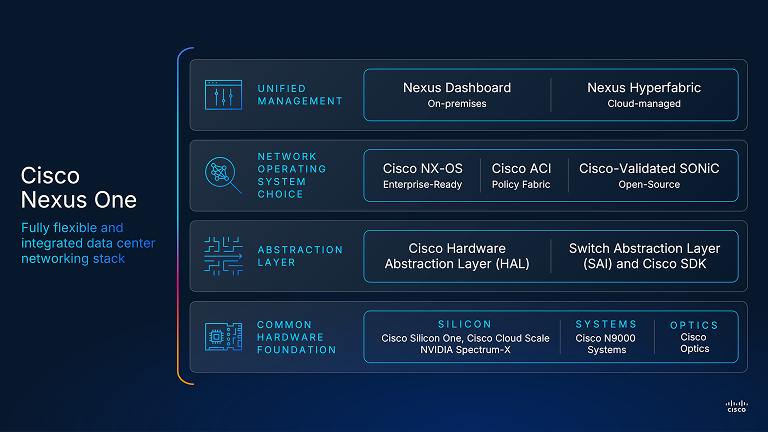
Cisco is not simply enabling an open-source binary on Cisco N9000 Series Switches; we are actively engineering the foundation behind it. Cisco is an influential driver of Free Range Routing (FRR), the routing brain that powers SONiC’s control plane. Cisco also sits on the SONiC Technical Steering Committee, drives SAI standards, and optimizes open-source stacks directly across both Cisco ASICs (Silicon One and Cloud Scale) and market-leading technology partner ASICs (such as NVIDIA Spectrum-X Ethernet switch silicon). This multi-silicon approach provides architectural flexibility across traditional and extreme-density AI environments while also providing silicon diversity.
Standardizing on the Cisco N9000 Series helps protect investments and simplify lifecycle management while preserving operational flexibility through Cisco Nexus Dashboard. Because the underlying Cisco N9000 Series Switches and Cisco Optics remain constant, the same hardware can run Cisco NX-OS, Cisco ACI, or Cisco-validated SONiC, all managed through Cisco Nexus Dashboard. If your operational model or business strategy shifts, your hardware infrastructure remains a long-term asset.
A vertically integrated networking stack changes the risk profile
Cisco-validated SONiC on the Cisco N9000 Series, with Cisco Nexus Dashboard automation addresses risks associated with open-source SONiC for mission-critical enterprise workloads.
- Hardened enterprise releases: Cisco provides a precompiled, security-hardened Cisco-validated SONiC binary based on open-source SONiC. We take upstream community builds, address security vulnerabilities, and perform extensive regression testing across our silicon choices, giving teams a production-ready image without the operational burden of compiling open-source SONiC and testing against hardware platforms.
- Unified visibility through Cisco Nexus Dashboard: Operations teams can monitor Cisco NX-OS, Cisco ACI, and Cisco-validated SONiC switches from a single, unified view with real-time visibility, telemetry, anomaly detection, and health monitoring.
- Single-point TAC resolution: Cisco Technical Assistance Center (TAC) supports the entire hardware and NOS stack, from the physical switches and optics up to the SAI, FRR routing protocol stack, and the compiled SONiC image. As your single trusted partner for production issues, Cisco TAC manages 1.4M+ annual service requests and has 9500+ certified Professional Services engineers. This support model helps ensure faster resolution and minimize downtime delivering a seamless, reliable experience that is hard to replicate with typical open-source support models.
Where Cisco-validated SONiC delivers maximum value
Enterprise and neocloud teams often need open-source networking economics with enterprise-grade automation and technical support. Cisco-validated SONiC is designed for enterprises and neoclouds seeking a precompiled, security-hardened, and fully supported SONiC binary running on Cisco N9000 Series Switches, integrated with Nexus Dashboard workflows and backed by Cisco TAC.
- Neocloud and AI/ML backend fabrics: Built for AI infrastructure providers scaling 8000 to 32,000+ GPU clusters. High-density 400G/800G Cisco N9100 Series Switches (NVIDIA Spectrum-X) and Cisco N9300 switches (Cisco Silicon One and Cloud Scale) allow architects to tune RoCEv2 congestion algorithms (PFC/ECN) within SONiC, maximizing GPU training efficiency without risking multi-vendor support fragmentation.
- Hybrid enterprise architectures: Designed for mainstream enterprise IT environments that balance a variety of application workloads with stringent security policies. Organizations can run Cisco NX-OS or ACI for complex application policies, while deploying SONiC on identical Nexus switches for specialized data pods, protecting their hardware investment as operational needs change.
Available now: Cisco-validated SONiC is available on the Cisco N9000 Series with Cisco Cloud Scale silicon for high-density 100G and 400G leaf-spine tiers, and on the Cisco N9100 Series with NVIDIA Spectrum-X for high-throughput, loss-sensitive backend AI fabrics.
Coming next: Cisco-validated SONiC will extend to N9000 Series Switches (Cisco Silicon One ASIC) for ultra-high-density fabrics. Future Cisco N9000 Series Switches are being designed to support Cisco-validated SONiC.
Success with open-source networking depends on matching the right operational framework to your long-term strategy and business goals. The ideal approach hinges on your day-to-day operational priorities, in-house expertise, and workload profile.
Cisco meets customers wherever they are in their transformation journeys, preserving operational choice without forcing trade-offs. With Cisco N9000 Series Switches, organizations can choose between the maturity of Cisco NX-OS, the object model-based automation of Cisco ACI, or enterprise-grade Cisco-validated SONiC. This combination of NOS choice, deep telemetry, silicon diversity, a fully integrated management stack, and global support infrastructure helps your networks scale securely into the AI era.
Cisco is taking a complete approach to scale-across, from systems, software, and optics. SONiC contributions, FRR work, Silicon One integration, MACsec, telemetry, EVPN/VXLAN, SRv6, and deployment models play a key role in offering a complete solution for all customers. Customers can then approach their offering from a build-your-own approach to a fully validated Cisco-supported design. The scale-across market is rapidly developing into one of the fastest areas of growth in AI networking and poised to exceed $50B by the end of the decade.Alan Weckel, Technology Analyst, 650 Group
Join us at the 2026 OCP Global Summit
Join Cisco at the 2026 OCP Global Summit in San Jose, California, from October 12 to 15, 2026, to see the next generation of AI-ready data center innovations in action.
Let’s build an open-source networking future together.