Today, Cisco introduces a newly-defined Small and Midsize Business (SMB) Specialization, an improved and combined version of the existing Small Business and Small Business Foundation Specializations. This evolution captures several market and technology trends critical to your customer’s needs, and positions existing and future Cisco SMB Specialized partners to succeed in the midmarket space.
The SMB Specialization curriculum has been revised to mirror the architectural go-to-market strategy employed by Cisco’s Advanced-level specializations. This new curriculum positions our SMB partners to sell across all technologies. The major focus for the enablement tracks are Borderless Networks, Collaboration, and Data Center, as well as updated Services training. And for the first time, Cisco introduces enablement focused on Cloud , SMB-level Cisco TelePresence® products and formal virtualization and data center switching.
No longer does your organization need to incur the sometimes unreimbursed cost of hiring one-on-one patient sitters, dedicating staff that can be better utilized elsewhere, or imposing on distressed family members to sit by their family member’s bedside around the clock.
With Cisco Virtual Patient Observation, centralized staff can observe multiple high-risk patients over your hospital’s existing network, and quickly alert caregivers if a patient is at risk.
This is one of those rare solutions that can pay for itself in months not years.
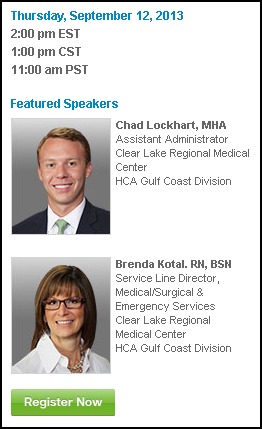
If this sounds “too good to be true”, then we invite you to join a live educational webcast that I’m hosting on September 12th at 11PST / 2EST to learn first-hand how HCA’s Clear Lake Regional Medical Center worked with Cisco to integrate Virtual Patient Observation into their operation.
You’ll learn about Clear Lake Regional Medical Center’s approach to implementing Cisco Virtual Patient Observation, the hurdles they encountered, and the lessons they learned along the way to a highly successful implementation and a satisfying ROI.
We’ll hold a live Q&A at the end so you can ask your questions directly of the experts.
Register now to hold your spot. If you can’t make the live webcast on September 12, you’ll want to register anyway so that we can send you the replay link.
In the meantime, if you’d like to learn more about Cisco Virtual Patient Observation, here’s how to get started:
At-a-Glance: Benefits of Virtual Patient Observation
Blueprint: Take advantage of existing networking investments for rapid investment payback
Ten use cases: Real-life scenarios for using video surveillance in hospitals
Request a call from Cisco: Discuss how video surveillance can help you lower costs and improve patient safety
Together, Cisco and Cloudera are well positioned to help organizations exploit the valuable business insights found in all their data, regardless of whether it’s structured, semi structured or unstructured. The solution offers industry-leading performance, scalability and advanced management capabilities to address the business needs of our customers.
The rack level configuration detailed in the document can be extended to multiple rack scale. Up to 160 servers (10 racks) can be supported with no additional switching in a single UCS domain. Scaling beyond 10 racks can be implemented by interconnecting multiple UCS domains using Nexus 6000/7000 Series switches, scalable to thousands of servers and to hundreds of petabytes storage, and managed from a single pane using UCS Central.
We would like to invite you to our upcoming Journey to Big Data Roadshow in a city near you, designed to help you identify where you are on your Big Data journey, and how to keep that journey going in a low-risk, productive way.
TechEd Australia kicks off today and the Cisco team is on hand to showcase how Cisco and Microsoft are teaming to develop integrated solutions that are enabling new levels of IT innovation in the data centre.
Make sure to come by booth #56/57 to speak with Cisco experts about how the Cisco Unified Computing System (UCS) and Nexus switch family integrate seamlessly with the Microsoft portfolio of enterprise applications and technologies, including:
Cisco UCS for Microsoft Private Cloud and applications (SQL and Exchange)
Cisco UCS Manager for Microsoft System Centre
Cisco UCS PowerTool for Microsoft Windows PowerShell
Krones boosts production efficiency in data center and executes safe migration from RISC platforms for mission-critical applications
Here’s a great story about the Machinery and Engineering company Krones Group, out of Neutraubling, Germany. The company manufactures machinery and complete plants for process, bottling, and packaging technology.
Millions of bottles, cans, and specially shaped containers are processed daily on behalf of breweries, the soft-drink sector, and manufacturers of wine, sparkling wine, and spirits as well as for the chemical, pharmaceutical, and cosmetics industry.
The company’s data centers are a key enabler for business growth. Consisting of 200 physical servers and 700 virtual machines spread across three locations, this critical infrastructure previously used a mix of technologies from different vendors. During a typical day, the three facilities handle around 1.3 petabytes of data and, in the case of the largest SAP database with more than 6TB, serve 5500 users concurrently. This data center environment relied on reduced instruction set computer (RISC) processor architectures for business critical applications such as SAP and databases, mostly running Solaris operating systems.
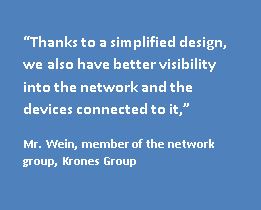
Krones selected a Cisco Smart+Connected™ Manufacturing solution, based on the Cisco® Unified Data Center. This pre-validated architectural approach combines server respective computing performance, network, and management into a platform designed to automate IT as a service across physical and virtual environments. The end result is increased budget efficiency, more agile business responsiveness, and simplified IT operations.
At the heart of the solution are Cisco Unified Computing System™ (UCS®) B-Series Blade Servers, which run numerous standard server software along with a host of Oracle databases, SAP systems, and Microsoft applications including SQL server, Active Directory, Exchange, SharePoint, and Citrix.
I recently had the pleasure of talking to Tony Shakib and Navdeep Johar at a recent Cisco Live event, and asked both to talk about The Internet of Things and what it means for business, particularly industrial businesses.
https://www.youtube.com/watch?v=Bie3WWJS3XE
Tony Shakib, Vice President, Business Solutions, Cisco
“Internet of things is the foundation; how do you make the sensors a lot smarter; how do you generate a lot more data from it; and how do you monetize and control the data so that you could put it into interesting applications….the next step is we’re trying to put all these technologies in the context of vertical [industry] applications”
Deploying Multi-Tier Application Stacks with Puppet and Chef
In a previous Cisco Data Center blog, we announced our configuration management accelerator for cloud to enable organizations to move beyond monolithic golden templates into a dynamic TOSCA-modeled application design canvas. Cisco Intelligent Automation for Cloud (IAC) has been working for months with PuppetLabs and OpsCode (Chef) and has had multiple successful customer proof-of-concept deployments.
The Cisco configuration management accelerator provides customers with a substantial improvement over the manual process of building and implementing multiple golden templates to build multi-tier application stacks. The application stack is now described, and the description drives implementation. Changes to the description apply to all future instances, and can even update running instances in continuous delivery scenarios. The benefit is that the description becomes the master plan and machines are consistently and automatically constructed from that master plan without intervention by IT. Software defines the application configuration.
Cisco’s cloud accelerator approach is true to an open philosophy that provides customers with a choice of solutions – not locking them into a single hypervisor, configuration tool, solution path, or even hardware selection. The configuration management accelerators follow directly in the footsteps of our multi-cloud accelerator released last year. That accelerator enabled Cisco IAC to provision, orchestrate and manage VMware vCloud Director, Amazon EC2, and OpenStack. It has also been extended by customers to include Hyper-V, Azure and Rackspace through the preplanned extensibility built into it.
Whether you need to support BYOD work practices, or provide more secure access to your data center resources, the Cisco Identity Services Engine (ISE) can help. With this all-in-one enterprise policy control platform, you can reliably enforce compliance, enhance infrastructure security, and simplify service operations.
Cisco’s leading One Policy Solution—the Identity Services Engine (ISE)—now delivers even greater capabilities.
One thing is clear – IT world is changing and at a pace much faster than we have ever known. It seems appropriate to culminate the series in the world of applications. All entities, big and small ultimately want their data center infrastructure to run applications. They could be collaboration applications for internal use or with partners. The applications could be developed in house or could be commercial off the shelf (COTS). Some of the applications can provide the firm a competitive edge in the market – think recommendation engine used by Amazon. At the end of the day the application is providing a valuable service. With the advent of the Internet of Everything (IOE), there are many sources of data and connections that applications have to consider while delivering the service.
https://www.youtube.com/watch?v=BJSjbttGaVM
Imagine the Amazon recommendation engine taking into account your location and the temperature from a gauge near you. Assuming that application services are delivered from a data center, the application must also be cognizant of the different access mechanisms, desktop computers, laptop computers, tablets and mobile phones. The rate of change in these new technologies is brisk. As these rapid changes take place, Cisco offers Application centric infrastructure to ease the transitions. Read Cisco CTO, Padmasree Warrior’s blog on this.









 Here’s a great story about the Machinery and Engineering company Krones Group, out of Neutraubling, Germany. The company manufactures machinery and complete plants for process, bottling, and packaging technology.
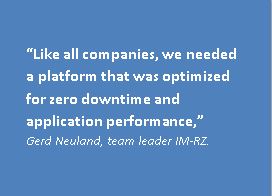 The company’s data centers are a key enabler for business growth. Consisting of 200 physical servers and 700 virtual machines spread across three locations, this critical infrastructure previously used a mix of technologies from different vendors. During a typical day, the three facilities handle around 1.3 petabytes of data and, in the case of the largest SAP database with more than 6TB, serve 5500 users concurrently. This data center environment relied on reduced instruction set computer (RISC) processor architectures for business critical applications such as SAP and databases, mostly running Solaris operating systems.
 At the heart of the solution are